
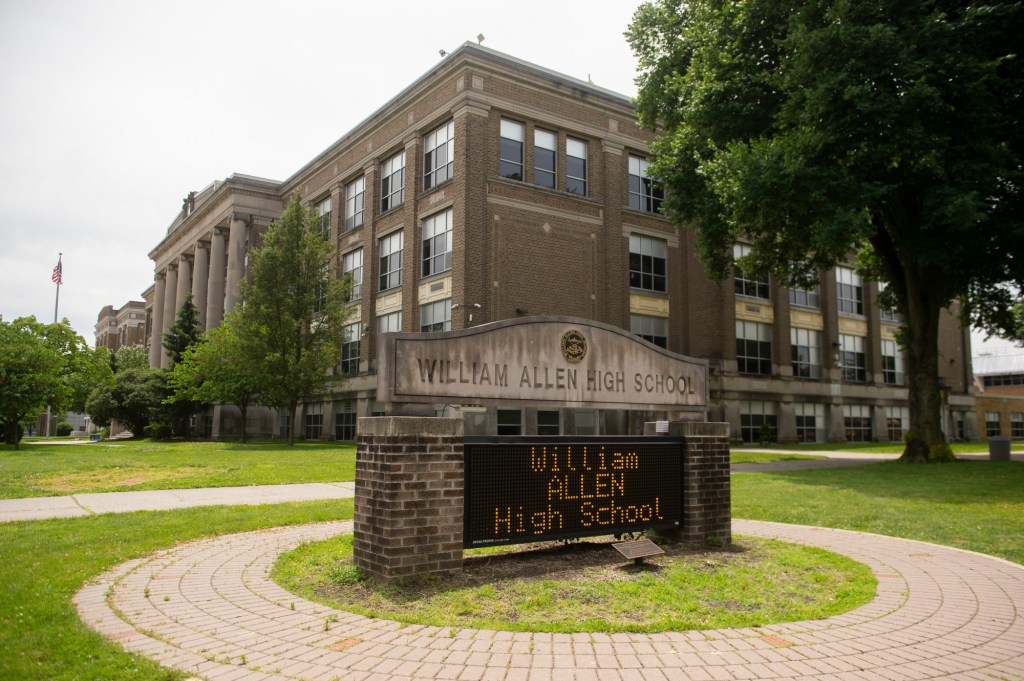
Allen High School students have made the long walk down to the stadium four times this school year in response to bomb threats. Trexler Middle School twice faced its own threats and evacuation.
Students are irritated, and some have started seeing evacuations as a reason to leave and go home, said David Thor, a 17-year-old senior who serves as a student representative to Allen High School Governance Council.
“They just don’t want it to happen anymore,” Thor said.
Following back-to-back threats at Trexler on Sept. 11 and 15, there were four threats at Allen between Sept. 17 and Oct. 27. A separate threat was made Oct. 21 at South Mountain Middle School.
The sheer frequency of the disruptions began to feel routine, Thor said, leaving some students resigned.
“It’s just a part of school life at this point,” Thor said.
The threats at Allen came from members of the freshman class, police and school officials confirmed, and Thor said more veteran students are wondering how to effectively reach out to the school’s youngest cohort.
Chief Operations Officer Robert Whartenby, the district’s spokesperson on this issue, said he has heard from the building principal, Alicia Knauff, that student-to-student conversations are happening.
“Dr. Knauff did relay to us in the after-action meeting that now there were some upperclassmen that talked to their ninth grade cohorts and said, ‘Guys, knock this stuff off. It’s really disruptive. It’s annoying. It’s getting colder. I’m in the middle of lunch and I’m eating now,’ so it’s great to see that the older students are kind of leading the way with the younger students. I think that’s probably the best form of communication,” Whartenby said.
School announcements have reminded students of the consequences of making a bomb threat, which is an expulsion-level offense. Administrators and a school resource officer met with the freshman class to drive home that perpetrators will be charged with a felony and could be responsible for paying restitution to emergency personnel for the cost of their response.
Informative assemblies also have been held at Trexler. Across the district, students are educated about terroristic threats, such as bomb threats, as part of their Safe2Say training.
The district’s new terroristic threats policy, passed in October, establishes mandatory reporting and investigation procedures and will ensure a consistent response, Whartenby said.
The policy requires that the parent or guardian of any student directly involved in a terroristic threat be notified as soon as possible, and the district also added language that mandates reporting to the school board.
State law requires that the district send an annual report to the Pennsylvania Department of Education noting all terroristic threats.
“This policy strengthens our commitment to students and staff safety and ensures every threat, whether verbal, written, electronic or otherwise, is taken seriously, investigated thoroughly and addressed appropriately,” Whartenby said.
District personnel begin investigations as soon as possible, putting their threat assessment procedures into place as evacuations proceed.
“All those things happen in real time as we’re standing out in the middle of the street, gathering more information and watching video and sharing it with law enforcement,” Whartenby said.
Charges were filed against two 13-year-old students in relation to the threats at Trexler and several 14-year-old students in relation to three of the Allen threats. The investigation into the Sept. 29 threat at Allen remains open, and charges were determined unwarranted in the South Mountain Middle School incident, police said.
Lehigh County District Attorney Gavin Holihan declined to comment on the ongoing investigations.
Collaborating with law enforcement
Allentown police Chief Charles Roca said bomb threats are a nationwide phenomenon but there has been an uptick on Allentown School District campuses this school year.
“The amount of frequency is concerning,” Roca said.
Building sweeps, canine deployment and evacuations are ordered when a threat is reported, an emergency response protocol that can take an hour or more to resolve.
“We treat every single one as if it were real,” Roca said.
Roca has fond memories of his own time as an Allentown student, and he’s concerned that today’s students do not fully understand the level of trauma and disruption that a bomb threat can bring to their fellow students.
“It’s important that our students are in school learning,” Roca said.
The Allen and Trexler students who have been arrested and charged for their role in bomb threats at schools this year have all been 13 or 14 years old.
At that age, students are not thinking long term, Roca said.
“In my opinion, I think it’s bad choices,” Roca said.
A felony charge can impact future employment and educational opportunities, Roca said, but he sees the juvenile justice system’s emphasis on rehabilitation as an opportunity for young people to recommit to serving their community.
“Don’t let that dictate your ultimate future,” Roca said. “Continue to be positive, make amends, reparations, whatever needs to be done to move forward.”
School resource officers are the first line of communication between the department and students, and those officers are the front-line workers both in providing mentorship and communicating to students the consequences of poor decisions, Roca said.
“That’s community policing in action,” Roca said.
The Police Athletic League and Police Youth Academy programs provide other opportunities for young people to build a positive relationship with law enforcement and to serve their community, Roca said.
“It’s important that the students that are doing the right thing, following the rules, are applauded and appreciated because that’s the example that needs to be followed by those who might even think about doing anything wrong,” Roca said.