
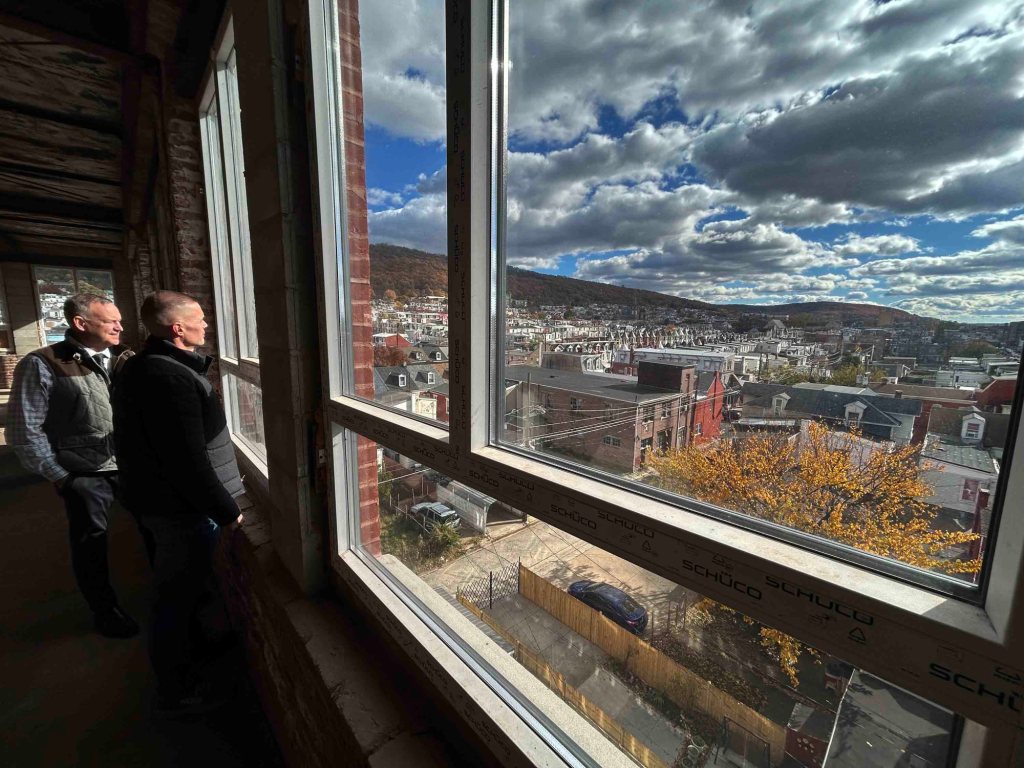
A century-old factory and former outlet store on Moss Street tells the story of Reading from its decades as a bustling industrial center and years as an outlet shopping destination to eventual decline and, now, rebirth, says developer Christopher Posch.
Posch, owner of Posch Development Group, Reading, and partner Mike Duka, owner of Duka Properties, New York, are working to transform the former D.S.W. Hosiery Mill, later known as The Great Factory Store Outlet, into a 55-unit residential complex.
Their plans call for a mix of 37 two-bedroom and 18 one-bedroom apartments that Posch described as affordable, quality spaces for working professionals and others employed in the city.
“We’re really focused on the nine-to-fivers,” he said. “The people doing those everyday jobs that keep the city running.”
Estimated at $6 million, the project is privately financed, though Posch said the team is open to future partnerships with the city that could dedicate some units to low-income or transitional housing.
On a recent tour of the sprawling brick structure at 1125 Moss St., Posch pointed out the repointed masonry, recently installed windows and new stone sills that replaced the broken glass and boarded openings that marred the building since the factory store closed in the mid-1980s.
“When we got this building in September of 2022, it was literally all broken windows on this side,” he said.
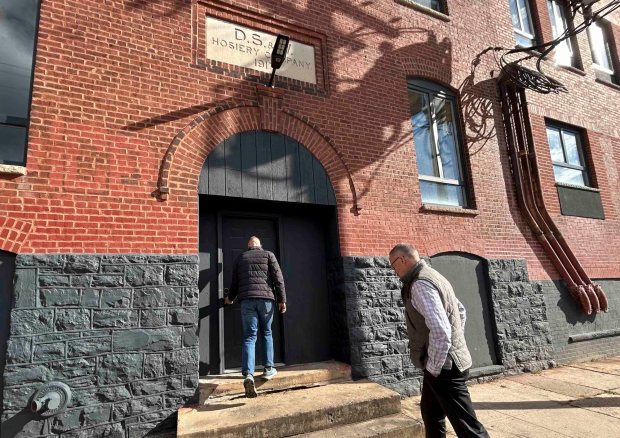 Developer Christopher Posch, left, and Reading Director of Community Development David Barr tour Posch’s apartment project at the former D.S.W. Hosiery Company at 1125 Moss St. (BILL UHRICH/READING EAGLE)
The vacant lot across the street, planned for parking, he noted, was a complete disaster, overgrown and filled with trash.
The lot was the site of another former factory, later also part of the outlet complex.
“That building suffered a fire, the second largest in Reading at the time,” he said, referring to the three-alarm arson blaze that burned for four hours on May 25, 1996. “Then for decades, this one sat blighted. Now, we’re getting both sites ready for the next 100 years.”
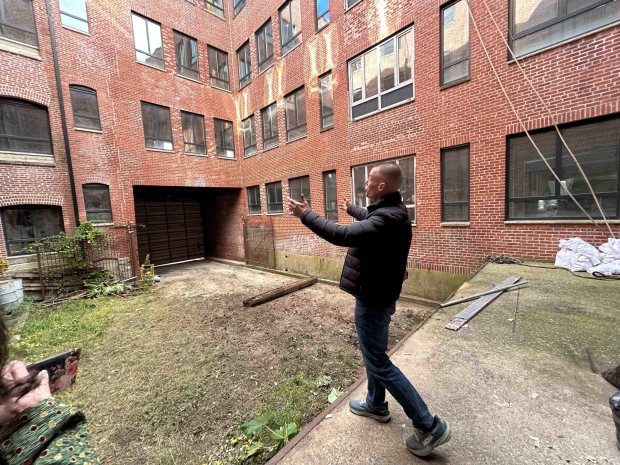 Developer Christopher Posch explains how a community courtyard will occupy a space at the former D.S.W. Hosiery Company at 1125 Moss St. (BILL UHRICH/READING EAGLE)
Parking, always a concern in city neighborhoods, will be addressed through 40 outdoor spaces and several spots within the building, he said.
Planned amenities include on-site laundry on each floor, a small tenant gym, and a landscaped courtyard carved from what was an overgrown tangle of vines and trees.
“When we first came in here, there were literally trees growing inside,” Posch said. “We cut all that down, cleared out about 50 dumpsters’ worth of debris, and started brick repointing. Now it’s going to be a great space for tenants to come and hang out, to build a community within the community.”
Inside the former factory, the old timber beams and steel supports tell the story of two construction eras, the 1917 wooden section and a later concrete addition.
Many of the original architectural elements, like arched fire doors and hoists once used to lift materials, will remain as subtle nods to the building’s industrial past, Posch said.
But not everything could be preserved, he said, noting the building’s interior bricks, though sturdy, were too deteriorated to leave exposed.
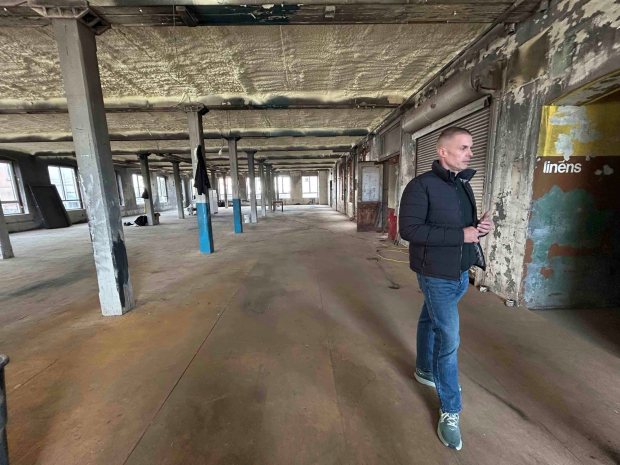 Developer Christopher Posch discusses apartment layouts at the former D.S.W. Hosiery Company at 1125 Moss St. (BILL UHRICH/READING EAGLE)
One surprise during the construction didn’t come from the structure, but from a family of temporary residents.
“I was up on the roof with the elevator guy, just fixated on this old Otis motor,” Posch recalled with a laugh. “He suddenly grabbed me and said, ‘Yo, watch out!’ There was a family of raccoons up there. You come across the craziest things in these old buildings.”
There was no need to serve an eviction notice, he said. The critters moved out on their own when construction activity increased.
For Posch, 46, redeveloping the Moss Street property is the culmination of a lifelong connection to real estate. The Allentown native grew up helping his grandmother collect rents from family-owned apartments, later ran Georgio’s Pizzeria in West Reading and gradually built a portfolio of rental and rehabilitation projects across Berks and Montgomery counties.
After selling the restaurant, he focused solely on real estate, expanding into commercial lending and development.
Duka has a similar history of investing, beginning in the Lehigh Valley before turning his attention to Reading.
The Moss Street redevelopment marks the first large-scale project for the partners, who met through a chance phone call about financing and discovered a shared vision for adapting underused industrial properties for housing.
“This has been quite an undertaking,” Posch said. “It’s our biggest project yet, and it’s been a long process, but the reception from the city has been great. Anytime you take a building that’s been sitting vacant for more than 20 years and bring it back, people appreciate it.”
David Barr, the city’s director of community development, praised the effort.
“We really appreciate Chris’ ambition in this early project,” he said. “He’s been a great partner to work with, and we’re excited to see this become a reality.”
Standing near a newly installed window overlooking the Pagoda, Posch summed up the project simply.
“This building tells the story of Reading over the past century,” he said. “Now it’s part of what’s next.”