
Ellen Braunstein
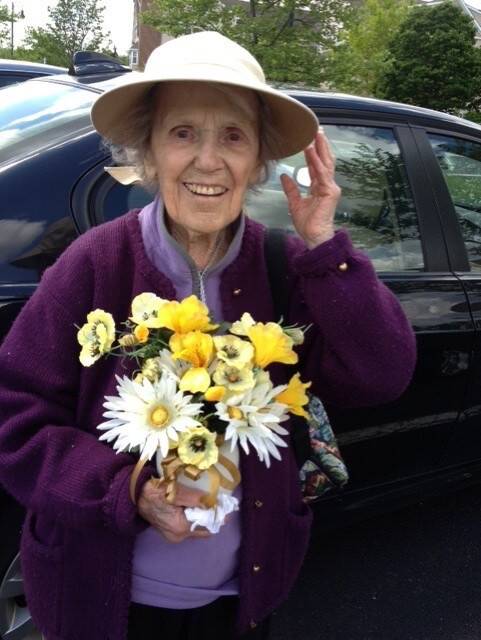
 Helen Vinikoor (Courtesy of the Vinikoor family)
When doctors told 7-year-old David Vinikoor he had to stop walking for six months because of a kidney condition, his mother carried him. “She was under 5 feet tall and never more than 100 pounds,” he said. “But she carried me on buses and trolleys all over Philadelphia because I wasn’t supposed to walk. People don’t carry 7-year-olds, but she did.”
That determination defined Helen Vinikoor, who died on Nov. 2 at age 105. Her children described her as tiny, funny, intelligent and steady — a mother of five who kept her independence well into her late 90s and lived a proudly Jewish life shaped by family, modest means and resilience.
Helen Margolis was born on July 9, 1920, in the Strawberry Mansion neighborhood of Philadelphia. She was the youngest of seven children of Abraham and Lena Margolis, Jewish immigrants from the Russian-Polish region who came to America in the early 1900s.
Her daughter, Carol Horowitz, said her mother grew up in a home where Yiddish was spoken and Jewish identity permeated daily life. “It was a very Jewish neighborhood,” she said. “Everyone walked to shul. There were little shops — the dairy store with white tile, the deli with sawdust on the floor and pickle barrels. It was in every breath we took that we were Jewish.”
The family lived in a brick house on North 33rd Street across from Fairmount Park. Helen was small even as a child and, Horowitz said, “adored by her father.” She graduated from high school in Philadelphia, began college and married young, around age 19. She did not return to school after the birth of her first child at 21.
Her marriage to Martin Vinikoor was “a love marriage,” Horowitz said. The couple eloped to North Carolina, where the justice of the peace assumed Helen was 13 because of her size. She was, in fact, a young adult starting a marriage that lasted 36 years until Martin’s death in 1976.
Raising five children, including two sets of twins, became Vinikoor’s full-time work. The family lived in the West Oak Lane neighborhood, where Jewish identity remained central even if observance was limited. “We celebrated all the holidays,” David Vinikoor said. “My parents were not super religious in a formal way, but we were culturally very Jewish. All of us went to Hebrew school. We knew who we were.”
The family belonged to Temple Sinai, where the children studied and the sons were bar mitzvahed. Vinikoor followed Jewish news throughout her life. “She adored the Jewish Exponent,” Horowitz said. “If it didn’t arrive on time, she would call immediately.”
Vinikoor never learned to drive. Instead, she walked everywhere — to stores, the synagogue and through the neighborhood. “Her whole life she walked,” David Vinikoor said. “She never used a walker, never took medication and stayed away from doctors.” She prepared food carefully, avoiding salt, grease and butter, and squeezed fresh orange juice by hand every morning for her children.
She did not engage in formal volunteer work, but her children said she consistently helped others one-on-one. As a young mother, she and her sisters brought food and clothing to new immigrants after World War II. Later, she supported neighbors who struggled. “Her heart extended to anyone in need,” Horowitz said. “She helped with money, food — whatever people needed.”
When her husband died, Vinikoor was in her mid-50s and had never worked outside the home. She studied for a civil service test, became a substitute librarian with the Philadelphia public schools and eventually served as an assistant librarian at Northeast High School for more than 10 years. “She was a fabulous reader and an intellect,” Horowitz said. “It was the perfect job for her.”
Her children described her personality as calm and principled. She never yelled and stood up for fairness. “If you said something that didn’t sit right with her, she would let you know,” Horowitz said. “But she was a very calm mother of five kids.” Helen was also funny, private and content with a small circle of friends.
She loved crossword puzzles and had a strong vocabulary and a memory for poems she learned in school. She lived independently in her Northeast Philadelphia row house until about age 98.
A central joy in her life was the family cabin on Goose Pond in Canaan, New Hampshire, a quiet retreat she visited three months every summer for decades. She continued spending summers there into her early 100s, even during the COVID-19 pandemic. “It was a gorgeous, peaceful place,” Horowitz said.
Vinikoor remained active past her 100th birthday. “Up until 103, I would pull up sometimes and find her walking around the block by herself,” Horowitz said. For years she exercised at KleinLife. She attended activities at her residence in Katy, Texas, where she later moved to be near her daughter, and loved to dance.
Her final two years were difficult. She fell at 103, broke her hip and, after surgery, became wheelchair-bound. Dementia followed. Still, her children emphasized that the vast majority of her 105 years were strong and independent.
“She had tremendous willpower,” Horowitz said. “She never thought she was old.”
Asked what it was like having a parent live to 105, Horowitz paused. “I don’t know anything else,” she said. “She enjoyed life and was interested in everything. She was amazing.”
Ellen Braunstein is a freelance writer.