
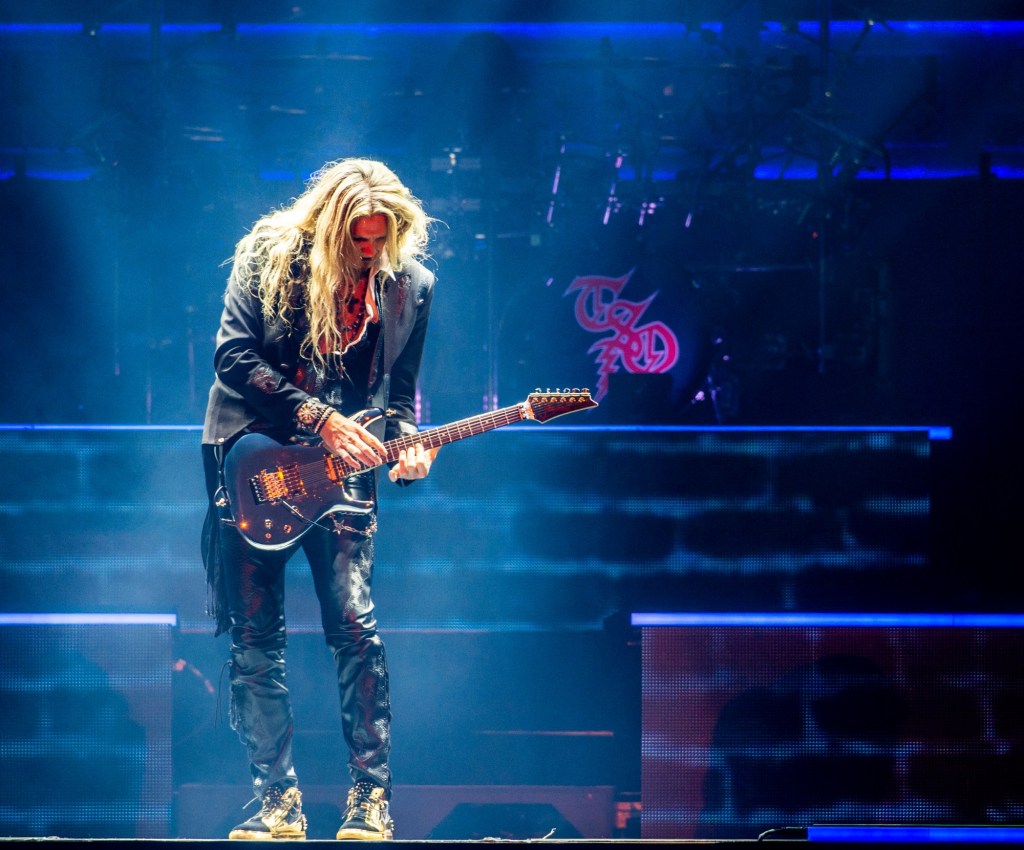
Jeff Plate sat behind his massive drum kit on a platform high above the stage in the Mid-America Center in Council Bluffs, Iowa, waiting for another run through of the concluding segment of “The Ghosts of Christmas Eve: The Best of TSO And More.”
A few minutes later, Plate, two keyboardists and four dancers were back at it, working out the choreography playing out against the giant LED screen that found wolves walking through archways behind them.
In late October every year, TSO converges on the arena just across the Missouri River from Omaha, bringing some 250 people, 40 trucks of staging, lights, sound equipment, costumes, and spreading them throughout the place.
The entrance lobby at Mid-America Center serves as the workroom for pyro and special effects, a long hallway is filled with tables where more than 100 guitars will be signed by band members, one to give away at each show.
“Backstage” is converted into offices for management, tour production and direction with locker rooms serving as rehearsal spaces — a mixing board in the showers — for the bands and singers, a “dance room” with mirrors, and spaces filled with costumes and video recording equipment.
The key word here is bands. There are two TSO troupes, one which goes east from Council Bluffs, the other west — the only way for TSO to meet the demand that will see it performing 106 shows in 64 cities from Nov. 13 to Dec. 30, including a stop Friday at the PPL Center in Allentown.
So, for the center’s main room, identical stages are built in nearby exhibition hall, then moved to each end of the arena floor, allowing each group to rehearse on its own stage, which tour director Elliot Saltzman said, is the major reason why TSO has organized and rehearsed its tours in Council Bluffs for 18 years.
“This is the best kept secret in the music business,” Saltzman said. “Where can you hang both of these? Some years, the east coast (staging) and west coast are inches apart. But we get them in here.”
As Saltzman delivered the rundown of the setup, pointing out changes for the 2025 show, like putting the 10 singers in lines on each side of the broad, clean stage, the east group with Plate at his kit began warming up for its rehearsal.
The weeks of rehearsals aren’t really needed to get the music in place, since most of the TSO band members and singers return each year.
“We’ve played ‘Christmas Eve/Sarajevo’ 3,000 times each,” Plate said while sitting on a couch with Al Pitrelli, who leads the other TSO unit. “When we come back to rehearsals, you brush the dust off musically, things really kind of come together pretty quick…
“The most intense part of our rehearsals is the main stage. With all the production, there’s a million moving parts of these shows,” Plate said. “These guys have to get everything set up and coordinated. It’s a team effort all the way around. There’s 20 people, basically in the band. “But there’s what, another 50 in production.”
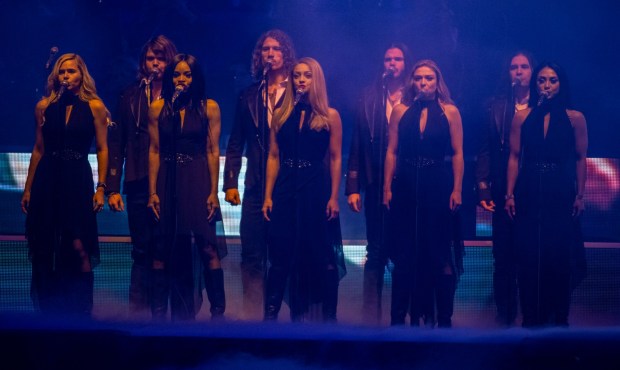 Trans-Siberian Orchestra performs songs from their “Christmas Eve and Other Stories” show at PPL Center in Allentown, Pa. on Saturday, Nov. 16, 2019. (April Gamiz / The Morning Call)
As the rehearsal moved on from the opening segments and a piece from “Beethoven’s Last Night,” the TSO album that is getting a 25th anniversary salute in the second half of show, producers, choreographer and Jon Oliva, who wrote songs with TSO’s late founder/producer/songwriter Paul O’Neill, settled in for a run through of the show.
“We have Brian Hartley, who’s one of the masterminds behind all of this,” Saltzman said. “He is the designer of the show, the content. We have a back room there where we have four content editors working around the clock.
“If Brian has a change, when you see how sophisticated and 3D it is, that has to be made,” Saltzman said. “You have to realize it. We don’t have a second chance.”
During rehearsal, less than a week before the first shows, Hartley sat a table about 50 feet from the stage, making notes on his computer, talking with choreographers, lighting technicians and producers, unearthing the details of the show, from saving a couple minutes of lift time for the show’s five platforms to how the drones will be configured during a set piece near the end of the show.
The Trans-Siberian Orchestra show is unique, a combination of musical theatre and an arena concert spectacle of lights, video and pyro and distinctive, genre-defying music, created by O’Neill.
A guitarist, producer and songwriter, O’Neill incorporated the sounds with which he grew up into the music he wrote first for the band Savatage, then, in the mid 1990s, Trans-Siberian Orchestra.
“Growing up in New York City, you go to Madison Square Garden. You see Kiss, you see Pink Floyd, Aerosmith, AC/DC,” said guitarist Pitrelli, a core original TSO member and New Yorker. “Down the block is Radio City and down the block the New York Philharmonic was playing Lincoln Center. And you’ve got the theater district on Broadway.
“Paul loved it all. When we were kids, AM radio, Two styles of music, good and bad. There it is,” Pitrelli said.
But Plate, who’s also been with TSO for three decades, says music alone isn’t what is now bringing three generations of fans — “we call them repeat offenders” Pitrelli quipped — to TSO’s shows.
“The story ‘The Ghost of Christmas Eve’ was something that people just kind of realized, ‘Wow, this is talking to me,’” Plate said. “The more I’ve done these albums and these tours and listen to these lyrics and these stories, it really connects…
“Paul was very conscious about trying to incorporate a lot of everything into the show,” he added. “But you wrap that up in the story, in these lyrics. it hits me, hits me right in my heart, But that’s not just me, that’s millions of people out there, and this is why they come back every year.”
There was no pyro during the east group’s rehearsal on the Saturday before the tour was to begin. That, Saltzman said, would be built into the stages and tested in the following three days.
But Pitrelli and Plate know what to expect when the balls of fire starting shooting off around them.
“Ever open your barbecue to check your steak, you get hit in the face, that’s what it’s like,” Pitrelli said. “It’s hot up there.”
“This year, there’s going to be pyro like five feet behind me,’ Plate said “We’ll test all this. We get up there and ‘Is it too hot? Is it too this?’ It comes and goes so fast. Honestly, I’m so used to it. I don’t even think about it when I’m up there playing. I know here it comes, there it goes. But the people in the back of the arena are like “Oh my God, how does he do that? I could feel it back here. That’s amazing.’”
Four days later, Plate and the east group were to leave Council Bluffs to travel to Green Bay, Wisconsin, for their first 2025 show.
That same night, the west group was to play the Mid-America Center to begin its half of the TSO tour.
“We do what nobody else has ever replicated before in our business,” said Saltzmann, who manages tours for Joan Jett as well as working with TSO. “We go in, sometimes without a pre-rig at five o’clock in the morning, chalk the floor. six o’clock, we unload 18, 19, 20 trucks, and we’re ready for a sound check six hours later.
“Then we do a show. We have an intermission in between, and then we do another show,” he said. “We get into trucks and our busses, and we do another two shows the next day, and the next day. We’ll do eight shows a week. We have done 10 shows in a week, and that’s with basically building a small city every time.”
That intense holiday-season touring schedule requires the TSO tours to be redundant in multiple ways.
“We can’t send the truck back or we can’t cancel the show and make it up later like all these groups do because we can’t make it up,” Saltzman said.
So TSO has spare busses and trucks stationed around the country, and “everybody knows what everybody else does” so they can fill in, even the drum techs, who have to know how to play the full show in case Plate or the west drummer are out for a day or two.
Three plus hours after he hit the cymbals and kick drum for the first time, Plate left the stage after a rehearsal that got thumbs up from the producers — and captivated visitors, even without the pyro.
Then it was flip-flop time. After an hour break, the east group headed back into the locker rooms for the evening and Pitrelli and the west troupe took their stage in the arena to run through the show that they’d be doing for real in five days.
It’s all business as usual for this one-of-a-kind combination of a rock band and orchestra that has been delighting fans for 25 years-plus of tours.
L. Kent Wolgamott is a freelance writer.