
BETHLEHEM, Pa. – Is artificial intelligence (AI) a good thing, a bad thing, or something in-between?
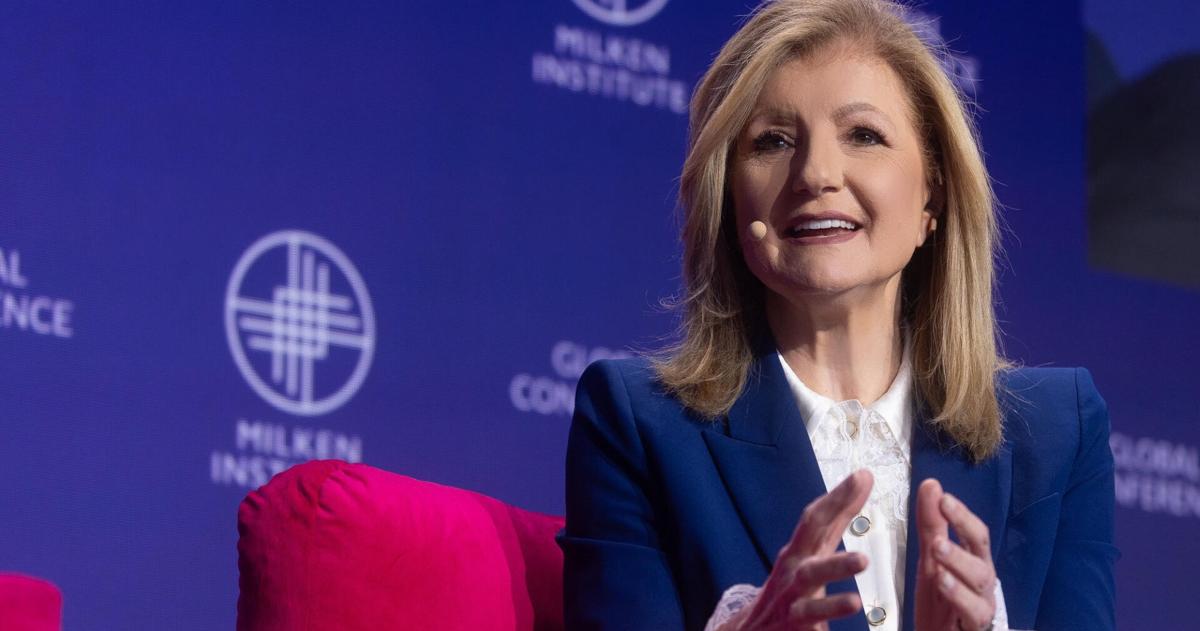
It’s a topic Lehigh University is digging into as part of its annual Compelling Perspectives series. On Tuesday night, author, entrepreneur and Huffington Post (now HuffPost) founder Arianna Huffington made the trek to Bethlehem to share her thoughts on the technology.
The event was called “AI: Innovation, Responsibility and the Future We Shape.”

Huffington shared the stage with Lehigh President Joseph Helble- “He told me I can call him ‘Joe,'” Huffington told the audience- for what was billed as a fireside chat, followed by a Q&A.
When Helble asked Huffington if the visit marked the first time she’d ever been to Bethlehem, she replied, “The first time, but I hope not the last.”
Before circling back to the topic at hand, Helble ran through some of the bullet points of Huffington’s early life, accompanied by humorous asides from Huffington herself.
Huffington was born and raised in Athens, Greece. She decided she wanted to attend Cambridge University in England when she saw a picture of it in a magazine. Many naysayers brushed her aside, but not her mother. “My mother said, ‘let’s find out how we can get you into Cambridge,'” Huffington recalled. And they did figure it out. She studied economics at the school, where she also became president of the famed Cambridge Union debating society.
Later, she moved to the United States to, as she put it, put an ocean between her and an ex-boyfriend in London. “If anybody here is dating someone who doesn’t want to marry them, think, ‘that may turn out to be the best thing that happened to me,'” she told the audience, to laughter.
Her “aha” moment to create the Huffington Post came in 2003, when she was running for governor of California. At the time, she drove an early Toyota Prius model, a source of embarrassment for her two daughters. “When I was driving them to school they would ask me to drop them off at the corner,” Huffington said. Arnold Schwarzenegger, the eventual winner of the race, was driving a Hummer. An online ad drawing a contrast between the two — the hybrid versus the Hummer — went viral (the 2003 version). “We suddenly realized the power of online conversation,” Huffington said.
The Huffington Post was officially launched in 2005 and would go on to win a Pulitzer Prize in 2012, the first digital outlet to earn the honor. Huffington stayed at the helm as editor-in-chief until 2016, long past the time when the stresses of the job, as well as the demands of being a divorced mother of two, caused her to literally collapse from exhaustion.
Back in 2007, Huffington recalled, “I got up from my desk to get a sweater because I was cold, hit my head on my desk, broke my cheekbone. And when something like that happens, you go through many tests because you don’t know what’s wrong with you. Do you have a brain tumor, do you have a heart defect? And after multiple echocardiograms and MRIs and doctor visits, I was diagnosed with burnout.”
The incident pushed wellness to the forefront for her, which would eventually lead Huffington to her next major business endeavor: the creation in 2016 of Thrive Global. It’s a company that crafts custom health and well-being platforms for corporations like Microsoft. The focus is not on making seismic changes that tend to fall by the wayside, like a New Year’s resolution; rather, participants are encouraged to embrace so-called microsteps, or nudges, that are “too small to fail,” Huffington said. Some examples: spending 60 seconds on mindfulness. Keeping cell phones outside the bedroom at night. Drinking a glass of water first thing in the morning. “How much water do you drink, Joe?” she chided Helbe, after noticing he hadn’t touched the glass of water on the table beside him.
Thrive Global has a specific AI-powered arm called Thrive AI Health that leans on artificial intelligence to play the part of coach in the process. “You know, there is a lot of emphasis on how AI can accelerate drug development, accelerate and improve diagnostics,” Huffington said. “But the thing I’m most interested in is, how can AI help us improve our habits?”
Helble questioned her on what could be perceived as mixed messages coming from the company: “You’re advocating for the use of more technology to help us improve our behavior when we’re already wrestling with the fact that these devices have taken over our lives in so many ways,” he said to Huffington, who pointed out that disconnection does have a place at the end of every day, and is an important microstep on the path to wellness.
While she supports using artificial intelligence in a foundational way, Huffington made clear that not all AI is AI that she supports. Helble asked her to react to a New York Times article about people falling in love with AI chatbots. “I don’t think it’s positive at all. I think it’s delusional,” she said bluntly.
Later, during the Q&A, Huffington was asked about guardrails for AI; do we need them, and who should be setting them? “Government is a very imperfect way to do it, because the engineers at the companies are so ahead of what engineers at the government level understand,” she said. “So companies are ideally responsible for that.”
She reflected further: “We’re at this inflection point where we can build a tool that can augment the best of humanity, or we can build a tool that can completely take over. I want to believe we’re going to do the former, but it’s by no means a forgone conclusion.”