
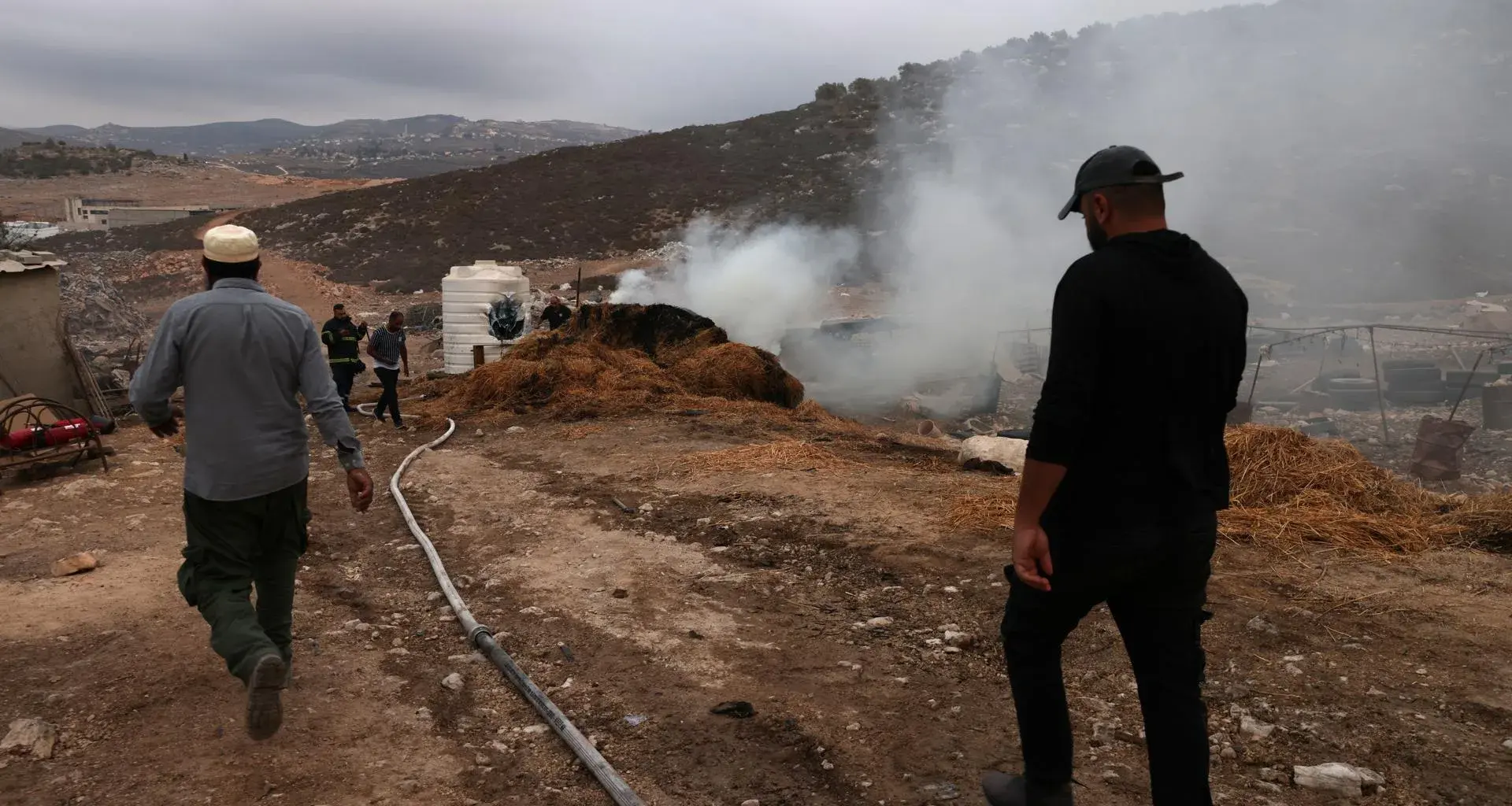
Jerusalem (EFE).- Dozens of Israeli settlers, who reside illegally in the occupied West Bank, burned on Monday three homes and several vehicles in the village of Jab’a, southwest of Bethlehem.
Dhiab Mashaleh, the head of the village council, told the Wafa agency that groups of settlers attacked them, setting fire to three houses, three vehicles, and a caravan.
Neighbors extinguished the fires, and no injuries were reported beyond material damage.
The Israel Defense Forces stated that police and soldiers were deployed in Jab’a after receiving reports that “dozens of Israeli civilians had set fire to and vandalized homes and vehicles within the area.”
When asked by EFE, the army did not detail whether any of the attackers had been arrested. The statement said that “Israeli security forces are conducting searches to locate those responsible.”
Shortly before, in another almost daily attack against the town of Sa’ir, northeast of the Palestinian city of Hebron, settlers burned a house and two vehicles and assaulted several Palestinians.
“The disturbances caused by Jews in Judea and Samaria harm the State of Israel, shame Judaism, and damage the settlement project. They are not us,” Israeli Foreign Minister Gideon Saar rushed to denounce on X, urging action with “a heavy hand.”
Police and judicial inaction is common when it comes to settler violence, which is often organized and overlooked by Israeli authorities at all levels. Settlers also receive state subsidies, as well as water and lighting services.
According to data from Yesh Din, an Israeli human rights organization, nearly 94% of investigations opened by the Israeli police into settler violence between 2005 and 2024 concluded without an indictment.
Since 2005, only 3% of open cases have resulted in full or partial convictions.
In October alone, coinciding with the olive harvest in the West Bank, the United Nations Office for the Coordination of Humanitarian Affairs (OCHA) registered at least 264 attacks against Palestinians, the worst month since these incidents started being recorded in 2006.
“Since 2006, OCHA has documented over 9,600 attacks of this type. Approximately 1,500 of these attacks occurred in 2025 alone, representing about 15% of the total,” the UN agency stated. EFE
pms/dgp