
Get in the game
I was saddened to read the article about the possibility of Lower Merion High School and Harriton High School merging their football programs because of declining enrollment. I remember when Lower Merion was the “powerhouse” when it came to football. My late sister, my brother, and I all attended Lower Merion (Classes of ’56, ’59, and ’61, respectively), and the greatest football rivalry on the Main Line was the last game of the season between Lower Merion and Radnor High School. The local newspapers covered it extensively. Our school had all kinds of placards and decorations up in the school, with the slogan “Beat Radnor,” during the week leading up to the big game. The night before the game, all the students and the coaches had a pre-victory celebration around a bonfire on the football field. The legendary John “Fritz” Brennan was the coach of Lower Merion, and what a successful career he had. His football team went undefeated for 32 straight games, between the years 1952 and 1957, and had only a few losses in the following years when I graduated. A statue of Brennan was placed near the entrance to Arnold Field, which, by the way, was named after Gen. Henry “Hap” Arnold, a graduate of Lower Merion and the only officer to hold the rank of a five-star general in both the Army and Air Force. Today, very few students even attend the games.
Paul Benedict, Broomall
Insurance is a blessing
No one is happy to see another person hurt. But if they have to deal with an injury, it is truly a blessing to have health insurance.
So while I was sorry to hear Sen. John Fetterman was hospitalized after his recent fall, I thought it was great he had insurance that allowed him to stay in the hospital a few extra days while doctors adjusted his medication regimen. I also couldn’t shake the sense of irony here: It seems grossly unfair that this man, one of eight senators who caved on the Democrats’ demand to save healthcare subsidies in the budget resolution, is able to receive the best of hospital care through his own elite insurance — even after he surrendered in the fight for affordable healthcare for his fellow Americans.
Mardys Leeper, Bryn Mawr
Keep the same energy
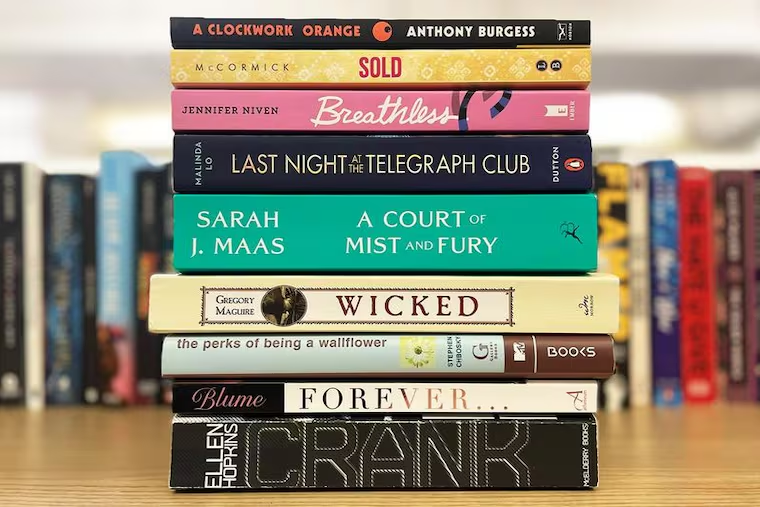
Recent reporting on the Cherry Hill School District’s internal memo about potential limits on student library books fit a pattern we’ve seen across the country. Few issues galvanize public outrage today like the prospect of “banned books,” and for good reason. Access to a wide, diverse range of literature is essential for a healthy democracy and for our children’s moral and intellectual development.
But there is a quieter crisis hiding behind the headlines.
While communities pack meetings and flood social media over which books might be restricted, there is comparatively little uproar over how few of our children can read fluently and confidently at all. Proficiency scores in reading are abysmal in many districts nationwide. That reality should trouble us at least as much as any debate over a handful of contested titles.
Our students deserve both: school libraries that offer rich, inclusive collections and sustained investment in high-quality reading instruction, tutoring, and early intervention. If we’re going to show up in force over schoolbooks, we should also be showing up over reading outcomes.
By all means, let’s protect our students’ right to read widely. But we should be just as passionate about ensuring they are able to read anything on the shelf in the first place.
Brandon McNeice, head of school and CEO, Cornerstone Christian Academy, Philadelphia
Join the conversation: Send letters to letters@inquirer.com. Limit length to 150 words and include home address and day and evening phone number. Letters run in The Inquirer six days a week on the editorial pages and online.