
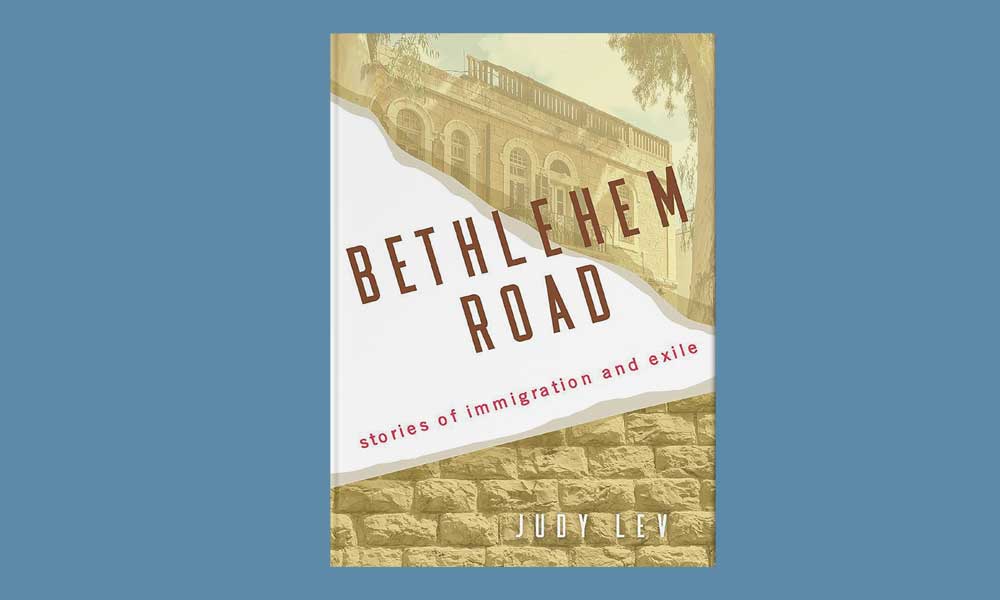
Bethlehem Road: Stories of Immigration and Exile
By Judy Lev
She Writes Press, 260 pp.
Since ancient times, Bethlehem Road has spanned the six-mile distance between Jerusalem and Bethlehem. In the Bible, Jacob and Rachel travel along it, Rachel dying in childbirth on the way (Genesis 35). Later, Joseph and Mary follow the same route (Luke 2). Today, you can walk its length in less than half an hour, starting near the southwestern corner of the Old City and ending at a Sonol gas station on Hebron Road, not far from the concrete separation barrier that marks the border between Israel and the occupied West Bank.
As in Sherwood Anderson’s Winesburg, Ohio or James Joyce’s Dubliners, the 12 short stories in Judy Lev’s vibrant new collection, Bethlehem Road, are linked by a common setting: in this case the one-third-mile stretch of Bethlehem Road in the West Jerusalem neighborhood known as Baka. One of the first developments built outside the Old City walls in the late 1800s, Baka has evolved over the years, going from a wealthy Arab enclave in the 1920s, to a gritty quarter occupied by displaced Jews from the Middle East and Europe in the 1950s, to the upscale “multicultural city-burb” it is today. Lev’s wise and witty stories trace the lives and struggles of Baka’s denizens over the three decades following the 1967 Six-Day War: their hopes and delusions, love and pain. Whimsical snapshots of minor characters such as Ovadia the falafel shack owner, Uri the Egged Tours guide and Herzl the vegetable guy are interposed between the stories, completing the “neighborhood tour.”
The young North American immigrants portrayed in Lev’s stories make aliyah out of religious zeal, Zionist idealism and, above all, a yearning to create a meaningful Jewish life. As 21-year-old Chicago native John/Yonatan declares in the opening story, “Ingathering of an Exile”: “I wanted to be a player, an actor on the stage, to take part in the miracle, not just watch from the sidelines…I wanted to build a new life in an old language. I wanted to forfeit the expected trajectory and to dive into the unknown.” Like ordinary people everywhere, Lev’s characters marry, have children, cope with illness and divorce. Yet they do so in ways that are uniquely shaped by this most un-ordinary place.
Eschewing the rags-to-riches narrative of Jewish-American immigrant fiction, Lev’s stories are not concerned with assimilation or with the generational conflict between the old world and the new. These olim, or immigrants, are not refugees fleeing poverty and persecution.
Rather, they are idealists struggling toward self-realization, dreamers seeking to write the authentic stories of their lives. Lev dramatizes this yearning in compelling and inventive ways. In “Ingathering of an Exile,” for example, John sees an explosion as a black cloud of smoke “in the shape of a samech.” A gate looks like a chet, a birthmark like a yud. He sees “gimmels, vavs, mems, and heys, the letters engraved in [his] skin.” Like a Kabbalist vision, the letters of the Hebrew alphabet spell out his future: the realization that Israel, not America, is the place where he will make his home.


Many of Lev’s characters, brought up as Reform Jews in America, are drawn to the Holy City by dreams of leading a religious life. With a wink to Isaac Bashevis Singer’s “Gimpel the Fool” and the simpletons of Chelm, Lev pokes gentle fun at pious excess. “Simon, the Tale of an Aspiring Jew,” for example, gives us a young man seeking spiritual enlightenment by studying the Idiot’s Guide to the Talmud, Part I and burying himself in the sand. In “The First Pregnancy in Jerusalem,” Canadian Helen Mor-Haim has a vision of Mary and Joseph walking with a donkey along Bethlehem Road and decides she is going to give birth to the Messiah. In “Every Man a Lamb,” chiropractor Dick Coen forces his children to watch the bloody slaughter of a paschal lamb by a Moroccan neighbor who lives across the street. “Dispersion: A Tale” offers a funny, modern-day twist on the biblical stories of Joseph and his brothers and the sacrifice of Isaac.
At the same time, the violent reality of what Israelis call “the situation” (hamatzav) is woven into the fabric of these stories—mostly in the background, but omnipresent nonetheless. The collection opens with an explosion that signals the moment Israel regains control of the Old City at the end of the 1967 war. The victory, of course, does not bring peace. In the stories that follow, a son serving in the army is killed by a sniper in Ramallah. A woman’s fiancé is horrifically injured after the bus he is riding in is blown up by a suicide bomber. A husband returning from the front in Lebanon suffers a breakdown from post-traumatic stress. The older residents of Baka are Holocaust survivors and refugees. As one character says: “Everyone here has a war story.” For Jews in Israel, Lev suggests, there is no escaping the violence of either the present or the past.
Perhaps the most moving story in the collection, “Law of Return,” is also the most political. In 1970, a young American, Laura, is about to buy a run-down flat at 49 Bethlehem Road. The flat is in an old stone house with two tall date palms in the front, entwined by grapevines, “meter-and-a-half thick walls…arched entranceways…huge windows and high ceilings.” An hour before she is to close on the purchase, however, an older gentleman knocks at the door.
“My name is Abu Yusef,” the man says. “My father owns this house.” Indeed, his father built it. Lev portrays the heartbreaking situation—Laura’s dreams and helplessness, Abu Yusef’s loss and grief—with empathy. The story’s ending complicates any easy equations of guilt or justice. As Abu Yusef says to Laura, “There are no victors in war. There is only pain. Everyone loses.”
The richly layered stories of Bethlehem Road offer a necessary counterpoint to the simplistic and often-biased portrayals of Israel since the October 7 attacks and the war in Gaza. They offer a glimpse into what life in Israel has been like over the past 50 years, and into what it means to try to build a life.
Margot Singer is professor of English and director of creative writing at Denison University.
Moment Magazine participates in the Amazon Associates program and earns money from qualifying purchases.