
POTTSTOWN — It was not just taxpayers, school districts, nonprofit agencies and health care providers who were frustrated with the four-month delay in adopting a state budget.
Rick Siger was frustrated, too.
The secretary of the Pennsylvania Department of Community and Economic Development, Siger was in Pottstown recently for the PAED 60th anniversary event, and took a few moments to speak with MediaNews Group.
Siger, a Columbia University graduate who worked in the Obama administration, said the budget impasse impaired some of his department’s efforts to improve Pennsylvania’s economy and to make sure communities benefit. Although the state employees who work at DCED continued to be paid, some of the funding arms for which DCED is most often known were frozen.
“We remained focused on taking the steps we could within a budget impasse, but now that the budget is concluded, we can continue the progress and momentum we had begun to see,” Siger said. “Our goal remains the make Pennsylvania a preferred place to live, and to work, and to open a business.”
One thing the budget passage has freed up is the $50 million budgeted to help his department market and stage events for the nation’s 250th Birthday next year.
“Pennsylvania is going to be the center of the world, given that this country was born right here in Philadelphia and we want to maximize the impact with marketing efforts and to translate that into economic gains that can be sustained through tourism and business development,” Siger told MediaNews Group following PAED’s Nov. 13 event.
His department, Siger explained, has several functions. It offers technical support and expertise for planning, marketing, and getting the grants that the department also offers.
Currently, Pottstown is using a DCED grant to pay for a streetscape study of downtown Pottstown, looking for ways to make it more pedestrian and business-friendly.
In fact, the budget includes an additional $20 million for the department’s Main Street Matters program, and Pottstown’s creation in June of a Business Improvement District downtown will provide access to some of that funding.
“Economic development is a team sport,” Siger said, “and we want local businesses and agencies to work with us and use the tools we offer to help communities thrive, because then the entire commonwealth thrives.”
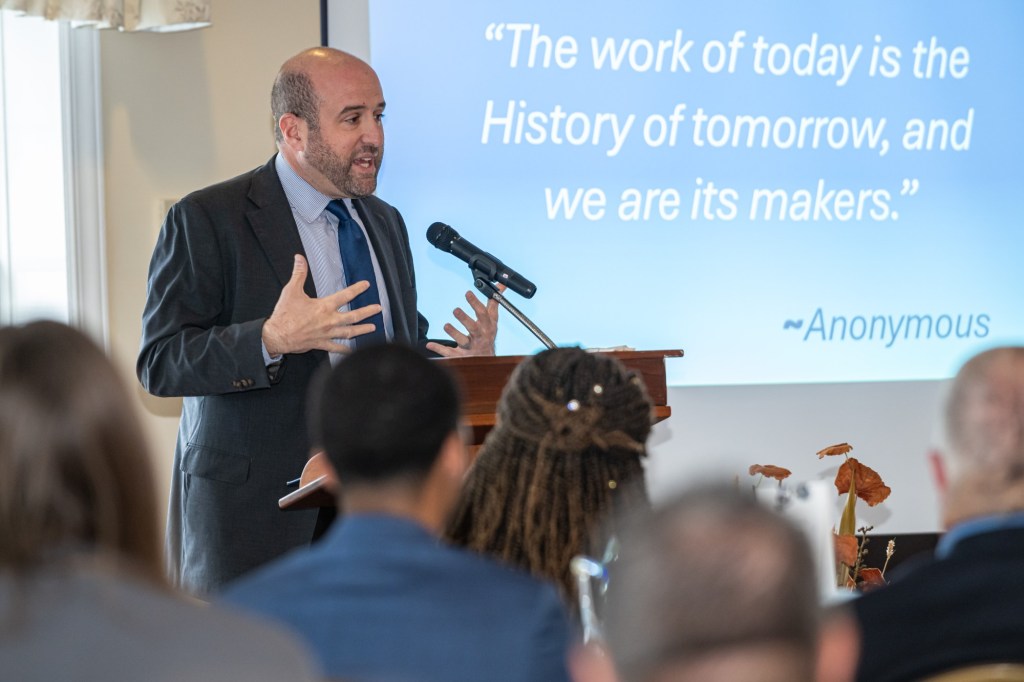
 Rick Siger, secretary of the Pennsylvania Department of Community and Economic Development. (Evan Brandt — MediaNews Group)
There is some evidence that is happening. Siger said currently, Pennsylvania is the only state in all of the northeast with a growing economy.
Siger pointed to what he said were some budget highlights as they relate to his department.
• The budget continues the scheduled decrease of the state’s corporate net income tax reduction from 9.99 percent in 2022 to 7.49 percent in 2026 to its end point at 4.88 percent in 2031.
• $500 million toward site development, making the re-use of brownfield properties shovel-ready. He said $113 million of that money has been spent already.
• The additional $16 million investment in the Department of Environmental Protection has allowed its backlog of hundreds of permit applications to reach zero.
• Getting a business license from the Department of State has gone from taking an average of eight weeks to one day.
“We are speeding up the pace of business in Pennsylvania without changing any environmental rules,” said Siger.
In addition to attracting new business, “we’ve fully reorganized the agency” to also focus on business retention and expansion,” Siger said.
An example of that is GSK’s new biologics flex factory, which will be built in Upper Merion, Montgomery County, and will produce medicines for respiratory disease and cancer. The company expects construction to begin in 2026.
“Right now, the national landscape can look a little cloudy for businesses and some of them may be inclined to hold off on new investments,” said Siger. “But when business executives look at Pennsylvania, they see a place that is moving forward on improvements.”
As a result, the Shapiro administration has added “17,000 jobs to the work force in less than three years,” Siger said.
“We’ve created a business environment that is more certain and has more predictability and businesses,” he added, “are voting with their feet.”