

By SHANNON O. WELLS
For many folks, encountering an elaborately designed mushroom cluster growing on a stately, aging tree creates a sense of enchantment and intrigue.
For Leigh Pavlichko, an arborist with Pittsburgh-based Boscage Tree Service, it just means trouble.
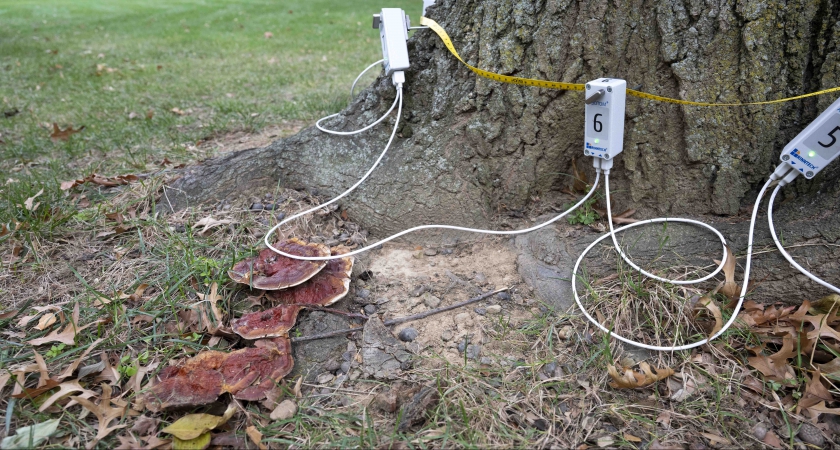
The ganoderma mushroom she encountered during a tree health assessment on the Cathedral of Learning lawn on Nov. 18 is among the indicators that even the mightiest-looking oaks may be in dire health.
“They often call them ‘shelf mushrooms.’ And a lot of times (they) can have a column of decay 15 feet above it and 15 feet below it — all the way into the root system,” she said. “Where a lot of people oftentimes are like, ‘It’s just a mushroom.’ Typically, in arbor culture, it’s not just a mushroom …
“As a certified arborist, if you see mushrooms on a tree, you’ve got to remove the tree.”
Pavlichko uses advanced diagnostic tools to give the Pitt grounds and facilities personnel a more complete picture of tree health while providing detailed insights of their wood and root conditions. The IML-RESI drill measures internal wood resistance to identify hidden structural issues, while Arbotom Sonic Tomography and ArboRadix use sound waves to detect internal defects and map root systems.
Assessing larger trees around Oakland is part of Pitt’s commitment to maintain a safe and attractive campus tree canopy by 2037 while mitigating possible campus safety hazards along the way.
Augmented by arborists like Pavlichko and state-of-the-art equipment, the assessment team includes the offices of Facilities Management; Planning, Design and Construction; and Sustainability.
As a relative quiet descends on the lower campus during Pitt’s upcoming holiday break periods — including Thanksgiving week and the last half of December — some changes to the Oakland tree line will occur.
“There are a few trees that are going to be coming down over Thanksgiving break and Christmas break,” said Andy Moran, senior manager of grounds in the Office of Facilities Management. “And that’s mainly for logistic reasons.
“We have to close sidewalks. We have to close roads. We have to re-route (traffic). And that is easier done without 25,000 students on campus.”
Many trees will be removed simply because they, as Moran puts it, “‘aged out.’ They’re just getting older. … They can’t be fixed. There’s signs of decay,” he said. “There’s a few, and they’re going to be replaced.”
EKG for a tree
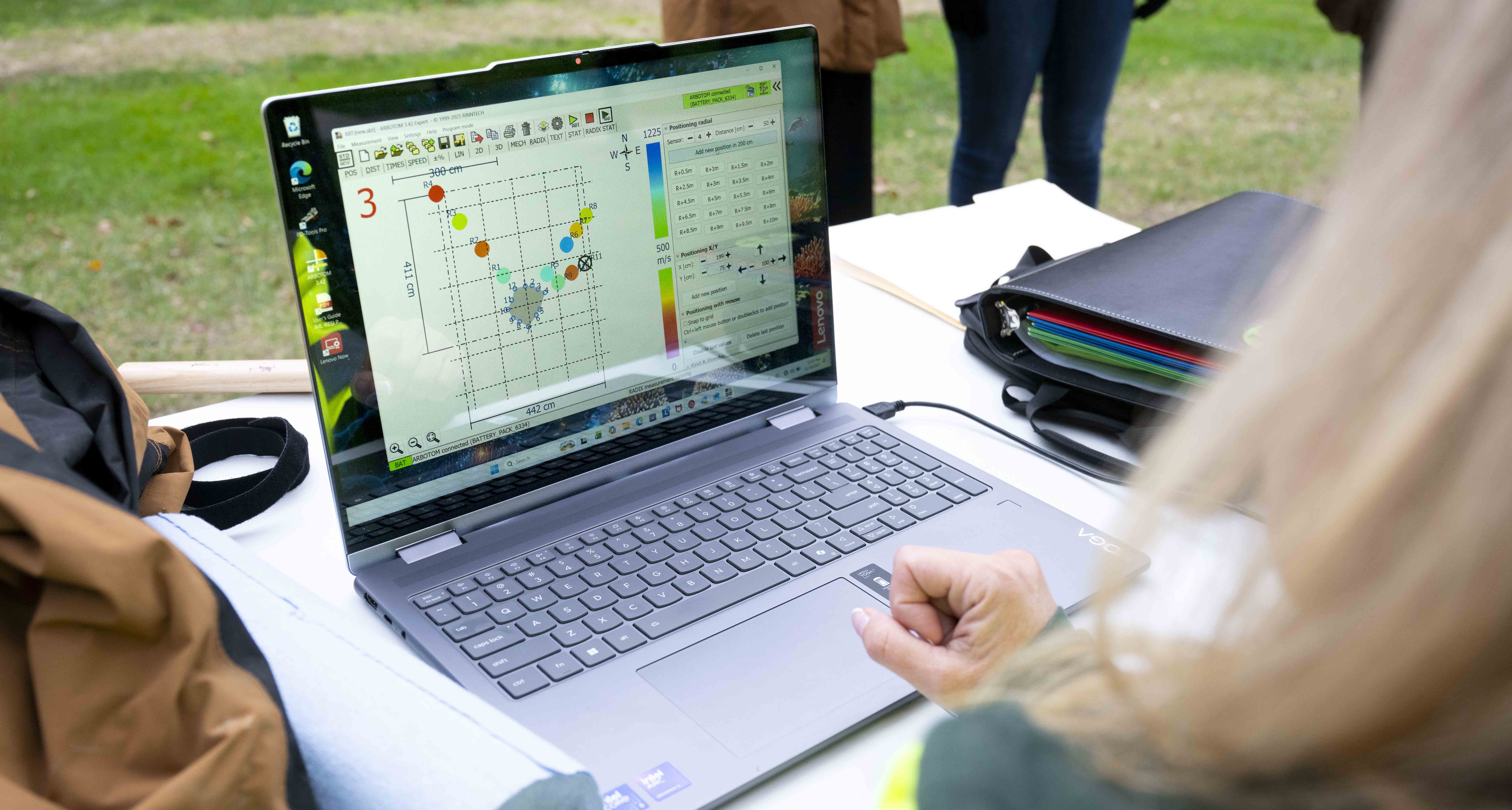
Campus trees are removed primarily for safety reasons stemming from structural problems. These may include root “girdling,” when wraparound roots constrict nutrient flow; deviated trunks or “leaders”; leaning; inner decay; and dead wood in upper branches that create a safety hazard to those below.
When assessing tree health, Pavlichko said visible decay or presence of mushrooms and other fungus provide a gateway from which the tomography and RESI drill tools can derive more detailed information.
“Once you see this, it’s basically like the tip of the iceberg,” she said of tree-clinging mushrooms. “The majority of the fungus is all throughout the tree.”
Before the new technological tools were introduced, “you had no way of knowing. You would just remove (the tree), and it would just be cut and dry. But now we have the ability with the technology … to determine where the weaknesses are on the tree — where the strength loss is.”
Pavlichko describes the IML-RESI drill, or resistograph, as minimally invasive technology that involves injecting an acutely thin needle directly into the tree.
“It goes about 16 inches,” she said. “As it hits the growth rings, it determines the strength. So you get what looks like (a medical) EKG. Then as soon as you hit decay or hollow spots, it flatlines.”
From there, she explained, “you cross reference with (information) you have here. … At that point you have a pretty good idea of what needs to be done for the tree.”
Examining a red oak near Heinz Chapel, Pavlichko said a tree can be solid in one area but suffer strength loss along some roots that may threaten the structure in another direction.
“You’re worried about the chapel, but you weren’t worried about anything over here,” she said. “You have a pretty good chance of determining — based on where your wind usually comes from, where the weather comes from — that your tree’s going to fall over this way.”
Shady situation
Historically, the University has assessed trees on all public Pitt property, said Laura Jellum, assistant director for marketing and communications in Finance & Operations and Pitt Sustainability.
Starting with the 2018 Campus Master Plan, Pitt has conducted campus-wide tree surveys, tracking with identifiers such as type, species and size. For that, and a follow-up tree survey in 2023, information is stored via Geographic Information Systems maintained by Pitt Grounds and the Planning, Design and Construction office.
Rachel Bowers, from the planning office, said many trees around the Cathedral of Learning were planted when the Cathedral, neighboring Stephen Foster Memorial and Heinz Chapel were completed in the late 1930s and early 1940s.
“Then there are other trees that have been planted (since). And a lot of those older trees exist around the perimeter of the space,” she said. “As you move closer into the interior, you’re starting to get trees that were planted in the ‘50s, ‘60s and ‘70s, so a little younger.
“And of course there are trees on the lawn and across campus that were planted a year to (a few) years ago,” Bowers added. “They will be shading campus for many, many more years to come.”
Looking up
In the years before technological tools were involved, Andy Moran said assessing tree health involved “a visual inspection.”
“That’s simply just looking up at the tree and seeing something. It could be a broken branch. It could be a crack in the tree. You’re physically looking at the tree,” he said, noting that the grounds crew engages in daily tree monitoring all over campus. “When they’re walking around, they’re just trained to look up in the trees.”
Anything they spot that’s concerning is reported to Moran and his assistants, who respond accordingly.
“If it’s classified as an emergency or if it’s just a hanging branch — depending on the amount of information we get from the groundskeeper — we would respond and make a little bit more detailed assessment based on our knowledge of trees,” he said. “If we feel that it was more advanced, we would call in a tree company (with) a certified arborist on staff.”
While regular visual inspection remains crucial, newer, cutting-edge technology is “confirming what is being seen on the outside of the tree,” Moran noted. “We may see that a tree doesn’t look healthy or has some issues, but the technology that we’re going to use may prolong the life of that tree a few more years.”
Trees can survive some hollowness and decay and still have a nice canopy. However, “their structure, their strength, is gone. And that’s what we’re trying to reduce, the risk of a tree toppling over because the interior is decayed,” he said. Using sound wave-based tomography, “they’ll be able to instantly see what’s inside of that tree.”
Another key tool, the 16-inch RESI drill detects a tree’s growth rings and translates them into a printable graph.
“As a tree is decaying, the growth rings are not significant anymore in structure, so that drill basically goes right through them (and) doesn’t sense any of the growth ring,” Moran explained. They’re able to confirm how much good wood is left in the tree.
The third tool, ArboRadix, uses sound waves to detect root strength.
“There has to be enough root strength to support the canopy of the tree. In a windstorm, you’ll see a tree snapping. … Basically the wood, the structural integrity of the tree is compromised,” Moran said. “Or you’ll see just a tree falling over with part of its root system. That means that the root system is compromised and can’t support the weight of the tree.
“In combination of those three devices, we will be able to better diagnose a tree.”
Shannon O. Wells is a writer for the University Times. Reach him at shannonw@pitt.edu.
Have a story idea or news to share? Share it with the University Times.
Follow the University Times on Twitter and Facebook.