
By SUSAN JONES
The landscape of college sports has seen huge shifts over the past decade, but the House v. NCAA settlement last summer brought on an earthquake that will long be felt by universities — and their athletic departments, student-athletes and supporters.
The settlement allows colleges to pay current players directly for use of their name, image and likeness (NIL) through revenue sharing, with a cap of $20.5 million per school for the 2025-26 academic year. The cap is expected to rise through the next 10 years. Because Pitt is in a Division I power conference, it is automatically held to the House settlement and can’t opt out.
The question many have is where all this money will come from.
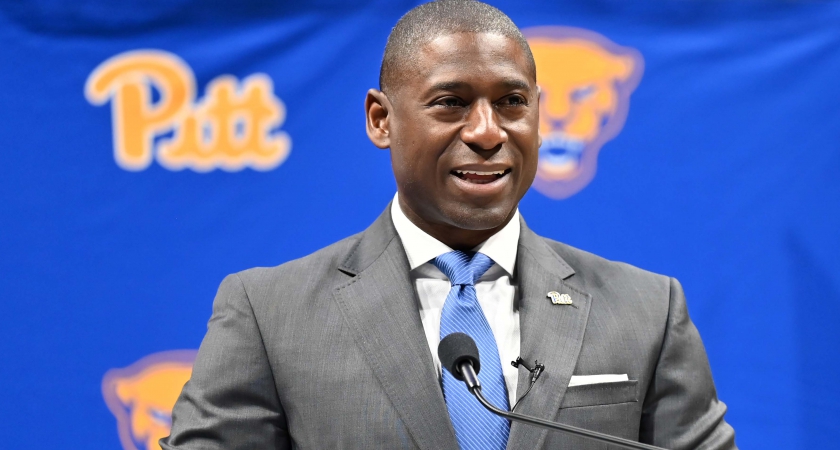
“We have an operational budget and our team, on an annual basis, determines how we are going to … spend our money,” Pitt Athletic Director Allen Greene said. “And we have a new line item of $20.5 million. … Our team has done a lot of work to reduce expenses, whether it be holding on positions, whether it be reducing certain line items in our budget to help fund revenue sharing.
“We’ve also generated more revenue philanthropically to help offset that, and we feel really good about continuing to position our teams for success while also being more strategic with where we’re investing our resources.”
In July, Pitt Athletics reported the Panther Club had its most successful fundraising year to date, driven by the largest number of donors in Pitt Athletics history (16,063) and more than $19.9 million in total cash contributions.
What the University is not doing is discontinuing some non-revenue sports completely. Greene said there are no plans to reduce the number of teams Pitt has, which has happened at other schools.
Even before the House settlement was finalized in July, the Associated Press reported on schools that had decided to close some programs: “UTEP dropped women’s tennis, Cal Poly discontinued swimming and diving, and Grand Canyon shuttered a historically dominant men’s volleyball program.”
In addition, Saint Francis College, a small private school in Loretto, Pa., that saw its men’s basketball team make the NCAA tournament last season, announced it will move from Division I to Division III over the next year, citing “realities like the transfer portal, pay-for-play and other shifts that move athletics away from love of the game.”
The settlement also includes a total of $2.8 billion to pay past players at all schools who missed out on earning money from NIL deals between 2016 and 2024.
The back pay damages will be paid over 10 years and will come from a combination of the NCAA’s reserve funds and insurance (about 60%), along with future reductions in revenue distributions that would normally go to its member schools from events like March Madness. That means schools won’t be directly paying these damages, but they will see revenue reductions over the next 10 years.
Revenue sharing
For current players, schools can divide the $20.5 million however they want among teams. Athletic Director Allen Greene said Pitt Athletics is using a formula that is “not unlike many of our peers.” And, he pointed out, most schools are using the percentage breakdown that the settlement spelled out for paying damages to former players “as a guidepost.”
That breakdown gives 90% of the $2.8 billion settlement to men’s football and basketball, which are the big revenue generators in college athletics; 5% to women’s basketball and 5% to all other sports.
Greene noted that only two sports — men’s football and basketball — generate revenue for the athletic department. Even though Pitt’s women’s volleyball team has been notably successful and has at times sold out the Petersen Events Center, it still doesn’t come close to being a revenue generator, he said.
“The only way that it gets close is if we charge a heck of a lot of money for tickets, like we would do for football,” he said, noting that even high-profile women’s basketball programs don’t make money. “There’s a difference between value and revenue. And when people talk about anything other than — by and large, football and men’s basketball — they’re really talking about value and not talking about revenue.”
At most schools, he said, “football really pays for the experience for everybody else.”
Once the $20.5 million is divided among the teams, Greene said it is up to each coach to decide how it is distributed.
Enforcing the rules
Because athletes also now have the option to enter the transfer portal as often as they wish, as long as they remain academically eligible, schools can compete for star athletes by offering them better deals.
Greene said there are ways to reduce spending on things like travel, for instance, by scheduling more regionally. But whatever cuts they make, there is an impact on student-athletes’ experience, he said.
“You’re giving up notoriety or stature or culture; something sacrifices in everything that we do, because our margins are so tight,” he said. “And I know it doesn’t seem like it, because of the money that we’re spending on all these different things. But there are aspects where we need to spend, because other schools are doing the same, and if we want to compete for prospects and athletes, there’s a price for admission. … The other areas where we can reduce, we absolutely reduce.”
For Greene, the big concern is not leveling the playing field, but figuring out “how to have a system that works for everyone. And that’s proven to be very challenging.”
There has always been a stratification between divisions, within divisions and within conferences, he said. “There has never been an even playing field. And to expect there to be an even playing field, I think, is misguided. What we would like are rules of engagement that are enforceable.”
The newly created College Sports Commission is in place to facilitate revenue sharing in college sports and to ensure that NIL deals made between student-athletes and third parties are fair and comply with the rules.
Greene said the new commission is “in a difficult position.” The commission is still working to get itself organized, including hiring people to actually enforce the rules. At the same time, the NIL and revenue sharing train has already left the station. “Eventually those worlds will have to converge in order for us to have some accountability around the existing rules, or any future rules,” he said.
The rules and the way student-athletes are being paid have evolved quickly through the past four years, Greene said. That’s one of the reason Pitt Athletics decided to absorb the work being done by Alliance 412, which was formed in 2022 to help monetize the brands of Pitt student-athletes.
In 2022, Pennsylvania passed a law allowing for collectives like Alliance 412 to collect money to pay players for NIL rights. Then schools began to have the ability, through state legislation, to be able to pay collectives money to pay athletes. Then it became permissible for schools just to pay athletes directly.
Greene told the Senate Athletics Committee that the sole purpose now of those collectives is for marketing and to help negotiate third-party NIL deals, such as product endorsements, with students.
“Our collective was not built to do that, and as we evaluated our skill set internally, through the collective, through a third party, we felt that we were in the best position to do it ourselves,” he said.
Athletics departments are supposed to be made aware of outside deals made with student-athletes, so it can go through the College Sports Commission clearinghouse. That money does not count toward the $20.5 million cap.
While all the changes in college athletics can be overwhelming and confusing, Greene understands this is the way the game is now played.
When asked if he thought the changes have been good for college sports, he answered philosophically.
“You ask the question as if it matters. I tend not to pay much attention to things that we don’t have control over.”
Susan Jones is editor of the University Times. Reach her at suejones@pitt.edu or 724-244-4042.
Have a story idea or news to share? Share it with the University Times.
Follow the University Times on Twitter and Facebook.