
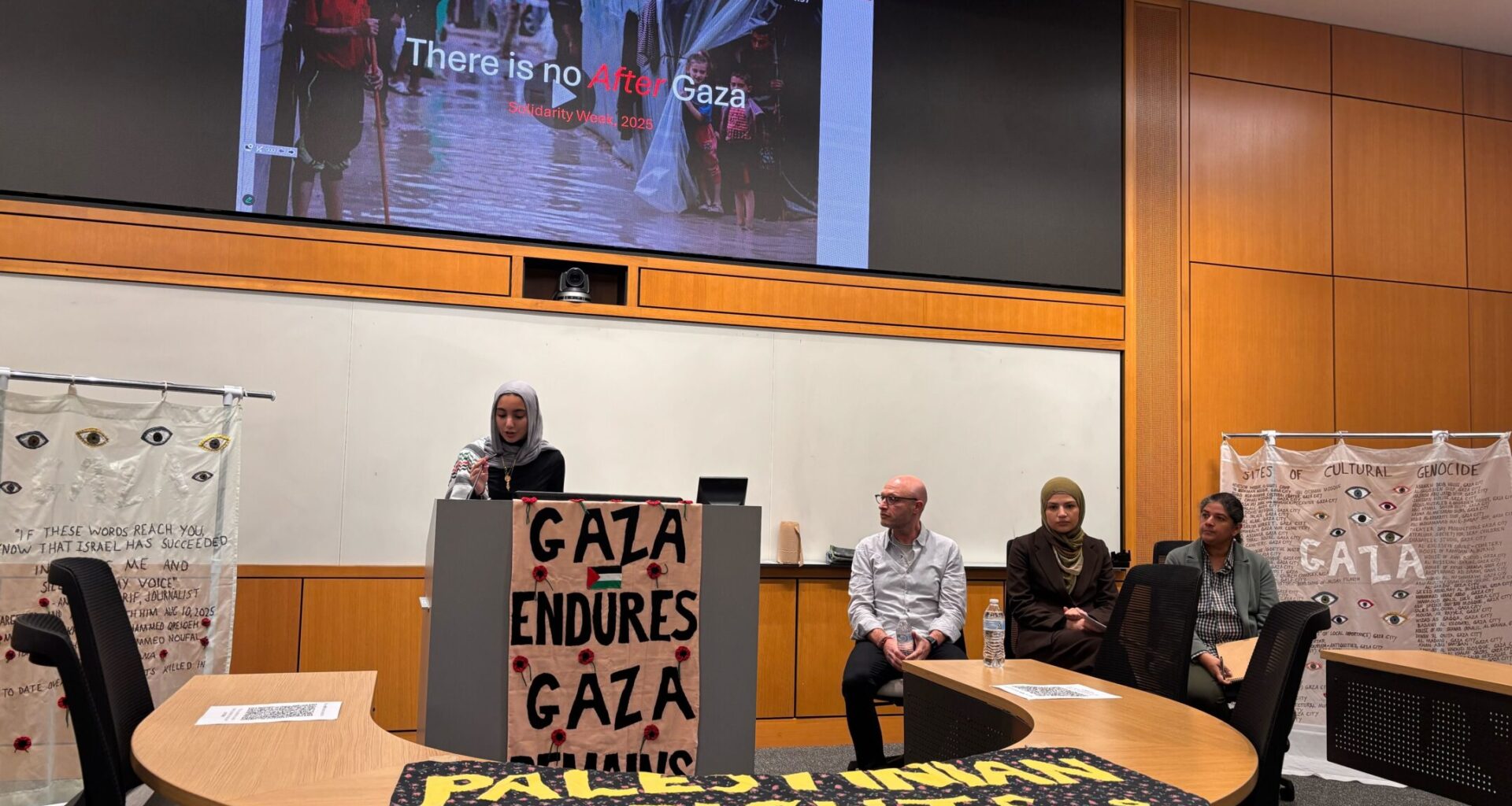
Lehigh’s Student Political Action Coalition hosted a Solidarity Week from Nov. 17 to Nov. 21, featuring events centered on global justice, student activism and the Israel-Palestine conflict.
The week included discussions on the current state of Gaza, the history of the conflict and efforts to raise awareness about ongoing conditions in the region. As part of the events, SPAC held a panel focused on solidarity with Palestine.
Panelists included Nitzan Lebovic, Lehigh’s chair of Holocaust studies and ethical values, Nandini Deo, an associate professor of political science, and Zeinah Latefa, an attorney at Gross McGinley, LLP.
Lebovic opened the conversation by discussing solidarity, saying harmful forms of it can make individuals complicit in genocide, as defined by the United Nations’ Human Rights Council. He said believing in an “after Gaza” — or a post-war normal — can reflect a detachment from ongoing suffering.
He said many who showed support for Palestinians before the ceasefire brokered on Oct. 10 have since stopped, which is an example of bad solidarity.
According to the United Nations Children’s Fund, most of Gaza’s schools have been destroyed. Lebovic said even though Israeli forces have withdrawn to a designated border, many Palestinians are living in rubble.
“These conditions are unbelievable, and if somebody thinks that this is something that can be established long-term, I do not know what to think of it,” Lebovic said.
To illustrate bad solidarity, he referenced Holocaust survivor Primo Levi, who wrote in his memoir “The Drowned and the Saved” that he felt German empathy after World War II was insincere, vague and detached.
Lebovic said true solidarity should feel uncomfortable.
“If we are in true solidarity with someone who is struggling, we cannot be comfortable with that, and that is totally fine,” Lebovic said.
Deo continued the discussion by addressing international solidarity and complicity. She said nations have historically united against colonialism and imperialism, especially during the Cold War through the Non-Aligned Movement which supported developing countries and champions international peace and security.
However, she said this kind of solidarity is inconsistent.
Latefa said international law is one reason why colonialism and unjust treatment persist.
According to the United Nations, international law is a set of rules, norms and principles that regulate relations between states and other international actors.
Latefa said states engaged in war are supposed to uphold protection under international law, including access to food and water, bans on collective punishment and protection for infrastructure.
“There is a difference between rule of law and rule by law,” Latefa said. “States like Palestine exist in a state of legal subalternity, where they exist in the legal system but in a subordinate, constrained and marginalized position.”
She said the law is intended to be impartial, yet global powers such as the U.S., China and France maintain dominant influence, reinforcing hierarchy.
“The Palestinian cause, therefore, is not an anomaly,” Latefa said. “It reflects broader patterns, where international law preserves colonial legacies.”
Latefa referenced historical examples, including the United Nations Partition Plan of 1947 and the Gaza Peace Plan introduced by the Trump administration.
She said these arrangements demonstrate the absence of Palestinian self-determination on the global scale.
Latefa said geopolitical pressures are prioritized over legal principles, which doesn’t benefit Palestinians.
“You get a seat at the table, but there is no actual movement around the table,” Latefa said. “And that brings us to this long term condition of subalternity, where Palestine is under an authoritative regime and Palestinians are refugees.”
Deo said conversations surrounding political issues can feel small, but they influence future structural and international change.
“Part of what power wants us to think is that it is inevitable, that things are the way they are, and that they cannot change,” Deo said. “But the world can change, and it can change very fast.We just have to imagine.”
Deo said engaging in solidarity doesn’t need to be a long-term commitment. She said simply showing up to events and bringing others can help spread support.
Latefa said scare tactics sometimes motivate people to support a cause, as many only care when something affects them.
“We are seeing an authoritarian-like regime (in the U.S.), so everything might not be as isolated as it seems,” she said.
Deo said it’s important to think about movements that brought significant change to stay motivated.
She said she might not exist without queer rights movements, civil rights movements and anti-colonial movements, which opened space for future activists.
“We live in a world that has been bequeathed to us by people who got up and did the right thing even when it seemed like it wouldn’t work,” Deo said. “Our job is to get up and do the thing, even if a part of you thinks it won’t happen in your life, you have to do it for the future generations.”