
ARCHBALD — From carpentry to welding and line working, more than 100 high schoolers received insight on potential careers and apprenticeship opportunities that provide family-sustaining wages during an NEIU program Wednesday at Valley View High School.
Local labor union representatives offered information on applying for apprenticeships and outlined the tasks and responsibilities associated with several trades as the students ponder life after graduation.
Apprenticeships are paid, on-the-job training programs that combine hands-on work with classroom instruction to prepare individuals for skilled careers.
Matt Lochie, a council representative for the Eastern Atlantic States Regional Council of Carpenters Local Union 445 in Scranton,noted that the process for becoming an apprentice carpenter starts with an information session before prospective employees are assigned a list of tasks and complete an in-person interview.
The last step is a skills assessment, which includes a math test and physical activities where participants carry materials, including plywood and two-by-fours, up and down ladders, Lochie added.
Those who complete all the requirements are placed on an eligible-to-hire list, he said. A high school diploma or GED credential is a prerequisite for applying for the apprenticeship.
Lochie cautioned students that a construction career has challenges but assured them it also offers room for advancement.
“This is a tough business; you definitely beat yourself up doing this trade,” he said. “The sky is the limit, but it’s on you guys. You have to be there every day, and you have to be on time. This is a career, not just a job. When you become a journeyman carpenter, that’s not where it stops; you can be a foreman, a superintendent or a project manager.”
Lochie noted first-year apprentices earn approximately $21 per hour and receive about a $3.50 raise each year as long as they meet the requirements.
He added that construction work schedules have ebbs and flows, so potential hire dates can be unpredictable.
“There are slow times and times you can’t keep up with, so it could take a day or it could take a couple months to get you out to work,” Lochie said.
Lochie feels optimistic about recent interest from young adults looking to join the construction trade.
“Our last information session, about 85 kids signed up,” he said. “We ended up interviewing about 50, but other years we would get maybe 20 kids, and by the end we would have five, so it’s pretty significant.”
He believes a bigger push by guidance counselors advising students to consider the trades as an alternative to college may be driving the increase.
“It’s nice that the schools are buying into this and giving the kids an opportunity,” Lochie said. “They can earn as they learn and start their career debt free.”
Patrick Weber, a senior at Mid Valley Secondary Center in Throop, who first developed an interest in construction in sixth grade, plans to enter the carpentry trade following graduation. He learned more about the occupation while receiving hands-on instruction at the Career Technology Center of Lackawanna County, where he framed a wall, installed shingles and insulation, and completed exterior finish work.
“I saw people on a rooftop doing shingles, and since then I’ve wanted to do it,” Weber said.
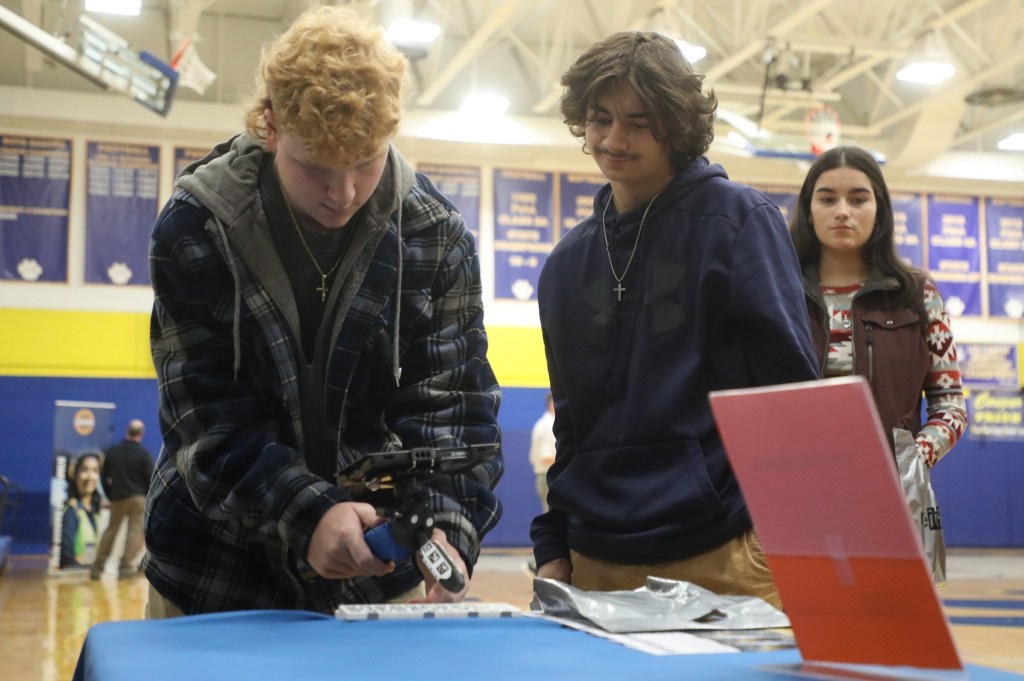
Jeff Schmude, marketing developer for the Wilkes-Barre-based Local Union No. 44 of the International Association of Sheet Metal, Air, Rail and Transportation Workers, allowed students to test out a virtual welding simulator, giving them a sneak peek at a potential career choice.
“I bring it to show them what they’re going to learn through their apprenticeship, if that’s the path they choose,” he said. “I tell them that all the time that I’m not discouraging them from college, I’m just letting them know there is another option and they can have a good career in the trades.”
Schmude stressed that each applicant in the apprenticeship program must be at least 18 years old, have a high school diploma or GED credential, and adhere to a code of excellence related to completing jobs and showing up to work in a timely manner.
Once someone completes the training program and becomes a journeyperson, they can work anywhere in the county, he added.
A first-year apprentice starts out making roughly $18 an hour, said Schmude. He added that journeymen earn roughly $37 an hour, and the rate goes up each May.
“We’re taking apprentices in every year,” Schmude said. “This past September we took in 13, and next September we’re looking at just about the same, if not more.”
Stephen Syrylo, a student at Lakeland High School, hasn’t decided on his future plans, but felt the program shed some light on interesting opportunities.
“Instead of going to college, you can go into the workforce but still learn a lot …. and you’re getting paid a decent, livable wage,” he said.
Students gather around Matt Lochie, who represented the Eastern Atlantic States Regional Council of Carpenters during the trades and apprenticeship program at Valley View High School on Wednesday, Nov. 19, 2025. (REBECCA PARTICKA/STAFF PHOTOGRAPHER)
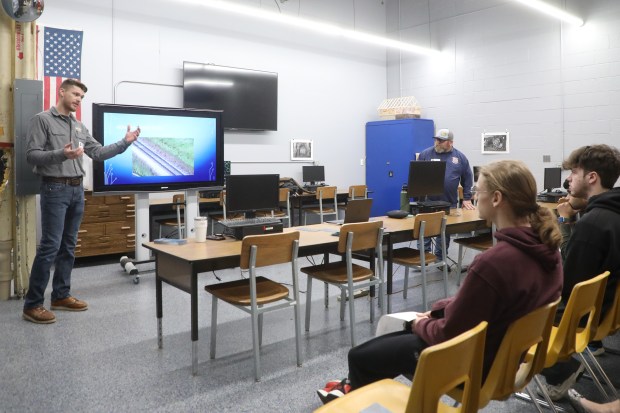
Valley View students listen to the Journeyman Bobby Scott’s presentation about the lineman profession during the trades and apprenticeship program at Valley View High School on Wednesday, Nov. 19, 2025. (REBECCA PARTICKA/STAFF PHOTOGRAPHER)
Show Caption
1 of 2
Students gather around Matt Lochie, who represented the Eastern Atlantic States Regional Council of Carpenters during the trades and apprenticeship program at Valley View High School on Wednesday, Nov. 19, 2025. (REBECCA PARTICKA/STAFF PHOTOGRAPHER)
Bobby Scott, a journeyman lineman for Local 1319 in Kingston and director of the Northeastern Apprenticeship Training program, informed students about the rigors of the structured apprenticeship, which includes a 7,000-hour minimum requirement under the direct supervision of a journeyman lineman. Applicants must be 18 years of age, and have a high school diploma or GED credential, and at minimum a Class B commercial driver’s license.
“This isn’t your typical office job,” Scott said. “We’re not showing up to the same place every day and we’re not doing the same thing every day. I’ve worked with helicopters, car accidents and house fires.”
First-period apprentices make $40 an hour, and journeyman line workers earn $66 an hour, Scott said.
“When you become a journeyman through our training, you can work anywhere in the world, but it comes with a lot of responsibility,” Scott said. “I tell everybody it’s 70/30: 70% of it is life changing — I’ve been able to provide for my family and set my kids up with their education — and 30% of it is grueling. It’s tough, but you have to show up for that 30% to make the big bucks.”
Scott recalled an instance of being dispatched to Flint, Michigan, just before Christmas, to repair power lines.
“On Dec. 23, I got a phone call that there were 8,000 people without power and a half-inch of ice on all the lines,” he said. “I spent all Christmas and New Year’s in Flint, but I knew my family was home, here in Pennsylvania, warm and safe, and that I was making a giant difference out there for those people. When those lights popped on, especially when all the houses are decorated for Christmas, after people had been out of power for eight or nine days, it’s an amazing feeling.”
Gina Rupe, a professional learning adviser for the Northeastern Educational Intermediate Unit, worked with local labor unions and area schools to ensure students would have an opportunity to meet and talk with the industry professionals.
During the program, students learned about the specifics of each trade, what it takes to be successful in each occupation, and the path each union official took to advance their career, she said.
“It’s essential to give (students) access to as many options as possible,” Rupe said. “It’s definitely a hot topic right now. They wanted to know what the first day of work would look like and the skills needed to make it in these trades.”
Zach Watters, a school counselor at Mid Valley Secondary Center, appreciates NEIU’s effort to organize events that highlight alternative post-graduation options.
“For us, this is targeting students who might not have a path yet or students who expressed direct interest in the trades,” Watters said. “I feel like so much emphasis is put on the college process, because there is so much to it, that sometimes it’s easy to miss these students. Knowing there is an event for them every year is great.”
Watters said he witnessed a shift in thinking among high schoolers regarding their future plans within the last several years.
“The emphasis used to be college for all, and now it’s finding a path that’s going to get you into the workforce the fastest,” he said. “I think students are so much more willing to say ‘I can get a good paycheck right out of school if I go into a trade.’ ”