
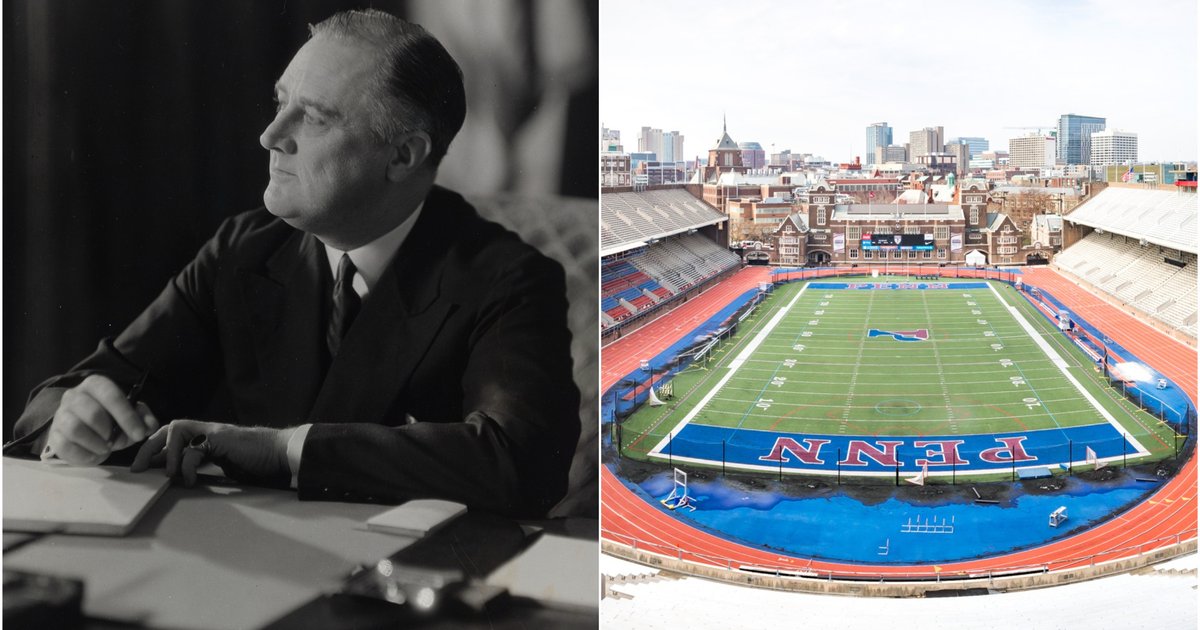
Crowds used to fill Franklin Field every Thanksgiving to watch the Quakers take on the Big Red. It was a holiday matchup that ran consecutively for 43 years, starting back when the stadium opened in 1895.
But the football tradition came to a screeching halt in 1939 due to an unusual intervention from the White House. In a bid to boost business, President Franklin D. Roosevelt proclaimed that Thanksgiving would take place one week earlier in November. The move was designed to extend the holiday shopping season, and while retailers rejoiced, college football teams scrambled. The Penn-Cornell showdown moved to the Saturday after the “new” Thanksgiving for three years, the length of the Turkey Day experiment. Even after FDR restored the holiday to its rightful place on the calendar, the Penn-Cornell classic was never the same.
MORE: Ken Burns’ new series highlights some lesser-known revolutionaries from Philly and South Jersey
Roosevelt had been considering a Thanksgiving shuffle for six years when he made the switch. Though the holiday had fallen on the last Thursday of November since Abraham Lincoln cemented the date in 1863, business leaders had been lobbying the president to bump it up to encourage more spending. As department store tycoon Frederic Gimbel, who heartily endorsed the change, told reporters, “We all know that it is an American tradition to begin Christmas shopping after Thanksgiving.” Moving the date from Nov. 30 to Nov. 23, 1939, would give shops like Gimbels a full four weeks of holiday sales — and amid the Great Depression, Roosevelt was looking for novel ways to boost the economy.
Not everyone was receptive to the change, which was announced in mid-August. Calendar manufacturers threw a fit over the confusion. Collegiate athletic departments had their own reservations, particularly the one at the University of Pennsylvania.
“This is awful,” Joseph T. Labrum, Penn’s director of sports publicity, told the Courier-Post at the time. “We simply can’t play Cornell on Nov. 23. That would be only five days (after) the tough Michigan game and our boys would hardly be able to recuperate.”
There was also the audience to consider. After four decades of Thanksgiving college football in Philly, city dwellers viewed the game as a holiday ritual.
“The Penn-Cornell game, for instance, has become synonymous with Thanksgiving in Philadelphia,” the Inquirer wrote. “To play it on the 30th, according to the schedule, after Thanksgiving is moved up a week, would remove from the game the holiday atmosphere that has been so colorful a feature, and would make it difficult for many out-of-town alumni to attend. Transferring it to the 23rd would cause complications, because another hard game is already scheduled for the Saturday previous.”
Penn compromised and bumped the event up to Nov. 25, the Saturday after “Franksgiving,” as critics called the holiday reboot. Despite the hand-wringing, the game was still well-attended; the Inquirer reported 69,000 attendees, only a modest dip from the previous year’s 70,000. Cornell triumphed 26-0, but Penn would win the next two matches, also held on the Saturday after the early holiday.
As more states, including Pennsylvania, broke with the federal decree and declared Thanksgiving on the final Thursday of the month, Roosevelt conceded defeat. Things returned to status quo in 1942, when Turkey Day fell on Nov. 26, the same date as the Penn-Cornell game. The teams would meet again on the holiday the following year, but the tradition soon began to sputter. There was no Thanksgiving matchup in 1944 or 1945. Though it came back for the rest of the post-war decade, it disappeared again in 1950 and 1951. In 1964, the game was scheduled for October in Ithaca, and the teams began alternating hosting duties.
The last time the Quakers and Big Red met in Philly for the holiday was in 1989, when the home team lost 20-6. Nowadays, the teams tend to meet early in the month; most recently, they faced off at Franklin Field on Nov. 8. While the rivalry has survived, clearly, a pre-Thanksgiving game doesn’t have the same spirit. On their most recent outing, an audience of just 10,914 watched Cornell cruise to a 39-17 victory.
Follow Kristin & PhillyVoice on Twitter: @kristin_hunt
| @thePhillyVoice
Like us on Facebook: PhillyVoice
Have a news tip? Let us know.