
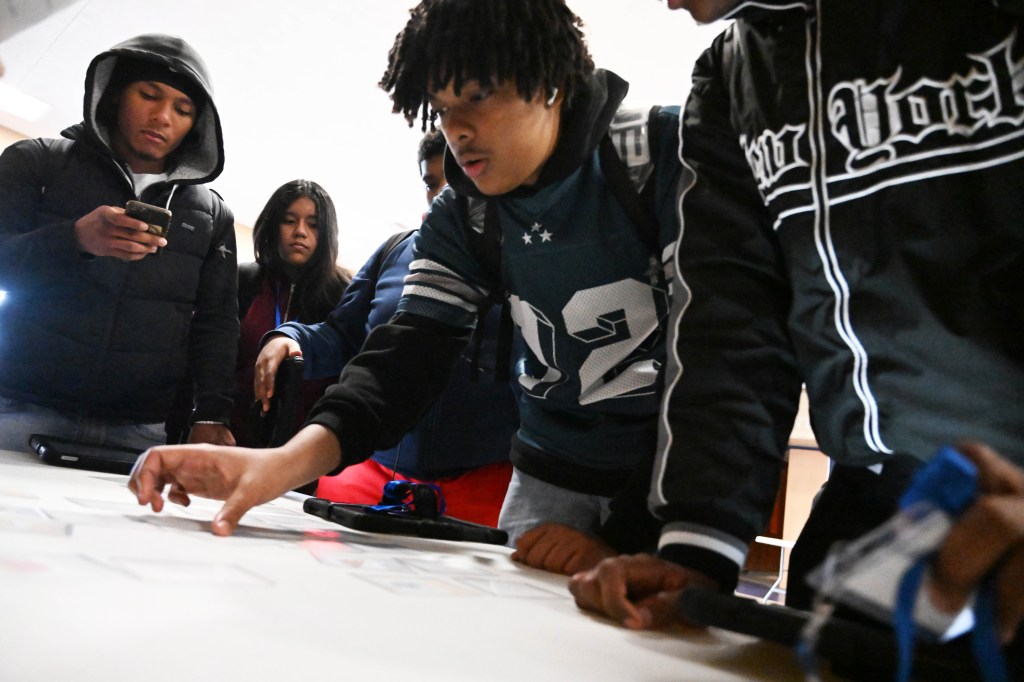
For one day, Destini Glover-Allen was a quality assurance manager with a $69,216 annual income and net monthly income of $4,269 — plus a spouse’s net monthly income of $2,876 — and had to allocate those funds between needs, like groceries and insurance bills, and wants, like dining and entertainment.
Robert Rivera had to decide the same, but with a $29,414 annual income and a net monthly income of $1,960 as an occupational therapy aide.
All was part of a financial literacy exercise last week at Dieruff High School, aimed at providing hands-on experience with monthly budgeting.
“Especially now, everything is getting more expensive,” said Glover-Allen, a 16-year-old Dieruff junior. “It’ll be better for us to understand what we’re spending our money on.”
The Wednesday event, dubbed the JA Finance Park, brought community volunteers into the Allentown school to bring to life curriculum from the Junior Achievement of Southeastern Pennsylvania.
The nonprofit serves eight counties, including Lehigh and Northampton. Its newly released high-school-level financial literacy course focuses on topics such as budgeting and investments.
Each student was assigned a persona that came with a job and related income. It was an eye opener for some.
Rivera, 15, said he’d come to the conclusion that renting could have advantages over home ownership after talking to a community volunteer about home maintenance costs.
“If you’re trying to fix your roof, that can be a lot, a lot of money,” Rivera said.
Overall, the financial literacy lessons helped prepare students for the future, Rivera said.
“It’s good to teach people how to have success,” he said.
The JA financial literacy curriculum aligns with requirements set by a 2023 state law that requires all Pennsylvania high school students to complete a course in personal financial literacy starting with the 2026-27 school year.
“From a very basic level it’s about money management and how that is connected to whatever it is that you’re choosing to do in the future,” said Stephanie Gambone, president and CEO of JA’s regional chapter.
In addition to the Finance Park simulation, JA’s curriculum includes other hands-on elements, such as a stock market challenge, to bring an experiential element to the financial literacy content.
“It also allows young people to practice it,” Gambone said.
Wednesday was the first time Allentown high school students worked through the JA Finance Park simulation. South Mountain Middle School students piloted the event in June, and all the district middle school students will participate in March.
The nonprofit trains teachers and supports their delivery of the JA financial literacy curriculum. There also is a virtual option, although the lessons are primarily designed for in-person instruction.
JA hopes to pilot the high school course in Allentown this spring, Gambone said. The nonprofit is working to expand its financial literacy lessons into other area schools, and has had interest from Bethlehem Area School District, she added.
At Dieruff, the Gear Up college and career counselors provided 12 hours of preview lessons before the Finance Park event.
Counselor Jayson Spangler said students sometimes tune out advice from teachers but the simulation offered a chance to hear third-party advice from outside sources that might sink in more.
“It’s not just a classroom,” Spangler said.
Volunteers share their own background and experiences with the students, providing different points of view, counselor Lori Shuhler said. Students need to learn how to start building credit and how to avoid piling up college loan debt, she added.
“It’s important to start budgeting now,” Shuhler said.
Yuliany Batista, a 16-year-old Dieruff junior, has worked retail and food service jobs. She was one of several students and instructors who mentioned how eye-opening it is to learn how taxes impact paychecks.
“They took a whole shift from me,” Batista said, describing that tax impact.
The financial literacy lessons made Batista think more about how to find a good job that can cover her expenses.
“For me it’s hard saving up,” Batista said, “so I’ve got to learn.”