
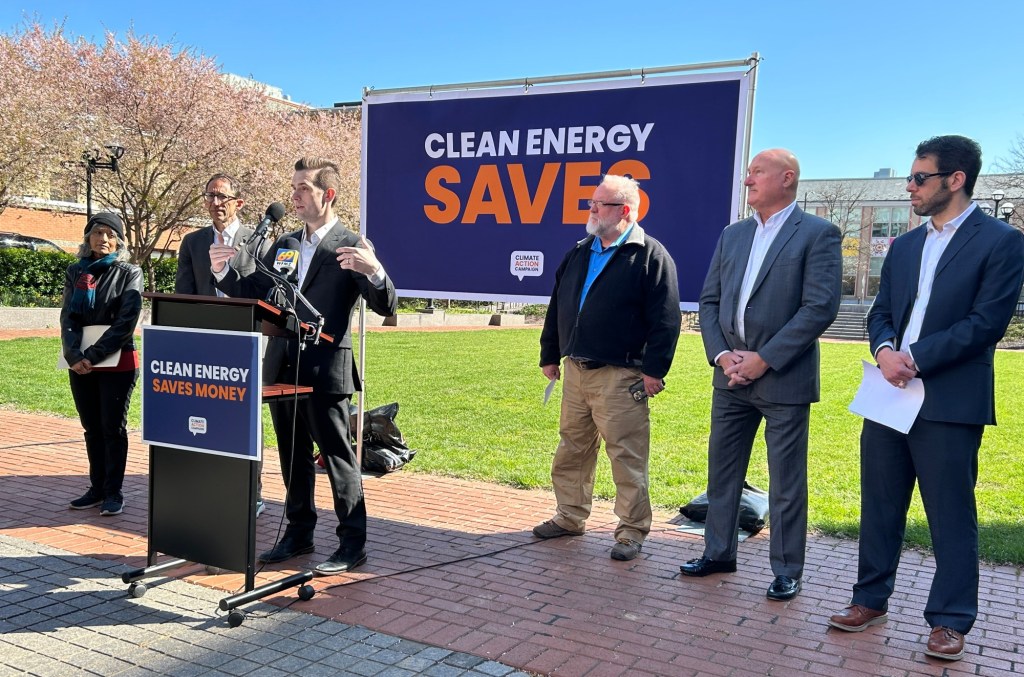
Millions of square feet of empty warehouse roofs will stand ready to host solar panels if the vision put forth in state Rep. Josh Siegel’s legislation comes to light.
New warehouse and distribution centers in the state would need to ensure their roofs are capable of supporting solar panels if the Siegel-sponsored bill becomes law.
The bill, which advanced out of the House Energy Committee on Tuesday, would also allow local authorities to pass tax incentives to encourage existing warehouses to retrofit their roofs.
The Lehigh Valley has added 44 million square feet of warehouse space in the last decade, Siegel said in committee testimony during an Oct. 6 hearing on the bill.
“That’s over 1,000 acres of roof space, and under H.B. 1260, 40% of it could be used to generate clean, local power,” Siegel said.
The definition of “solar-ready” in the bill says that a minimum of 40% of a warehouse roof area must be suitable for solar panel installation, meaning it is free of obstructions such as HVAC systems or vents and it has sufficient structural integrity to hold the weight of a mounted solar energy system in addition to wind and snow loads.
Interior construction would also need to leave space for wiring and inverters needed to connect solar arrays.
The modular nature of solar arrays make them easy to install, and developers are ready for this construction, Rob Bair, president of the Pennsylvania Building and Construction Trades Council, said during the Oct. 6 hearing.
“As long as the warehouse is built with roof structure to carry it, we can deploy it rapidly and it’s low impact,” Bair said.
Finding a solar-ready warehouse can be challenging, but the components are often standard design features that are readily available without a large cost increase, Victoria Moroney, director of market development at solar commercial rooftop developer ForeFront Power, said at the Oct. 6 hearing.
“It’s not that any of these requirements are overly cumbersome or expensive,” Moroney said. “It’s just that warehouse developers don’t have this in mind when they’re developing their facilities.”
Warehouses don’t consume a large amount of electricity, so a solar array would not need to cover the whole roof to meet the facility’s energy demand, Moroney said.
Adding solar panels can cut energy costs, and a developer could also lease the roof space to generate money from an array, Moroney said, adding that large tech companies are starting to incorporate solar-ready design into their facilities.
“I think these companies would not be making that decision if there was not a positive ROI on that investment,” Moroney said.
Next steps for legislation
Siegel’s bill is similar to legislation that passed in New Jersey in 2021, and House Energy Committee Chair Elizabeth Fiedler has said the experience of our neighboring state is one reason to push Pennsylvania’s proposed bill forward.
Trade associations in New Jersey supported that legislation, and developers said solar-ready buildings were easier to lease, Fielder said at the Oct. 6 hearing.
Construction companies reported that solar-ready requirements only added 1% to the total project cost for a 50,000 square foot warehouse, Fiedler reported.
Bair agreed that construction costs should be manageable for developers.
“We already build for snow loads,” Bair said. “It’s really not that much more to ramp it up.”
Additional project costs could be “a little more than 1%” for a larger warehouse, Bair said, but a bigger roof also gives a developer more opportunity to rent out the power-generation equipment and increase revenue.
“At the end of the day, if he could lease that roof space for 30 years, I think he’s going to be more than willing to incorporate it into the design,” Bair said.
The Nov. 18 committee vote fell along party lines, in part due to concerns raised about placing a mandate on private property.
“As far as mandates go, I think it’s one that carries with it a very minor cost,” Siegel said.
Seigel — who will step down as representative of the 22nd district next month, after his election as Lehigh County executive — also emphasized that mandates in service of the public good should be seen as a positive, and that rising electricity costs mean developers and ratepayers alike need a way to use renewable energy to their advantage to insulate themselves from further price rises.
“It’s deeply unjust for us as legislators to think only about the needs of private industry and ignore the consequences of what it means for our constituents,” Siegel said.
The last two capacity auctions from the regional grid operator pushed up supply prices and raised customer bills by more than $20 a month, PPL spokesperson Dana Burns estimated. PPL is now asking to raise its residential rate 7%, a move that will be investigated in upcoming public hearings.
In addition to lowering electricity costs, building and retrofitting solar-ready warehouses could increase construction work in the Lehigh Valley.
Support from unions could help ensure the bill passes the full House, Siegel said, counting “15 to 20” Republicans with strong labor connections as potential supporters.
The Pennsylvania House goes back into session Dec. 17, and Siegel’s last day in the Legislature will be Dec. 18. Those two days are the last legislative days of the year, but Siegel said he’s in talks with other representatives to carry on the bill to the next session if necessary.