
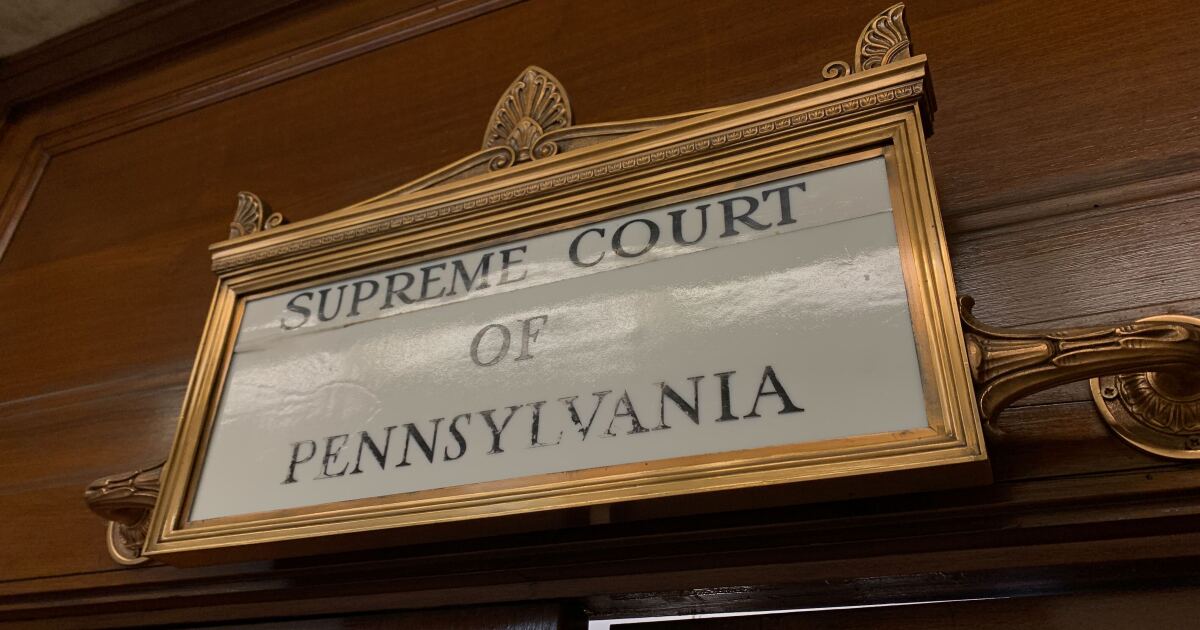
In a 4-3 decision, the Pennsylvania Supreme Court ruled Monday that local agencies do not need to give 24-hour notice when making changes to public meeting agendas — as long as a majority of the body votes to do so.
The decision angered supporters of government transparency who argue that it weakens the state’s Sunshine Act, which sets requirements for conducting official business in public view.
Under the ruling, said Melissa Melewsky, in-house counsel for the Pennsylvania NewsMedia Association, “[Local agencies] can add anything they want as long as they vote to add something to the agenda, and then post it the day after the meeting.”
“How does the public ascertain what will be discussed and acted upon with any kind of certainty when an agency can add virtually anything at the last minute?” Melewsky said.
Under amendments signed in 2021 by Gov. Tom Wolf, the Sunshine Act generally requires officials to post meeting agendas at least 24 hours in advance. The agenda is usually required to identify any votes officials plan to take.
But in her majority opinion, Justice Christine Donohue, noted that the law also lists some exemptions to that requirement. They include votes on emergency business where there is a “clear and present danger” to the community, or situations involving late-developing matters that involve either trifling decisions or cases in which the agency takes administrative action short of a policy discussion or vote.
But as written, Donohue wrote, the law also identifies an additional exception: “An agency may add a matter of agency business to the agenda” if a majority of voting members approve doing so.
That last category of exemption arose in the case before the court, which involved an October 2021 vote by a Lehigh Valley school board to approve a teachers’ union contract. Earlier that day, the union agreed to a contract that included a 3% pay raise for nearly 700 teachers: While there was no mention of the contract on the agenda for the meeting, a board majority voted to add it during the meeting, and then voted to approve the contract.
The board argued the agreement with the union was reached within the same day, so the body didn’t have time to notify the public of the change. But a state Senator representing the area, Republican Jarett Coleman, took the board to court.
Coleman argued that all four of the exceptions in the law must be in play to allow a last-minute agenda change, and the state Commonwealth Court ruled in his favor. Advocacy groups from across the ideological spectrum — including the ACLU of Pennsylvania, the conservative Commonwealth Foundation, and the Pennsylvania NewsMedia Association — urged the Supreme Court justices to uphold that ruling.
But Monday’s ruling turned on a single word: “or.”
Donohue noted that when the Sunshine Act identified four categories of exception to the 24-hour rule, it separated them with the word “or.” That, she wrote, was “unambiguous and creates four freestanding exceptions,” with any one of them sufficient to waive the notification requirement.
Donohue acknowledged that the majority-vote exception was “the broadest exception” of the four, since it didn’t require that matters be of either minor or life-and-death importance. But she said requiring officials to put themselves on record by voting to add an agenda item provided accountability.
”If the [legislature] intended something different from hat is expressed in that plain text, it is free [to] amend the statute,” she added.
Not everyone agreed, and the ruling provided an unusual ideological split. Donohue’s opinion was joined by Justice Kevin Dougherty, who like her was elected as a Democrat, but it also by Sallie Updyke Mundy and Kevin Brobson, who were both elected as Republicans.
Chief Justice Debra Todd and justices Daniel McCaffery and David Wecht — all elected as Democrats — dissented. Todd argued that allowing a majority of officials to circumvent the 24-hour notice at will would “effectively over[ride] narrow exceptions to the agenda requirement.”
“While I agree with the majority that the plain and common meaning of the term ‘or’ should be taken at face value … the application of that plain meaning would lead to an interpretation of the Sunshine Law that is inconsistent with the manifest intent of the General Assembly,” Todd wrote.
Coleman agreed. In a statement, his office said the court majority “has opened Pandora’s Box. Although a split decision, today is a dark day for transparency in Pennsylvania. This ruling negates the need for governments to publish accurate agendas twenty-four hours before public meetings and essentially allows them to operate with no public notice.”
Melewsky predicted that lawmakers will react by amending the Sunshine Act again.
“If there’s a decision that cries out for legislative change, this is one of them,” she said. “The General Assembly made clear what they intended to do in 2021 when they passed this agenda requirement, and this decision really renders that meaningless.”