
Thanksgiving is the sole American holiday whose name tells us exactly what we are meant to do.
This Thanksgiving — among many other blessings — I am giving thanks for our country’s vibrant, independent local journalism, and for the nation of laws and press freedoms that help preserve and defend it.
More than any other American holiday, Thanksgiving is about the exercise of free speech. Whether cordial or contentious, our views of our families, our culture, our sports teams, or our politics are debated freely over the American Thanksgiving table.
In a world in which we spend far too much time living in our own information bubbles, Thanksgiving allows — indeed forces — us to communicate across the table, across generations, and across sometimes deep partisan divides.
From the outset, the notion of Thanksgiving and freedom has been intertwined. In George Washington’s Thanksgiving Proclamation of October 1789, the new president asked the nation to give thanks “for the civil and religious liberty with which we are blessed, and the means we have of acquiring and diffusing useful knowledge.”
As worded, the proclamation is more a celebration of American freedoms than the blessings of a sumptuous meal. If Independence Day celebrates the declaration of American freedoms, then Thanksgiving celebrates their enactment and — one hopes — their permanence.
If Independence Day celebrates the declaration of American freedoms, then Thanksgiving celebrates their enactment and — one hopes — their permanence.
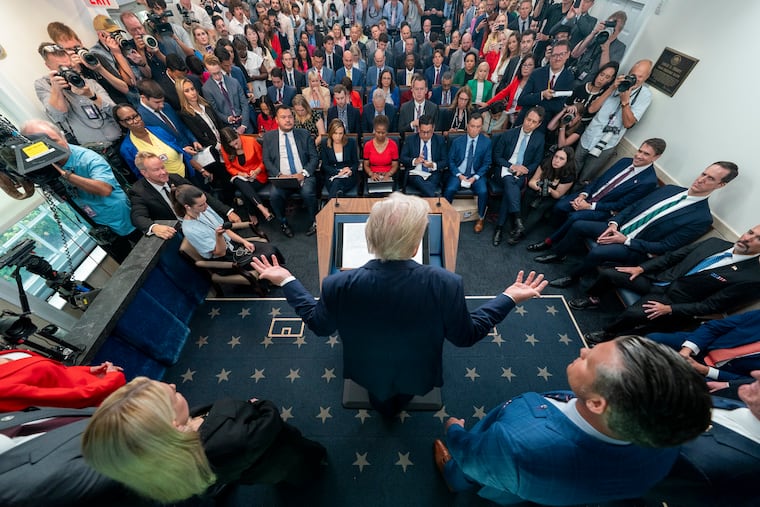
But on this, more than any Thanksgiving in memory, a free and independent American press seems in peril.
This Thanksgiving follows a year in which an American president has sued and collected multimillion-dollar personal damages from CBS’s 60 Minutes and forced the suspension of an outspoken late-night talk show host.
The current administration has orchestrated the virtual elimination of Voice of America and other vital U.S. international broadcasting and the defunding of NPR and PBS, among several other legal suits and regulatory intimidations.
What does not get printed is as important as what does. The palpable chill of partisan press criticism has meant the self-censorship of even some of the nation’s wealthiest newspaper owners.
It doesn’t have to be this way.
More than a decade ago, The Inquirer was purchased by the late H.F. “Gerry” Lenfest, a philanthropist and cable television pioneer, and donated to the nonpartisan Lenfest Institute for Journalism.
The Inquirer is now the largest American newspaper under nonprofit ownership. The newspaper remains editorially independent of its parent company to protect the very freedoms for which its owner stands.
» READ MORE: How local journalism empowers voters in an age of misinformation and political discord | Opinion
Thanks, in part, to this nonprofit structure, The Inquirer and its independent, high-impact journalism enjoy the funding support of individual donors, large and small, and of foundation and corporate contributors, both local and national.
It is said that “all politics is local,” and the same may be said of news. What happens in our nation or on our planet can often be best understood when reported from a local perspective.
The Inquirer, and the dynamic Philadelphia-area journalism scene of which it is a part, are a blessing for our city, our region, and our country.
Over the past year, a skilled, dedicated, and high-integrity group of women and men from The Inquirer, our region’s local TV stations, WHYY, WURD Radio, Impacto, the Philadelphia Tribune, Spotlight PA, and a diverse array of community news organizations have reported on the region’s biggest challenges: from the plight of our immigrant communities to solutions for gun violence, to economic mobility in what remains among the poorest big cities in America, to electoral politics in America’s largest swing state. This work saves lives, makes kids safer, and holds local and state government to account.
All those who report and edit the news, all who stand ready to defend their words in the courts or in the court of public opinion, everyone who helps fund great local journalism with their subscriptions or their donations, and all who read and act upon the vital insights of a free and independent local press deserve our thanks — and these days, our prayers.
Jim Friedlich is CEO and executive director of the Lenfest Institute for Journalism, the nonprofit organization that owns The Inquirer. @jimfriedlich