
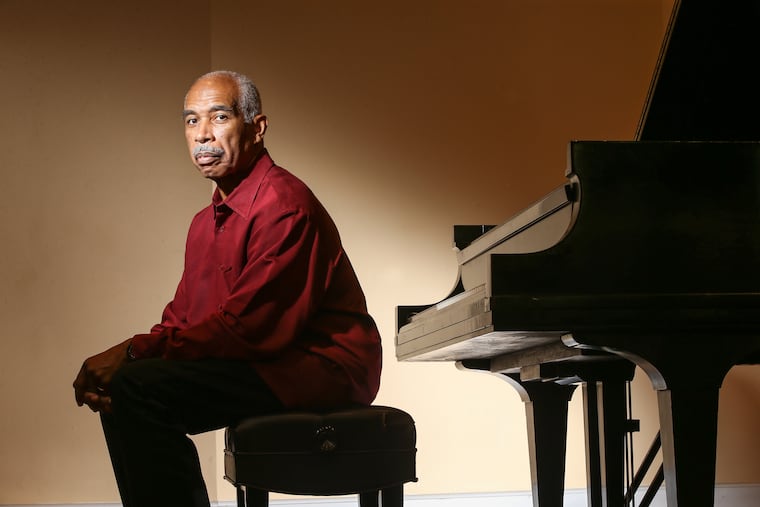
Concert pianist Leon Bates, whose musical authority and far-reaching versatility took him to the world’s greatest concert halls, died Nov. 21 after a seven-year decline from Parkinson’s disease. He was 76.
An articulate, charismatic presence, Mr. Bates was a Philadelphia born and educated pianist, and while growing up in Germantown, showed talent as early as age six.
He started formal study at Settlement Music School and graduated from Temple University’s Boyer College of Music, where he studied under the legendary Natalie Hinderas. In his final student recital, Mr. Bates played Ravel’s fearsome Gaspard de la Nuit.
As a leading figure in the generation of Black pianists who followed the early-1960s breakthrough of Andre Watts, Mr. Bates’ dream-come-true career encompassed Ravel, Gershwin, and Bartok over 10 concerts with the Philadelphia Orchestra between 1970 and 2002. He played three recitals with Philadelphia Chamber Music Society and taught master classes at Temple University, where he also gave recitals at the Temple Performing Arts Center.
Though he maintained residency in Philadelphia with his wife and three children in Mt. Airy, Mr. Bates toured the great concert halls of Europe, China, South Africa, and America, often playing 100 concerts a year. His forceful repertoire of Rachmaninoff and Liszt was partly enabled by his hobby — body building — and the stamina that came with it.
“What set Leon Bates apart was his genuine character and the way he focused on the music above all else. He impacted countless lives through his generosity, his example, and the depth of his artistry,” wrote his student of 10 years, pianist Dynasty Battles, on Instagram. Beyond that, added Battles, Mr. Bates showed him how every concert program could be “a journey” and that rich, “radical” elements in music were already there to be found.
Mr. Bates’ sense of communication was illustrated by how he embraced outdoor concert settings. In such acoustically risky circumstances, he performed at Chicago’s Grant Park, played Rhapsody in Blue in the July 4, 1995 Concert on the Parkway at the Philadelphia Museum of Art, and, with Duke Ellington Orchestra, had an audience of 20,000 at Rome’s Olympic Stadium.
In less-recreational settings, Mr. Bates’ Philadelphia Chamber Music Society programs were a high-style mixture of the lesser-known and the familiar: Edward MacDowell and Samuel Barber, for example, were followed by the mighty Liszt Sonata in B Minor.
Most adventurous of all was his 2018 recital that he did not personally perform due to his Parkinson’s diagnosis, but had students and other associates step in to play Ives and George Walker. In his prime, Mr. Bates premiered new works by living Black composers such as Walker’s Piano Sonata No. 3 and the Adolphus Hailstork Piano Concerto No. 1, in performances acclaimed for the same commitment he brought to masterworks of the past.
“When you really are involved in the process of making music, it’s something that’s with you when you’re sleeping, when you’re awake, when you’re relaxing, when you’re truly focused on working at the instrument,” he told Chicago-based journalist Brice Duffie during an in-depth 1991 interview. “It is the sum total of all of that time together that really produces what people get when they see the performer come out on stage.”
Besides being a fine pianist, Mr. Bates was also a great talker. He traveled with two prepared lectures — one on the 1954 Brown v. the Board of Education Supreme Court ruling that declared school segregation unconstitutional, and the other, titled “American Originals,” on modern American composers.
“Leon offered school shows where he often dressed in the local football team’s jersey. No suits or ties — just to connect visually with the students,” recalled his longtime agent Joanne Rile. In his WRTI-FM radio show titled Notes on Philadelphia during the 1990s, Mr. Bates was what Charles Abramovic, chair of the Temple University keyboard studies, described as “beautifully articulate and a wonderful interviewer. The warmth of personality came out. He was such a natural with that.”
And he was fun, says fellow-Philadelphia-born Lambert Orkis, now professor of piano at Temple, who was among the musicians interviewed on the show.
Even during interviews, the Bates body-building regimen didn’t let up with his squeezing a rubber ball for hand exercise, and inevitably exposing his impressive musculature.
When tapped to choose a Steinway piano to reside at the Temple Performing Arts Center, Mr. Bates “was looking for projection and power that were hallmarks of his playing,” recalls Abramovic. The Parkinson’s symptoms were noticed by others before he did — though he bore the onset of the disease with public dignity.
He declared, “My spirit is still there.”
Mr. Bates made numerous recordings and received an honorary doctorate from Washington and Lee University in Lexington, Va., as well as the Raoul Wallenberg Humanitarian Award from the Greater New York Wallenberg Committee.
He is survived by his wife of many years, Jocelyn; his three sons, Christopher, James, and Jock; and five grandchildren.
Details for a memorial service will be announced at a later date.