
Dan Johnson takes you through his preview, prediction, and pick for NFL Week 13’s Black Friday game between the Philadelphia Eagles and the Chicago Bears.
Black Friday in Philadelphia should be meaningful-football showcase & theater. Chicago walks in at 8-3, the new-blood contender that’s spent two months stealing one-score games. The Eagles match that 8-3 record but return home off a blown twenty-one point lead in Dallas. Lincoln Financial will feel like January anyway, with top-seed leverage hanging over every third down. For Chicago this becomes a measuring stick, and for Philadelphia it’s a sanity test on live television. Below is my prediction for NFL Week 13’s Black Friday game between the Philadelphia Eagles and the Chicago Bears.
Here’s how I’ll play it. I’ll be pumping out these predictions for individual games all season, with plenty of coverage here on DraftKings Network. Follow my handle @dansby_edits for more betting plays.
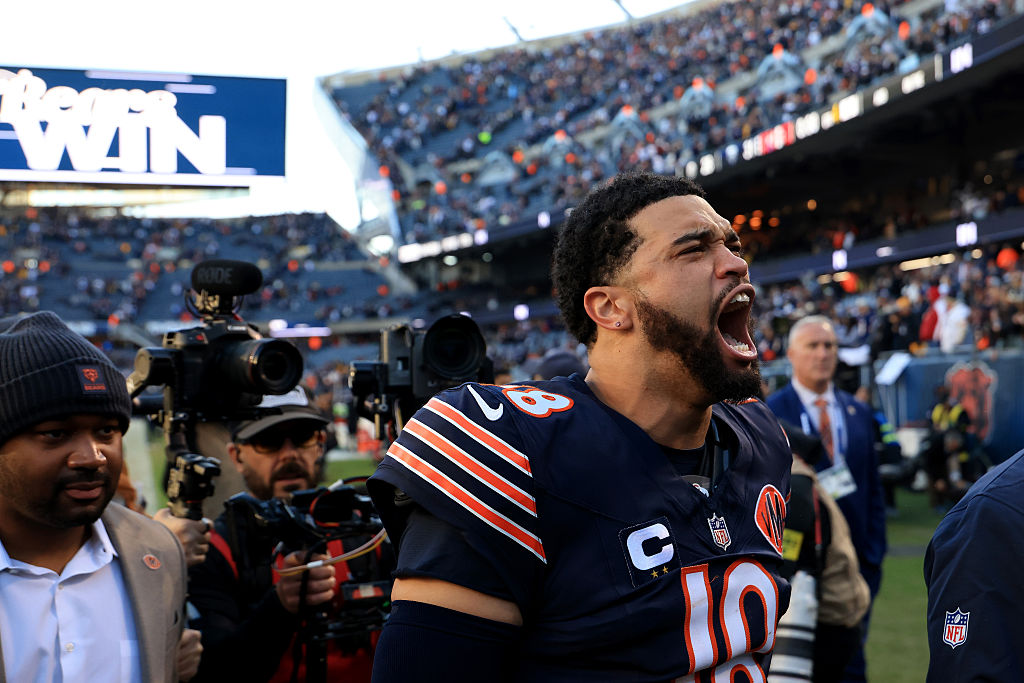
The starting point is Chicago’s offense against Vic Fangio’s defense, because that is where the number feels stretched. The Bears sit at +0.059 EPA per play with a 44.79% success rate, clearly more efficient than Philadelphia’s +0.020 and 41.86%. They run it at 4.8 yards per carry with 1,565 rushing yards and thirteen scores, good for +0.032 rush EPA, against an Eagles front that grades elite by rush EPA allowed but just endured a brutal, high-stress afternoon in Dallas. Caleb Williams has 2,568 passing yards with sixteen touchdown passes and four interceptions plus 293 rushing yards and three rushing scores, charting at +30.3 EPA with a 43.9% success rate while taking sacks on only 4.2% of pressured snaps. Rome Odunze, DJ Moore and Colston Loveland are all heavily positive by EPA, with Odunze at +66.6 and a wild 95.2% success rate on his touches, and the trio particularly punishes zone coverage where Fangio lives. When Chicago spreads the field it can still pivot into heavier looks with Loveland and Cole Kmet, which matters because the personnel splits show Philadelphia’s defense dominant versus eleven personnel at -0.06 EPA per snap but softer versus twelve at +0.10. That flexibility tracks with an offense that has lived around 397 yards per game over the last five, including a 576-yard eruption against Cincinnati.
On the other side, the Eagles’ case starts with Jalen Hurts’ clean efficiency and Chicago’s softer defensive profile. Hurts sits at 67.2% completions with 2,284 yards, seventeen touchdown passes and a single interception plus 298 rushing yards and eight rushing scores, grading at +36.4 EPA with a 44.3% success rate. Underneath that headline, the structure looks shakier: team rush EPA at -0.040, Saquon Barkley stuck at 3.7 yards per attempt with -21.9 EPA and only a 37.7% success rate, and an attack that has swung from +24.9 EPA against the Giants to -13.06 against the Lions within a month. Chicago’s defense is almost dead neutral at -0.003 EPA allowed with a 46.34% success rate allowed, but it generates pressure on 38.9% of dropbacks with a 6.1% sack rate and stacks real ball production from Tremaine Edmunds and Kevin Byard. Personnel data shows this group more vulnerable against eleven personnel, giving up 6.7 yards per snap and +0.04 EPA there, which aligns with DeVonta Smith, A.J. Brown and Dallas Goedert testing Tyrique Stevenson and Nahshon Wright outside. Smith and Brown should win plenty of isolated routes, but Hurts is facing pressure on 40.9% of dropbacks and taking sacks at a 7.5% clip, which keeps Chicago’s pass rush in the script.
Bears vs. Eagles pick, best bet
The strongest pushback toward Philadelphia is that the defense could close the entire gap by itself. The Eagles sit at -0.057 EPA allowed per play with a 43.08% success rate allowed, pairing a 49.2% pressure rate with corners like Quinyon Mitchell allowing just 42.4% completions on sixty-six targets. Their run defense lives at -0.062 EPA allowed, and if that four-man front wins early there is a very real scenario where D’Andre Swift and Kyle Monangai spend the afternoon in second and long. Chicago’s own coverage numbers for Stevenson and Wright include real damage in the end zone, exactly where Hurts, Brown and Goedert thrive on fades, slants and crossers. Philadelphia also has the building, the continuity and the urgency after giving away that massive early lead in Dallas, with top-seed equity and division control attached to a win. The clean Eagles argument boils down to the more mistake-free quarterback, the clearly better defense and the more proven sideline staff in a home environment.
The spread still looks a step too high when everything sits together. Chicago owns the better offensive EPA, the more efficient season-long rushing profile and the hotter quarterback over the last month, with Williams at +37.36 EPA in that stretch. Philadelphia’s ground attack is propped up by volume instead of efficiency, and Barkley’s negative EPA line matches what the tape has shown. Hurts is more precise throw for throw, but he is also under heavier pressure and more likely to take sacks behind a line that has already allowed twenty-seven. Pressure numbers point to the Bears handling heat better on offense and creating it consistently on defense, while Odunze, Moore and Loveland give multiple ways to punish Fangio’s zone-heavy structures. In a game with a total sitting in the mid-forties, asking an inconsistent offense with a negative rushing profile to win by more than a score against a live, explosive underdog feels rich. On paper it behaves more like a four-point gap than a full touchdown.
My card lands on the underdog. Bears +7, with Eagles 24, Bears 20.
Best bet: Bears +7 (-110) at Eagles
Tail it with me in the DKN Betting Group here!
For a prop lean, Colston Loveland 40+ receiving yards at +160 is the cleanest way to ride Chicago’s structural edge. He has twenty catches for three hundred yards and three touchdowns on twenty-five targets over the last five games, with a catch rate at eighty percent. Season-long, his +33.2 EPA and roughly seventy-nine percent success rate scream featured option as opposed to not auxiliary piece. Philadelphia’s defense locks down eleven personnel but leaks efficiency against twelve, where Loveland and Cole Kmet stay on together and force heavier bodies. Fangio’s split-safety shells and that 49.2% pressure rate encourage Caleb Williams to work seams and option routes between the numbers. Loveland already punishes zone looks with a mid-seventies catch rate and over three hundred yards into soft spots. At +160, and still attractive down to about +135, I would rather ride his intermediate volume than chase a streaky Eagles run game.
Best prop lean: Colston Loveland 40+ receiving yards (+160)
Tail it with me in the DKN Betting Group here!