
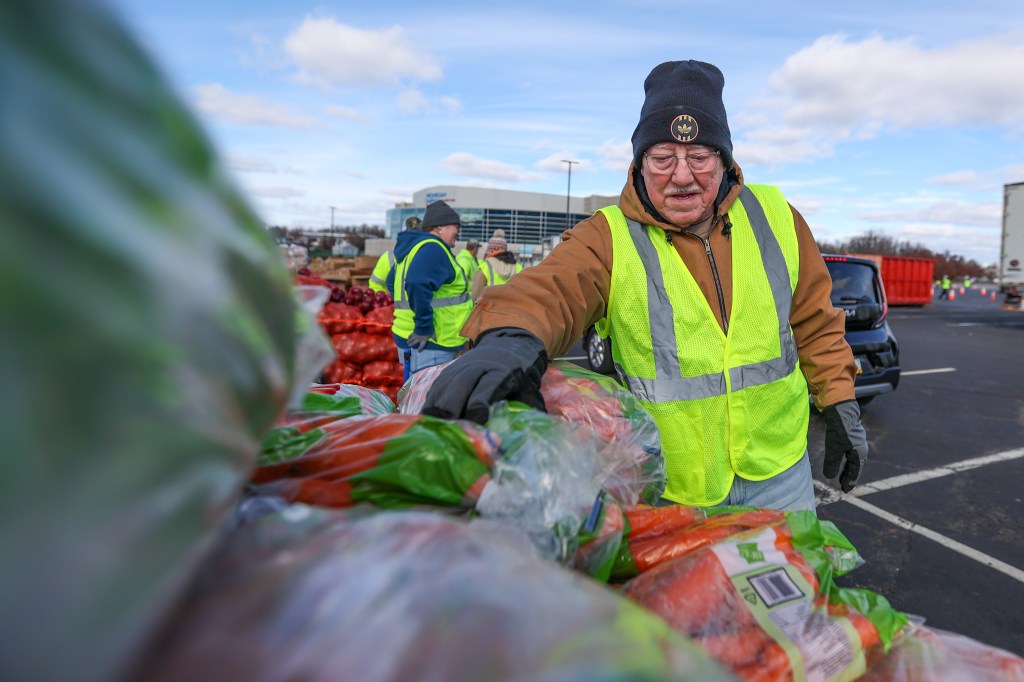
Seeing our friends and neighbors rally to assist those who are less fortunate inspires us most at this time of year.
In Scranton, volunteers with the Area Agency on Aging delivered free Thanksgiving dinners to homebound residents Tuesday, the Friends of the Poor packed food to deliver to needy families and Meals on Wheels earned a rare day in the spotlight for the invaluable work it does year-round preparing meals for our older neighbors who need them.
The day before, volunteers staffed a lunch sponsored by UFP Industries and the Schuylkill Technology Center for dozens of Pottsville residents in need at the Servants to All Homeless Center in Schuylkill County. In Luzerne County, it is certain plenty of minds were eased by the 46th annual Commission on Economic Opportunity Weinberg Northeast Food Bank Thanksgiving Project, which provided free Thanksgiving meals to local families looking to celebrate the holiday.
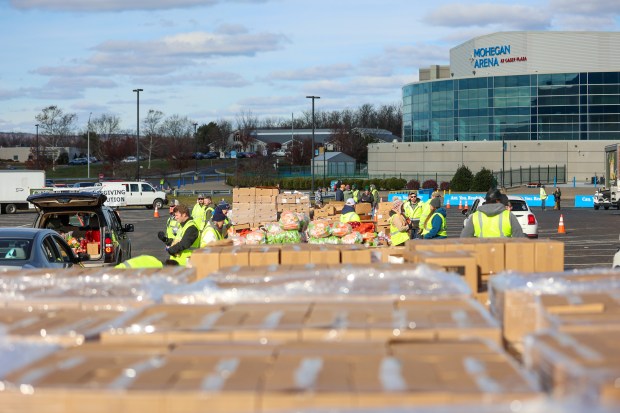 Volunteers distribute food during the 46th annual Thanksgiving Project Food Distribution at the Mohegan Arena in Wilkes-Barre Twp. on Tuesday, Nov. 18, 2025. (JASON ARDAN / STAFF PHOTOGRAPHER)
Cars began to line up at the Mohegan Arena in Wilkes-Barre Township before 7 a.m. on Nov. 18 for the scheduled 11 a.m. distribution to pick up their dinners, and there were three other pickup dates scheduled around Luzerne and Wyoming Counties the rest of the week to help accommodate about 10,600 families who signed up to participate in the project.
“Without something like this,” CEO executive director Jen Waraback told The Citizens’ Voice, “you’d have potentially thousands of families not having a Thanksgiving dinner. That’s why it’s important to us.”
Certainly, this represents a mere sampling of the good works being done throughout the area to feed the hungry as the holidays kick off.
We’re in the midst of the time of year for that kind of generosity — or, perhaps more fitting, generosity that kind. This is apt because we’re also firmly in the stretch of weeks when the need for it is at its greatest.
Demand for food assistance, around the region and the nation alike, is approaching record levels, if it hasn’t reached them already. The Thanksgiving Project, in fact, estimated a more than 32 percent increase in families who applied for the meals this year over 2024.
In a nation as wealthy as ours, food insecurity shouldn’t be the issue it is. But the recent disruption of services for Americans who rely on SNAP benefits caused a predictable rush on food banks just about everywhere, and there is no shortage of experts who believe demand is not going to slow anytime soon.
President Donald Trump’s One Big Beautiful Bill Act, signed into law on July 4, takes a hatchet to the federal contribution to social programs like SNAP and affordable housing. The OBBBA is expected to cut the federal contribution to SNAP by 20% — around $187 million — through 2034, according to the nonprofit Congressional Budget Office. It estimates that about 4 million people could lose food assistance, or see it cut substantially, over that time.
It’s an estimate and doesn’t take into account states who could kick in more from their coffers, or generate the income on their own, to supplement federal money lost. Gov. Josh Shapiro took a step toward that in October, making $5 million available for Pennsylvania food banks struggling to meet demands during the time SNAP benefits were threatening to dry up.
In short, experts fear common necessities likely are going to be more difficult for at-need citizens to come by in the coming months and years. Grocery costs are rising. Unless Congress acts, Medicaid is facing cuts and premiums for those who purchase their health insurance through the Affordable Care Act are expected to balloon in 2026.
Consider this a call for all who can help area food banks to do so, by doing whatever you can — from donating canned goods, to kicking in some money, to simply considering a volunteer role — to help food banks around the area that strive year-round to slow the hunger crisis.
But make no mistake, the government needs to do its part, from the state all the way to the feds. This is a national problem, and only focused, compassionate policy, and large-scale resources, can turn the tide over the long haul.