
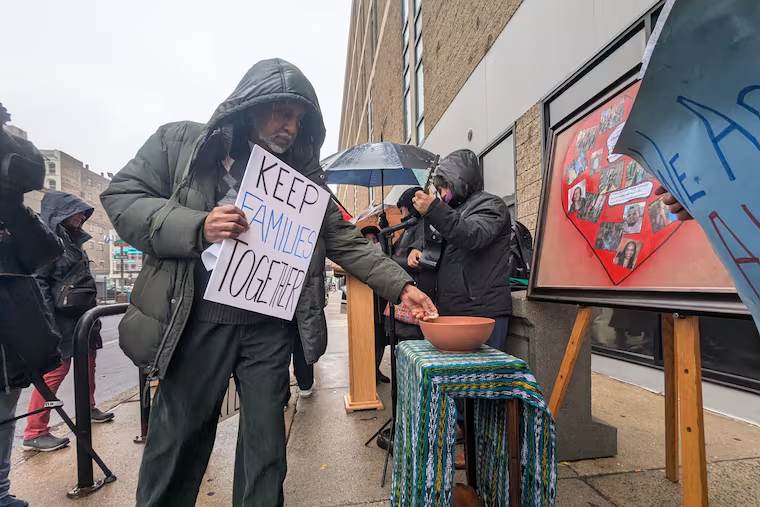
On a rainy Wednesday a week before Thanksgiving, members of the congregations of the Roman Catholic parishes of Holy Innocents and St. Joan of Arc gathered in front of the U.S. Immigration and Customs Enforcement office in Center City.
They stood vigil in witness to what the Rev. Christopher Neilson — the founder and president of Christianity for Living Ministries and founder and pastor of the Living Church at Philadelphia — calls “the core requirements God has for humanity”: act justly, love mercy, and walk humbly with God.
Another religious group appeared at ICE’s door near Eighth and Cherry Streets on the day before Thanksgiving. This time, it was an interfaith mix of folks led by Christianity for Living Ministries.
And there will be more. On Wednesdays to come, members of Mennonite Action, a couple of United Methodist churches, a Quaker meeting, two synagogues, a Presbyterian church, the Sisters of St. Joseph of Philadelphia and more Catholic parishes have all pledged to take part in a recurring demonstration that Neilson calls ICE Profest 40 — an ecumenical and interfaith action to oppose the government’s pitiless anti-immigrant crackdown slated to take place over 40 weeks. The word profest was coined by Neilson to mean “an amalgamation of faith expressed through proclamation, prayer, and protest.”
It’s easy for small, quiet acts like this to get lost in the din of all the outrageous actions coming from President Donald Trump and his administration, or amid the larger protests that draw millions of participants.
But organizers are hopeful that whatever their movement might lack in numbers, it more than makes up for in the power of their spiritual conviction — a conviction that is grounded in the Bible and other sacred texts.
“We proclaim God’s word of justice, mercy, and humility (Micah 6:8),” Neilson told me via email. “We pray for ICE agents and authorities (St. Matthew 5:44-45; St. Luke 3:24; 6:27-28; I Timothy 2:1-4), many of whom are conflicted and have crises of conscience. [We pray] for their courage, transformation, and turning, and for the protection and provision of the detainees and deportees, who are traumatized, from family separation and living in constant fear (Isaiah 1:17; Psalm 10:17-18; 82:3; St. Luke 4:18-19).”
“And,” he added, “we protest ICE activity, i.e., the orders ICE agents are given and the ways in which they are carried out, that dehumanizes and victimizes those created in the image and likeness of God [who] are our neighbors, and [which] disobeys and violates God’s command to welcome and love the stranger and alien (Leviticus 19:33-34; Deuteronomy 10:18-19; St. Matthew 25:31-46).”
The number of weeks — 40 — during which this will happen has biblical significance, Neilson said, as a period of transition from trial to transformation. (Think of the 40 days and 40 nights Jesus traveled in the wilderness before the crucifixion.)
For me, the timing of when ICE Profest 40 is gearing up is especially resonant.
We’re moving from Thanksgiving — a secular holiday which, in good years, I get to celebrate with a family that includes foreign-born and U.S.-born folks — into Advent.
» READ MORE: Our favorite charities to support this holiday season | Opinion
The beginning of the liturgical year is when Christians like me move from anticipation to action as we wait to celebrate the birth of Christ into a humble, migrant human family. I love the hush that precedes a world on the brink of transformation. I suspect that is why the quiet power of ICE Profest 40 actions moves me so deeply.
“The tone of these vigils is different,” Peter Pedemonti, the codirector of New Sanctuary Movement of Philadelphia, told me via email.
“They are not as loud as a protest, but they have the potential for big impact,” he said. “We are seeing people sign up who are new to public witness, and so they serve as an entry into collective action. This is important as we fight not only the attacks on immigrant communities, but also Trump’s rapid steps toward authoritarianism. We need everyone right now, and it is really important we have paths for new people to get involved.”
“I have been doing faith-rooted organizing for nearly 20 years. These spiritual tools we have work. We can’t always see the immediate impact, but I have seen them help win campaigns. And so I believe that when we bring them to ICE, we are engaging in something powerful,” Pedemonti added. “The religious community has an important role right now. We are the moral voice, and when we see Trump trample our faith teachings and our democracy, it is critical [that] faith communities speak out.”
While my own faith tradition has long had priests, religious men and women accompanying immigrants and advocating for their rights, the United States Conference of Catholic Bishops has been pretty circumspect about commenting on the Trump administration’s policies.
But that changed this November.
In a statement issued after the conference’s plenary meeting, the bishops wrote, “We oppose the indiscriminate mass deportation of people,” and soon thereafter, Pope Leo XIV expressed his wholehearted support for the bishops’ statement.
Leaders from many other faith traditions and denominations have, of course, also stood publicly with immigrant communities threatened by Trump’s policies.
» READ MORE: Sorry, MAGA Christians, you aren’t the only ones praying | Sabrina Vourvoulias
But for Catholics who supported Trump — 55% overall (62% of white Catholics, 41% of Hispanic Catholics), according to the Pew Research Center — the Catholic bishops’ statement could serve as a come-to-Jesus (heh!) moment.
It is certainly a clear call for transformation during this most transformative of seasons.
What can the birth of Christ mean to us Christians if we would deny people shelter near us simply because they are unknown to us, and from elsewhere? What can it mean if we don’t stand against the indiscriminate targeting of innocents? What can it mean if we justify killing people based on the mere prognostication of threat?
I won’t speak for other people of faith, but for me, those are questions that go beyond political affiliation or temporal power, and touch on the “act justly, love mercy, and walk humbly” core requirements Neilson referenced.
The timing of when ICE Profest 40 is gearing up is especially resonant.
On the first Sunday of Advent, one of the readings will be Isaiah’s proclamation that the people “shall beat their swords into plowshares, and their spears into pruning hooks; one nation shall not raise the sword against another, nor shall they train for war again,” and that throws me right back into the fact that both the Catholic bishops in their statement, and the Rev. Neilson in his description of the ICE Profest 40 vigils, reference ICE agents.
ICE agents aren’t wielding swords, of course, but they do carry firearms and other implements with which they smash the windows and doors of terrified immigrants. And with the proposal that military members could be “trained” by deployment to U.S. cities to support ICE and U.S. Customs and Border Protection agents, it’s not that much of a stretch to make Isaiah fit the moment.
» READ MORE: ‘Say it with me: Our government is forcibly disappearing people’ | Sabrina Vourvoulias
I’m going to confess something now. I’ve prayed often for immigrants, never for ICE agents. In fact, I bristled a bit when I heard the bishops equating the vilification immigrants have experienced with the vilification of ICE agents — no one has accused ICE agents of eating pets, or separated them from their families, or turned them from legally residing to unauthorized in a moment.
But, as we saw with this week’s shooting of two National Guard members in Washington, D.C., those who have been asked to carry out the administration’s ill-conceived and oppressive policies may also be endangered by them.
The shooting reminded me of what Pedemonti told me: “If we want ICE to see the humanity of those they are persecuting, then we need to model that and see the humanity of ICE agents.”
“We believe all people can change,” he added, “and so in the tradition of St. Óscar Romero, who called on soldiers in El Salvador’s authoritarian regime to put down their arms, we call for ICE agents to follow their conscience and refuse to follow orders, to leave people with their families, to leave the people in peace.”
I guess it’s time to broaden my prayers. Don’t get me wrong, my rosary (the one which, along with its crucifix and Our Lady of Guadalupe medallion, has monarch butterfly beads representing migrants) will still be in regular rotation with prayers for immigrant justice. But maybe the Romero quote with which I open my prayers using a niner that has his medallion will be different: I want to make a special appeal to soldiers, National Guard members, and policemen: Each of you is one of us.
The first candle we light at Advent represents hope, after all, and no matter how far away or unlikely the desired outcome appears, hope always leads to transformation.