
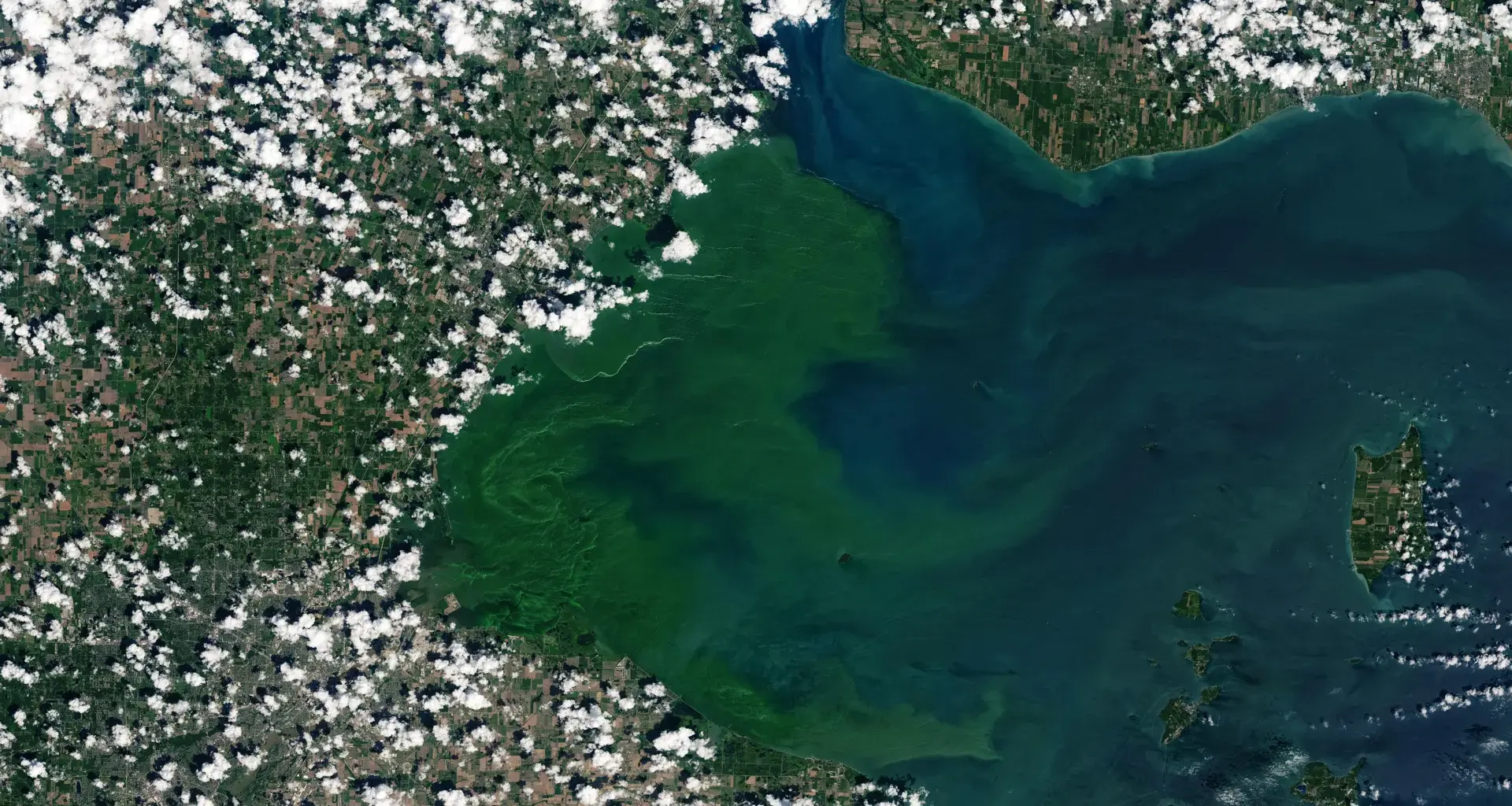
During the warm months, Lake Erie becomes an ideal setting for cyanobacteria, also known as blue-green algae, to grow rapidly. Under these conditions, the algae can form large blooms that release toxins at levels capable of harming both wildlife and people.
Researchers at the University of Michigan have now pinpointed the organism responsible for producing these toxins. Their work identifies a particular type of cyanobacteria, known as Dolichospermum, as the source.
Harmful algal blooms, or HABs, can consist of many cyanobacterial species, each capable of generating different toxins. Determining which species produces which toxin is important for monitoring, predicting, and managing bloom events.
Tracing the Source of Microcystin and Saxitoxin
A major bloom in 2014 generated the toxin microcystin and posed a serious threat to Toledo’s drinking water supply. Earlier, in 2007, scientists detected signs of an extremely strong toxin called saxitoxin in Lake Erie, although its biological source remained unknown. Saxitoxins belong to a group of closely related neurotoxins that are considered among the most powerful naturally occurring toxins.
“The main advantage of knowing which organism produces the toxin is that it helps us understand the conditions that cause toxin production — that is, what conditions make those organisms successful,” said Gregory Dick, professor of earth and environmental sciences and of environment and sustainability. “Such information can help guide policy and management, though we’re still a long way from that in this case.”
Using DNA Sequencing to Identify the Toxin Producer
To determine which organism was responsible for saxitoxin, the U-M team collected samples directly from HABs as they appeared in the lake. Lead author Paul Den Uyl applied “shotgun” sequencing, a technique that reads all DNA present in a water sample. With these sequences, he reconstructed a complete genome and then searched that genome for the genes involved in making saxitoxin.
Their analysis revealed several strains of Dolichospermum living in Lake Erie. However, only certain strains carried the ability to produce saxitoxin. While the reason for this difference is not yet clear, the researchers began examining the environmental conditions that may influence toxin production.
Environmental Clues in Temperature and Nutrient Levels
The team collected samples from multiple sites across Lake Erie throughout the year and measured how much of the saxitoxin-related gene appeared in each sample. They often detected higher levels of this gene in warmer water.
“That is interesting because we do know that the lakes are changing with climate change,” said Den Uyl, a scientist at U-M’s Cooperative Institute for Great Lakes Research, or CIGLR. “With the warming of the lakes, one of the big questions is, how is that going to change the biological communities, including harmful cyanobacterial blooms?”
They also observed that the gene linked to saxitoxin was less common in areas with elevated ammonium levels. The team suspects this pattern may relate to a distinctive characteristic of Dolichospermum: the presence of a gene that suggests it can use nitrogen in the form of dinitrogen, an abundant atmospheric gas. According to Dick, only a limited number of organisms can use nitrogen in this form, giving Dolichospermum a competitive advantage under certain conditions.
“One of the neat things about having the whole genome is you can see everything the organism can do, at least theoretically,” said Dick, who is also director of CIGLR. “You have the whole blueprint for what the organism can do, and we do see the capability of obtaining fixed nitrogen from the water. It’s just that getting it in the form of dinitrogen gas is kind of a superpower. Not a lot of organisms can do that, and it makes them more competitive under those conditions.”
Monitoring Long-Term Risks in a Changing Lake
According to the researchers, they have monitored saxitoxin in the lake for nine years, but this span is too short to determine whether toxin levels will rise as the climate continues to warm.
“But now that we know who’s producing it, I think we can keep a better watch on these organisms and we can also directly assess the gene abundance over time,” Dick said. “We plan to continue monitoring the abundance of this organism, but it’s too early to tell if it’s becoming more abundant. It’s just a correlation, but that correlation with temperature is concerning.”
Their study appears in the journal Environmental Science & Technology.