
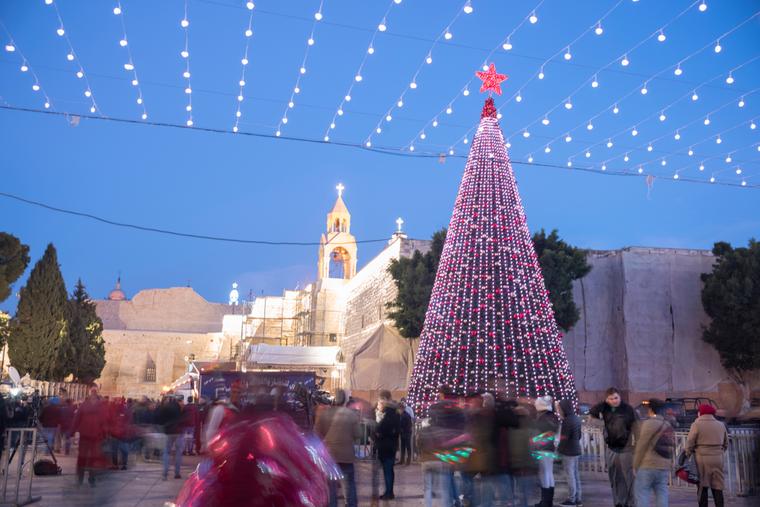
JERUSALEM — Following two years of subdued Christmas celebrations due to the ongoing Hamas-Israel war, this year the holiday will be celebrated in the Holy Land in all its splendor, especially in Bethlehem.
“The tree is already up and employees are working 24 hours a day to prepare for Christmas,” Bethlehem Deputy Mayor Lucy Talgieh told the Register. “After five years of COVID closures and then the war, we want to celebrate.”
The festivities will include a tree-lighting ceremony at Manger Square, and the streets leading to the square and the Church of the Nativity will be full of decorative lights. A full-blown holiday gift fair and a Christmas Eve choir will both be back this year. The annual Christmas Eve Jerusalem-to-Bethlehem procession led by the Latin patriarch, Cardinal Pierbattista Pizzaballa, which was so somber the past two years, is expected to be much more joyous.
The decision to restore the traditional public Christmas celebrations reflects the hope that the war in Gaza may be nearing an end, which in turn offers encouragement to Holy Land Christians, especially in Bethlehem, who have been facing a dire economic situation. Bethlehem’s fragile economy, and especially the local Christian community, are extremely dependent on pilgrimages. For the past century, the shops surrounding Manger Square, which sell beautiful hand-crafted mother-of pearl crosses and hand-carved Nativity scenes created by local Christian artisans, have supported entire extended families.
During the COVID closures and the war, almost every shop was shuttered, and most of the artisans closed their studios, perhaps permanently, for lack of pilgrims and relied on the internet.
Tourism was starting to recover from COVID closures when Hamas infiltrated Israel on Oct. 7, 2023, triggering the war with Israel. Overnight, virtually all foreign airlines canceled their flights to Tel Aviv, making it nearly impossible for visitors, including pilgrims, to visit. Even those who managed to come were barred from the West Bank by Israeli security closures.
In December 2023, the bishops of Christian churches in Jerusalem jointly called on all Christian parishes to cancel their public Christmas celebrations and to instead collect donations for war victims.
“We are not living in normal times,” the bishops wrote in the 2023 statement. “Therefore, we, the bishops and heads of churches in Jerusalem, call upon our parishes to set aside unnecessary celebrations this year.”
But a year later, the patriarchs and Church leaders admitted the restrictions had harmed local Christians.
“While our intentions [last year] were good,” Church officials wrote in a 2024 joint statement, “many around the world nevertheless misinterpreted this call to signify a ‘cancellation of Christmas’ in the Holy Land — the very place of our Lord’s Holy Nativity. Because of this, ‘our unique witness to the Christmas message of light emerging out of darkness’ (John 1:9) was diminished not only around the world, but also among our own people.”
Still, the Bethlehem municipality kept public celebrations to the bare minimum last year, in solidarity with Palestinians in Gaza.
This year will be different. With the blessing of the Palestinian Authority, which rules part of the West Bank, many of Bethlehem’s shops, restaurants and hotels will be open all of December and hopefully beyond.
“Pilgrims can expect safety and security here,” said Deputy Mayor Talgieh, who is Catholic.
Franciscan Father Rami Askarieh, a parish priest of Jerusalem, said the decision to allow Catholics to fully celebrate Christmas this year came from Cardinal Pizzaballa, the Latin patriarch of Jerusalem.
During a meeting in October, “the patriarch insisted we will celebrate Christmas just as Muslims celebrate Ramadan and Jews celebrate their feasts,” Father Askarieh said. “The people are exhausted by all the things that have happened here. They need a symbol of hope, a light in the darkness. Celebrating Christmas and peace gives them hope. He said we need to give this joy to all the people around us, both Christian and non-Christian.” Despite what people see on the nightly news, the atmosphere in Bethlehem and Jerusalem is peaceful. Nonetheless, amid the noticeable uptick of pilgrims in recent weeks, Bethlehem will continue to struggle until the parking lots near the Church of the Nativity are again full of tour buses. “Many pilgrims are waiting for signs of normalcy, but there are always tensions,” Askarieh said.
Elisa Leopold Moed, CEO of Travelujah, an Israel-based travel provider that arranges customized tours for Christian groups, said there is now “more interest” in coming to Israel than there has been since the war began. Although many airlines are now flying to Israel, she said, it is clearly too late for groups to book a trip for Christmas.
“The problem is that when groups wanted to book a flight months ago for the winter, you couldn’t get a group flight.”
Most groups book six to 12 months ahead, she explained. “Six months ago, there was a war with Iran.”
The good news is that round-trip group rates from North America have gone down considerably, from at least $2,000 per traveler to about $1,400 for much of 2026. While groups ask about safety, their biggest concern, Moed said, is whether they will be able to enter Bethlehem, which has been open to tourists for more than a year.
“The answer is that our groups are going into Bethlehem now. We go to the church, have lunch at a restaurant in Bethlehem and shop in Bethlehem. The tour operators are cooperating to make that happen. Bethlehem is open.”
Deputy Mayor Talgieh said Bethlehem is expecting at least 11,000 visitors for Christmas week. While that number may seem small, it is a sign of hope for the city’s residents.
“Bethlehem is the right place to celebrate Christmas,” she said. “With Jesus’ help, we will be reborn. We are looking forward to a better future.”