

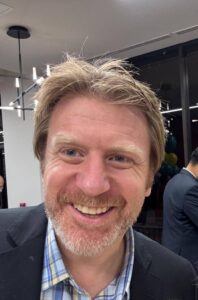
 Matthew Abelson. Courtesy of Matthew Abelson
Rabbi Matthew Abelson spent years working in the pro-Israel advocacy field, supporting his pulpit colleagues as they navigated conversations about the Jewish state. But Abelson realized he wanted to go back to the educational field, where he worked after graduating college.
He joined the Jack M. Barrack Hebrew Academy at the start of the 2025-2026 school year as a Jewish studies teacher, working with high schoolers.
The Lower Merion resident recently moved to the area for his new job and is integrating into the Philadelphia community professionally as an educator and personally as a member of Sha’arei Orah Congregation in Bala Cynwyd.
What made you interested in working in the Jewish professional field?
Growing up, we belonged to a Reform synagogue. I participated in Hebrew school basketball [and] in the Maccabi Games. As an undergraduate, I got very connected to Hillel in my junior year and just started to learn more about Judaism and Zionism in a way that became kind of a lifelong passion. And I think I’ve always felt a certain synergy with people in my community, and it made me want to be an educator, a leader for our community.
Are you from the Philadelphia area?
I am a New York transplant. I did serve as rabbi in Reading, Pennsylvania, when I was ordained in 2015, and I don’t think I realized how much of a gem the Greater Philadelphia Jewish community is. My wife and son and I feel very fortunate to be here. We love living here, and we’re really happy.
What’s it like teaching the next generation of Jewish kids?
Our young people are facing a more challenging world than I think many of us would have hoped they would be, meaning more challenging in terms of many factors than I think I and my parents’ generation experienced. I think they understand that, and they are courageous, and it’s an honor to be able to work with them. What I teach is comparative religion. I teach a class on Israel and Zionism. I teach a class on ethics and morality. I teach a class about the Hebrew Bible and the prophets. It’s been awesome.
What was it like transitioning from your old role into this new one?
The youth are overwhelming in the best way. I had worked with young people in the pulpit and tutored students for the b’nai mitzvah, but when you’re in a room with 18 students, 15 years old, there’s a way in which your attention is grabbed in so many different directions, and then it’s really an incredible experience to maneuver in that space and also try to teach content.
So there’s a level of stimulation, sometimes overstimulation, that’s really exciting at its best. It’s a really amazing experience when you get to actually impart knowledge in the midst of that.
Can you describe your teaching style?
The skill that was most beneficial to me in my education … is, are you able to not draw from your outside knowledge when you answer questions, but relearn subjects by interacting with a source? So, for example, you read the book of Samuel, and you read the verses, and from those verses you answer the questions that have been assigned. So there’s a formality to it that I think is a bit old-fashioned, but I think my students are adapting.
You played sports growing up. Has that passion continued with you today?
I’ve had sort of a rebirth in the last couple years. My wife turned me on to weight training, and I’d always done weightlifting, but it’s played a bigger role for me. And I have a mentor that I work with who is a big believer in strength training, in terms of fighting the aging process, which is a concern for me because I’m 45 and I can feel the differences. I’m still obviously young enough to be able to engage in sport and activity, but differently from when I was younger.
How has your relationship with sports changed?
It’s been a bit of a renaissance for me, and then my goal is to connect it to Judaism and try to develop a rabbinic teaching around it. I think this is an underdeveloped area where we know Jewish kids love sports, and they love watching sports and participating, but the synagogue and sports have sometimes been separate.
Yes, there are basketball leagues, like I mentioned. I grew up playing Hebrew school basketball through the synagogue, so I would love to develop some programming and some education around that.
How has your Jewish identity impacted you?
The connection that happens when you meet another Jewish person in the world has always been something I’ve remarked upon. I’m someone that grew up in a pretty integrated environment, in the sense of being in public schools and in a suburb, growing up among people of all backgrounds. But there’s a certain special experience of connecting with another Jewish person, and that has always been kind of notable for me.