
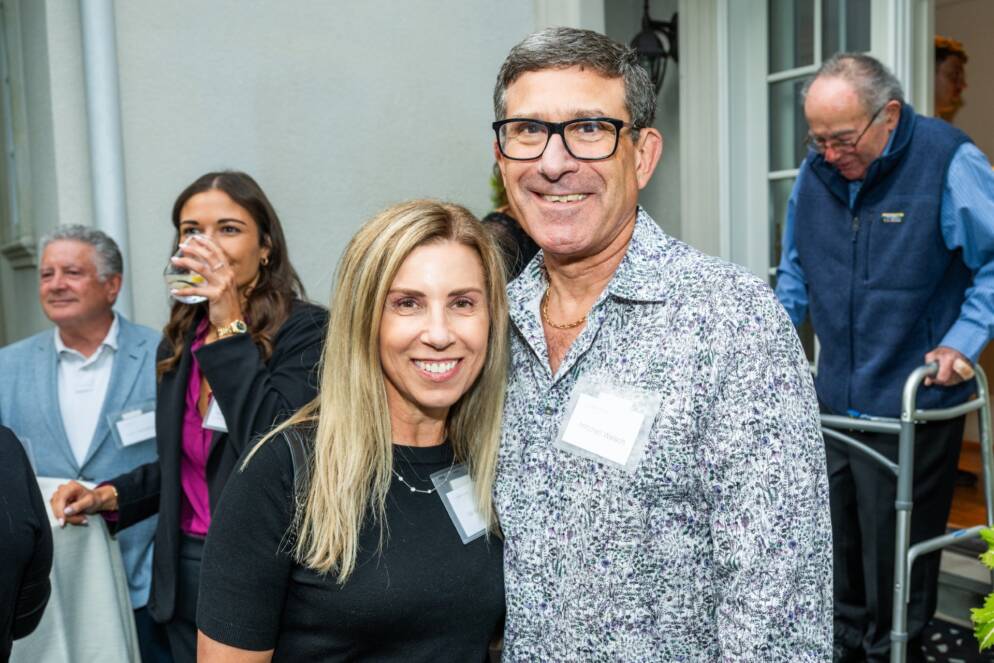
 The Bridge members Isa and Mitchell Welsch. (Photo credit: Jordan Cassway)
In 2008, four friends got together and gathered a group of 55 women to hear the stories of other women whose lives and finances had been thrown into disarray by the collapse of the housing market that year.
“People were dealing with financial crises from the economic downturn that they had never experienced before and so we knew we needed to respond,” said Pia Eisenberg, the chief business and resource development officer for the Jewish Family and Children’s Service of Greater Philadelphia. “The first thing we did was have a parlor meeting in someone’s home for women, and we called the parlor meeting ‘In Her Shoes.’”
That meeting, says Eisenberg, led to creation of a giving circle called The Bridge: A Critical Needs Funding Group. Nearly twenty years later, the group still exists, with each member contributing $1,800 per year to people or nonprofits agreed upon by the group.
“Collectively they are able to do so much more as a group than they would be doing as individuals,” Eisenberg says.
Giving circles have risen in popularity as a more community-focused type of philanthropy where a group of people pool their funds and donate periodically to people or nonprofits of their choosing.
According to a report published by The Association of Baltimore Area Grantmakers and the Maryland Philanthropy Network, during the late 1990s, giving circles emerged as a higher-engagement form of philanthropy. Donors who wanted to do more than simply write a check were looking for new ways to ensure their contributions made maximum impact.
What emerged from this need was two strategies. One was venture philanthropy. The other was giving circles. The latter trend was especially popular among women, African Americans and younger donors.
“[JFCS donors] have stayed with it from the very beginning. They love it,” Eisenberg said. “They feel empowered because they have a voice all year round. They feel engaged because we’re talking to them all year round. We’re not just asking for a gift once a year. They’re educated. They’re learning about the organization. … It’s emotional, because in the moment that someone needs a hand up, these members of the giving circle of The Bridge feel like they are truly partnering with this person to become stabilized.”
Philadelphia boasts a wide variety of giving circles that focus their funds on everything from women’s issues to teenagers to teachers. JFCS is unique because it doesn’t just have one giving circle – it has six.
The Bridge is just one impactful part of the organization. According to Eisenberg, it has raised about $582,000 since its inception.
“Because of the success of The Bridge, it has been replicated internally as well,” Eisenberg added. “All the dollars raised are put to use within our scope of programs and services.”
Another one of the giving circles, Seth’s Picks, stemmed from a mother who had lost her son, Seth, in a car accident. Seth loved sports, so that circle “is all about helping children experience like things outside of school, enrichment activities outside of school,” Eisenberg said. She added that Seth’s Picks has raised just under $300,000.
By no means are giving circles limited to Philadelphia. According to Philanthropy Together, today there are an estimated 4,000 active giving circles worldwide, 60% of which are women-centered.
In fact, Eisenberg said she has spoken around the country at other JFCS agencies about the success of Philadelphia’s giving circles.
“Just recently, the JFCS in Jacksonville started their own giving circle like this, and very quickly got 33 families to join,” she said. “It’s really been lovely to see how it’s replicated in other places. I once got a call from someone in Australia who heard about it, and that blew my mind.”
The JCFS of Greater Philadelphia’s other giving circles include a teenage philanthropy group called Teen Empowerment Program. Brianna Torres, volunteer manager at JFCS of Greater Philadelphia, said the program is her favorite to run.
“We’re meeting once a month, we’re talking about philanthropy, we’re talking about leadership, we’re talking about giving back values, and we’re also volunteering,” said Torres. “We’re really diving deep into what it means to be a philanthropist and to give back.”
According to Eisenberg, the Teen Empowerment Program has raised more than $145,000 – not as much as the other giving circles within JFCS, but highly impactful for both the recipients and the teens behind the donations.
“We explore Jewish values [and] how our values should really inform our giving,” said Torres. “They’re able to really experience what a gift to that program might mean by through volunteering.”
Most giving circles direct their donations to organizations. But for most of the JFCS giving circles, donations are given to individuals in need.
That, Eisenberg said, has led many participants to become more deeply involved in the Jewish community.
“Members of The Bridge are very eager to ask their friends to participate in something like this, because it’s such a meaningful experience,” Eisenberg said. “I like to say it’s been a wonderful portal into JFCS, and a lot of the members of this giving circle have gone on to chair our large annual event, they’ve gone on to become board members and board chairs of the organization. So, it has been all of these incredible byproducts that we didn’t imagine when we first were just trying to respond to a financial crisis in the Jewish community.”