
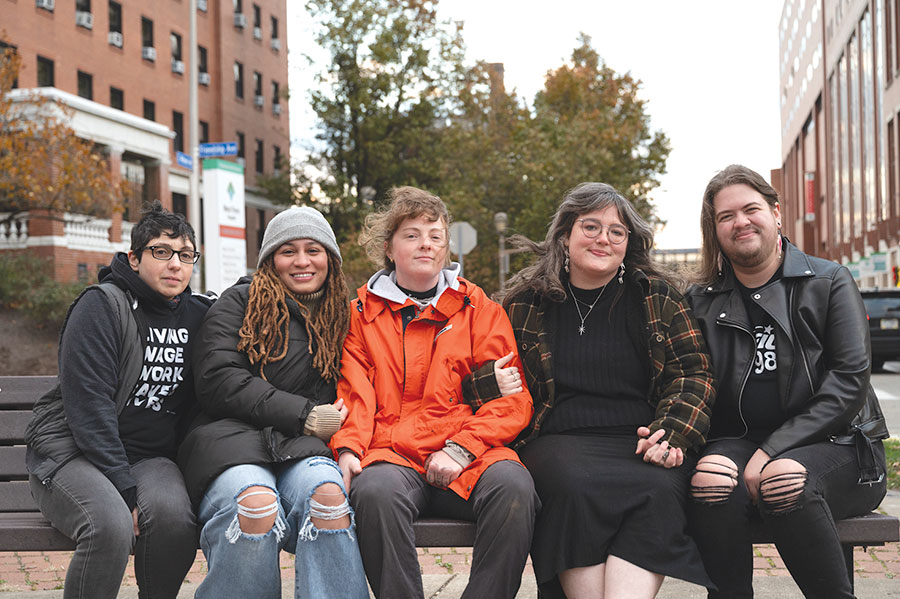
Since unionizing in June, workers at the Allegheny Reproductive Health Center (ARHC) have been holding the line. The newly-formed Allegheny Reproductive Justice Union (ARJU), affiliated with the Office and Professional Employees International Union (OPEIU), began bargaining for its first contract in August. Employees at the region’s only independent abortion clinic are negotiating for higher pay, healthcare, benefits including parental leave, codified gender inclusivity practices, and other protections.
“We’re really just asking for a fair seat at the table,” Noah Thompson, an observation technician and ARJU bargaining committee member, tells Pittsburgh City Paper.
In the three months since the bargaining process began, ARJU members say they’ve faced firings, stonewalling by management, a week-long clinic closure without pay, and a winnowed staff — shrinking their bargaining unit from 15 to eight people, says Thompson. Those fired have included longtime employees like Nikki Terney, who’d been planning ARHC’s 50-year anniversary celebration. (The union has filed Unfair Labor Practice charges with the National Labor Relations Board.)
Contract negotiations remain “slow-going,” and in the wake of unionization, workers have experienced what MA Raffaele, a front lead, intake specialist, and counselor, calls a wholesale “culture shift” at the previously “human-forward” clinic.
“It does feel like the carpet’s been ripped out from under our feet,” Raffaele tells City Paper. “There’s a lot of confusion on what is actually happening, and were those values [that ARHC espoused] even real?”
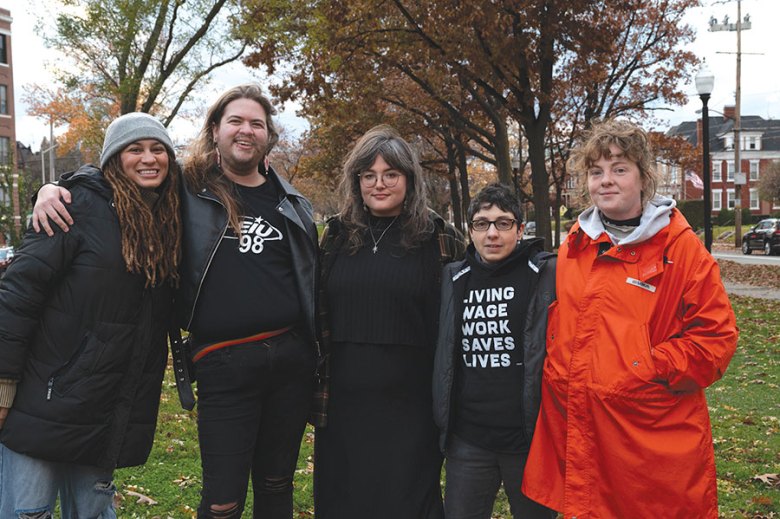 (L to R) ARHC union workers Raven Kirksey, Noah Thompson, Emily Quinn, M.A. Raffaele, and Katherine Yoho Credit: Mars Johnson
But the challenges have only hardened the union’s resolve, particularly in a time of restricted abortion access following the Dobbs v. Jackson Women’s Health Organization decision in 2022. ARHC is the only clinic in western Pennsylvania that provides surgical abortions up to the state legal limit of 23 weeks and six days of pregnancy.
“Pittsburgh is such an important access point,” Thompson says.
ARJU believes their recent experiences affirm the need for their union and underscore that improving their workplace conditions is a larger struggle that impacts patient care.
“We’re asking for living wages and fair working environments that everyone can thrive in,” says Monet Murphy, an observation technician, ultrasound assistant, and bargaining committee member. “We’re doing our best to maintain abortion access and still have rights for the employees [who] are doing their damnedest to make sure everybody gets the care that they need.”
As ARJU members await a contract, they’ve been heartened by an outpouring of community support, including from The Auto(nomous) Body Shop.
“We’ve made some really beautiful connections,” Emily Quinn, a counselor who left the clinic in November after five years, tells CP. “Even if the clinic is not providing the level of care that it should be, there are people in your community who will help you find that care … I still feel like I am in the abortion community of Pittsburgh, which is a beautiful place to be.”
“What we’re doing is important,” Quinn adds. “Everyone deserves fair, equal wages and support. As much as we relayed [those values] as a clinic to the patients, the people that work there are also part of the community, and it’s fair and normal to want to support that — and to work in a place that supports that.”
This article appears in The Big Winter Issue: Winter Guide/People of the Year.
RELATED