
Compiled by SUSAN JONES
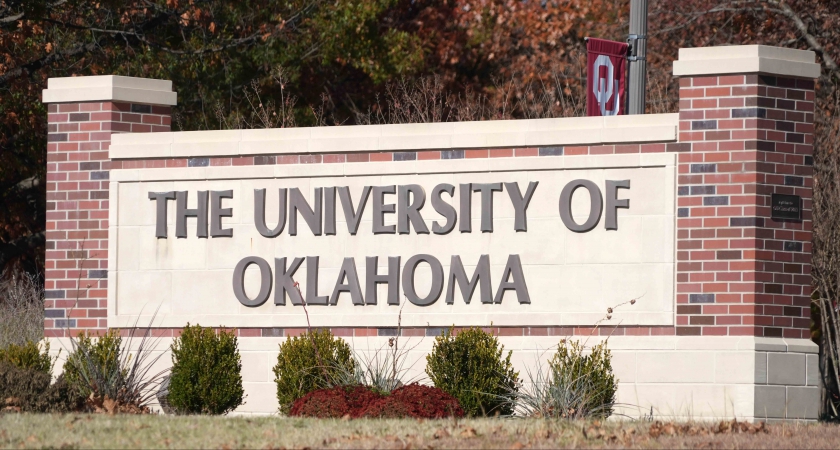
In late November, University of Oklahoma officials placed a graduate teaching assistant on leave after a student who was given a failing grade on a written assignment claimed she was discriminated against due to her religious beliefs.
Samantha Fulnecky, a junior psychology major at the university, was assigned in a psychology class to write an essay in response to an article about how people are perceived based on societal expectations of gender. Her response focused on her interpretations of the Bible and the ways in which she disagreed with the article.
Fulnecky’s instructor, Mel Curth, said she gave Fulnecky a zero because she submitted “a reaction paper that does not answer the questions for this assignment, contradicts itself, heavily uses personal ideology over empirical evidence in a scientific class, and is at times offensive.” Read the assignment instructions, essay and response in The Oklahoman.
The Freedom From Religion Foundation is now calling for Curth to be immediately reinstated. “The student was not persecuted for her faith. She was penalized for not properly completing the assignment,” says foundation legal counsel Chris Line. “Academic standards aren’t anti-Christian.”
DEC. 1:
Texas Tech University System Chancellor Brandon Creighton imposed restrictions on how faculty discuss race, sex, gender identity and sexual orientation in classrooms and introduced a new course content approval process, underlining that instructors could face discipline for not complying, according to the Texas Tribune. In a memo to university presidents, Creighton said instructors may not promote that “one race or sex is inherently superior to another; an individual, by virtue or race or sex, is inherently racist, sexist or oppressive, consciously or unconsciously; any person should be discriminated against or receive adverse treatment because of race or sex; moral character or worth is determined by race or sex; individuals bear responsibility or guilt for actions of others of the same race or sex; or meritocracy or a strong work ethic are racist, sexist or constructs of oppression.”
The University of Alabama has ended publication of two student-run magazines, one focused on women and the other on Black students, in order to comply with legal obligations, officials say. Local and student media reported that Steven Hood, the university’s vice president for student life, said that because the magazines target specific groups, they’re what the Department of Justice considers “unlawful proxies” for discrimination. Both publications received university funding.
NOV. 30: A recent NBC News poll found that just 33% of respondents believe a four-year degree is worth the investment due to improved job prospects and lifetime earnings, while 63% contend that graduates too often leave campus burdened with substantial debt but lacking specific job skills. This represents a dramatic shift from 2017, when Americans were nearly evenly divided on the question, and from 2013, when 53% viewed degrees as worthwhile investments.
NOV. 28:
Northwestern University agreed to pay $75 million to the Trump administration over three years and make policy changes in exchange for regaining access to roughly $790 million in federal research funding, Higher Ed Dive reported. The Chicago-area university also agreed to provide the federal government with detailed admissions data, end diversity statements in hiring, and ask international applicants why they’re seeking to study in the U.S, among other requirements. And the university canceled an agreement struck with pro-Palestinian protesters last year to end their five-day encampment on campus.
California State University trustees have approved substantial pay increases for top administrators despite widespread faculty layoffs and a $2.3 billion budget shortfall, sparking fierce criticism from faculty unions and state lawmakers. The policy change eliminates salary caps for CSU presidents, vice chancellors and Chancellor Mildred García, while introducing performance bonuses up to 15% of base salary and enhanced retirement benefits. President salaries will increase between $22,000 and more than $100,000, with housing allowances rising to $60,000-$80,000.
NOV. 26:
The University of Chicago cut its 2025 budget deficit by about 44% to $160 million after years of belt-tightening measures amid financial headwinds, it announced last week. The private nonprofit’s operating loss fell by over half to $86.4 million, per its latest financials. “We substantially outperformed our plan for the year,” said Ivan Samstein, the university’s chief financial officer, in a statement. “This is no reason for overconfidence — we still have a lot more work to do. But it is a very good start.” The University of Chicago unveiled a range of budget cuts earlier this year, including a plan to eliminate 100 to 150 staff jobs, reduce doctoral student numbers and scale back capital spending.
Ohio State University is discontinuing eight academic programs and proposing to consolidate several others to comply with Ohio’s higher education reform legislation that took effect this summer, according to Edu Ledger. The university will eliminate majors in integrated mathematics and English, medieval and renaissance studies, music theory, musicology, biochemical sciences, landscape horticulture and two sustainable agriculture programs, according to a report approved by the institution’s Academic Affairs and Student Life Committee.
NOV. 25: The Trump administration has opened a new investigation into protests at UC Berkeley that occurred last month in opposition to an event hosted by Turning Point USA, a conservative group founded by Charlie Kirk, who was assassinated in September, according to EdSource. The probe by the U.S. Department of Education will review whether UC Berkeley violated the Clery Act. The federal law, enacted in 1990, requires colleges to report campus crime data and to give timely warnings of crimes that pose a threat. The U.S. Department of Justice was already investigating the Nov. 10 protests, which occurred outside Zellerbach Hall on the campus’s Sproul Plaza. According to the Los Angeles Times, protesters showed up outside the event, leading to clashes between them and attendees.
NOV. 24:
As Duke University navigates a $108 million federal research funding freeze and multiple investigations by the Trump administration, administrators want faculty to avoid talking to the media about institutional operations, The Chronicle, Duke’s student newspaper reported. According to an August email obtained by The Chronicle, Jenny Edmonds, associate dean of communications and marketing at Duke’s Sanford School of Public Policy, encouraged faculty to “continue to engage with the media to disseminate (their) research as (they) have always done,” while also cautioning that “media attention to institutions of higher education and discussions about institutional responses to policy changes have become more prominent than ever.”
The Trump administration asked a Pennsylvania court to compel the University of Pennsylvania to turn over the names and contact information of some Jewish employees and students. In recent days, students, faculty members, on-campus Jewish groups and others have rallied around Penn officials’ decision not to disclose the information. As of Nov. 24, an Action Network petition started by Penn faculty members asking students, alumni and employees to “stand with Penn in its brave and necessary stance” had received hundreds of signatures.
NOV. 22: A University of Oklahoma professor was arrested by immigration officials at an airport, marking the first publicly known instance of a tenure-track faculty member landing on ICE’s radar this year. He was released on Nov. 24. But it remains unclear why the professor, who is from Iran and has been teaching in the United States for over a decade, became a target.
NOV. 21: State University System of Florida institutions collectively plan to terminate 18 academic programs and suspend another eight after reviewing how many degrees they award, Emily Sikes, the public system’s vice chancellor for academic and student affairs, said at a meeting with lawmakers. In the review, officials identified 214 programs systemwide that they say are underperforming based on how many graduates they’ve produced in the past three years. System universities plan to continue at least 150 of those programs while consolidating another 30.
NOV. 20:
Virginia Tech students staged a protest after the university announced it has reallocated $8.4 million in diversity, equity and inclusion expenditures, including the the planned 2026 closure of Ujima, a living learning community with an Africana studies focus, and Lavender House, an LGBTQ+ studies-focused LLC. Two additional LLCs — Orion, a sciences program, and Rhizome, focused on local approaches to global challenges — will also close, affecting roughly 500 students total. The cuts, reported during a Virginia Tech Board of Visitors meeting, come as the institution continues scrutinizing its programs to comply with the Trump administration’s efforts to eliminate DEI initiatives from American colleges and universities.
Indiana may reject proposed degree programs at public institutions that don’t “cultivate civic responsibility and commitment to the core values of American society.” Last month, the Indiana Commission for Higher Education introduced a question on “civic responsibility and commitment” in its new degree proposal form, Indiana Public Media reported.
NOV. 19: The National Science Foundation and National Institutes of Health doled out about as much total grant funding in the recently ended fiscal year as they did the year before, despite the Trump administration’s “unprecedented” earlier slowdown of federal science funding, Science reported. According to the journal’s analysis, “NSF committed approximately $8.17 billion to grants, fellowships, and other funding mechanisms in the 2025 fiscal year, about the same as in 2024.” It found that NIH spending also remained level during the fiscal year that ended Sept. 30.
Susan Jones is editor of the University Times. Reach her at suejones@pitt.edu or 724-244-4042.
Have a story idea or news to share? Share it with the University Times.
Follow the University Times on Twitter and Facebook.