
For decades, a community of companies focused on a niche tech has been brewing in central Pennsylvania. Now, the ecosystem is ready to level up.
Informally known as Sensor Valley, six counties are formalizing a coalition that brings resources to the sensor tech ecosystem. But first, economic development orgs need to spread the word that this industry exists in Pennsylvania, especially after years of being overshadowed by Philly and Pittsburgh’s reputations, said Noelle Long, director of export development at SEDA Council of Governments (COG).
“These companies have operated in isolation, and so they all have specific needs, and they could all benefit from cross-pollination.”
Todd Erdley, central regional director at Ben Franklin Technology Partners
That’s where snappy branding, flexing academic partnerships and facilitating collaborations between companies come in.
“The strengths here in central PA that sometimes get overlooked,” Todd Dolbin, vice president of economic development at the Chamber of Business and Industry Centre County, told Technical.ly. “But we have a lot of special things happening here, and getting the word out is something that would be really beneficial for not just our region, but for the whole state.”
Those strengths include a consistent relationship with the local university Penn State and resources for local startups.
Sensor technology detects and measures factors like temperature, pressure, motion or sound. They’re used in many fields, such as manufacturing, transportation and healthcare. Ultrasonic sensors measure distance using sound waves and are commonly used to see what’s happening inside the body, for example.
The region has about 60 sensor-related companies and the market for this technology is expected to increase by 10% over the next eight years, according to a report put out by the Chamber of Business and Industry Centre County. It’s a market worth $31 billion in the United States.
Sensor Valley wants to gain notoriety similar to the life sciences industry in Philly, which had $4.7 billion in economic impact in 2023, and the robotics scene in Pittsburgh, which contributed to $3 billion in tech funding that same year.
The thought process behind efforts to formalize the Central PA cluster is that stakeholders coming together will communicate what they need and help each other. That will lead to more resources for companies and more success stories in the region.
As Sensor Valley develops that reputation, the hope is that companies from outside the region will want to come there and work with local stakeholders.
“Our goal over the next few [years] is growing the message, increasing companies, attracting companies, attracting workforce, retaining workforce, better connections with the university,” Dolbin said, “to really make this area a gem.”
Penn State sets the foundation
Like in Philly and Pittsburgh, relationships with universities are also an important factor in economic development. Centre County and the surrounding area largely relies on Penn State, Dolbin said.
In the early 1900s, Penn State started to build up its capacity for materials science research. This work complemented the wave of companies popping up in the region during the 1950s and ‘60s.
Today, companies work with the university to use lab space and equipment to help develop products or solve manufacturing challenges, said Dave Fecko, director of MRI industry collaborations at the Penn State Materials Research Institute.
“You have the combination of a concentration of people with like-minded ideas,” Todd Erdley, central regional director at Ben Franklin Technology Partners, said. “You have a forcing function as far as Penn State with material science … and then you have the ability to tap into a strong workforce with low cost of labor.”
A major electronics company enters the scene
One success story is Echo Ultrasound.
The company’s founder Gene Larson started it in a trailer in Lewistown, Pennsylvania, and eventually grew it to a full manufacturing facility in Reedsville. The company was acquired multiple times before finally being purchased by Philips Ultrasound in 1998.
Echo is also an example of an established company that had employees who left to start their own venture, contributing to the industry’s natural growth, Erdley said.
Even though Philips is a global company, its presence in the United States is largely concentrated in Pennsylvania.
Philips recently moved all of its United States systems manufacturing to Reedsville, doubling down on the region, Scott Roycroft, operations material manager for Philips Ultrasound, told Technical.ly.
“[Philips] recognized the value of having the research and development, the intellectual property and the manufacturing capabilities that we had,” Roycroft said, “and decided they were going to have that for themselves.”
The ultimate goal? Increase cash flow
The efforts to formalize the cluster aim to accelerate progress for the industry and open more doors for local companies, said Long, from SEDA-COG.
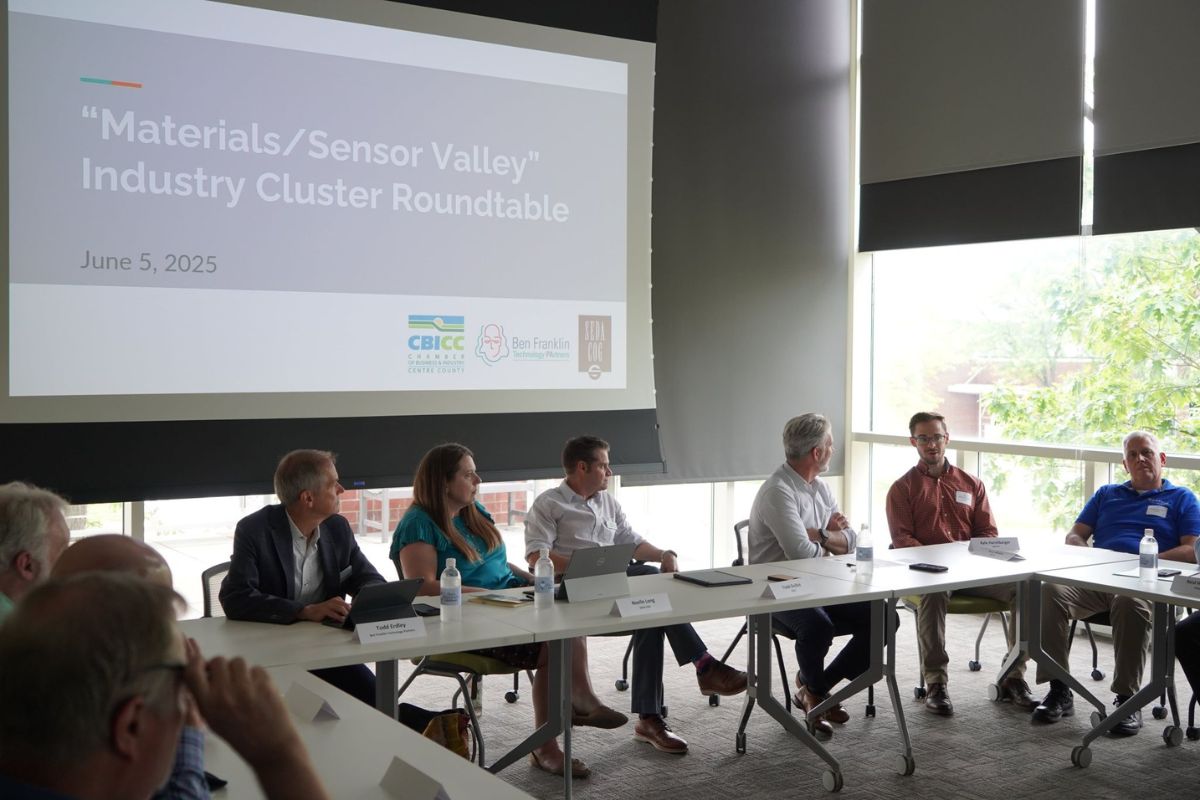
The Sensor Valley cluster has had two roundtable meetings so far, one over the summer and one in the fall. The first meeting brought together about 20 local sensor tech businesses to chat about the strengths and challenges they see in the region, Dolbin, from the Chamber of Business and Industry Centre County, said.
Companies said they want more connections with educators to strengthen their workforce pipeline, links with the local supply chain and visibility as an industry in the region, he said.
Eventually, the region wants to develop more resources, like an accelerator and more opportunities for growth capital, said Erdley, from Ben Franklin. These resources will continue the momentum that makes the region a desirable place to operate a company.
The region’s economic development orgs are also pursuing state and federal funding opportunities to grow the cluster and create more resources, Dolbin said.
The money would help amplify the region, address resource needs and connect companies with capital that will help keep startups in central Pennsylvania, according to Erdley.
“These companies have operated in isolation, and so they all have specific needs, and they could all benefit from cross-pollination,” Erdley said. “So as you start to bring them together, you start to hear about critical needs that they want.”
This story is made possible thanks to support from Ben Franklin Technology Partners of Southeastern Pennsylvania, a nonprofit that leads the Philadelphia region’s equitable economic growth by nurturing and investing in innovative, early-stage companies, and through purposeful involvement in regional and national initiatives.