
March 12, 1957, does not stand out particularly as a date in Cold War American history. Egypt was talking about moving on Gaza, and Ralph Bunche and Dag Hammarskjold at the U.N. were trying to talk Nassar out of it. President Eisenhower was meeting with the Democratic leaders of the Congress to talk about the federal budget. Arctic explorer Admiral Byrd had just passed away at age 68.
But one thing did hover over all of this. The Director of Civil Defense, Val Peterson, explained in the New York Times that day to readers why he needed $32 billion for nuclear fallout shelters. “In a thermonuclear war, there are no means of saving all the people. It simply cannot be done; we are going to lose millions of people if we have a war. We believe in shelters. We don’t want to mislead the people but there is no answer to this thing except to have peace.”
What made that day special in the eyes of the community leadership in Allentown was that there was a special guest coming to the city. Movie star and now host of the popular General Electric Theater television program Ronald Reagan was visiting and addressing them. It was not, after all, every day that you got a chance to see a movie star.

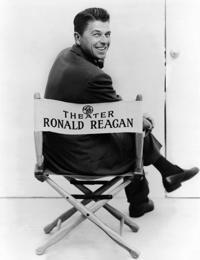
Ronald Reagan in General Electric Theater
Ronald Reagan Library
Television was one distraction from possible nuclear war. Quiz shows, at least until they broke into scandal in 1959, were one way to do that. Another was dramas, so-called soap operas and westerns. Popular in radio days, people were drawn to them. And those who had heard favorite programs with performers like Jack Benny were attracted to seeing them on the small black and white screen. Color television was out there but it was expensive, and few programs were broadcast in color until the mid-1960s.
From the Mickey Mouse Club for the Baby Boomer generation to American Bandstand for the teenagers to westerns like Gun Smoke and Broken Arrow for adults, television programs had become America’s chief form of entertainment.
And of course, there was ELVIS who that year made his final appearance on Ed Sullivan, had two concerts in Canada and made two movies, “Loving You” and “Jailhouse Rock”. He also purchased and moved into Graceland that year. That December Elvis would get his draft notice, much to the consternation of his many fans.
But critics were complaining about the low level of entertainment on what intellectuals of the day had already christened the “idiot box.” Into this gap stepped adult drama like that put on by United States Steel Hour (1953-1963). Sometimes known as “anthology dramas” or “kitchen sink dramas,” they were hailed by critics and for a time attracted wide audiences.
General Electric Theater began on the radio in 1953 and switched over to television later that same year. It was called an anthology program that offered a mix of drama and comedy. An alphabetical list of the many who appeared there printed by Wikipedia goes from Bud Abbott to Keenan Wynn.
On September 26, 1954, Reagan debuted as the one and only host for the program. Reagan was certainly not unknown to movie audiences. He had made several well-received films both before and after World War II. His role in 1951’s comedy “Bedtime for Bonzo” that featured a chimp was sometimes used to stereotype a typical Reagan film. Apparently, this did not bother him as later, according to one source, he had it shown at Camp David when he was president.
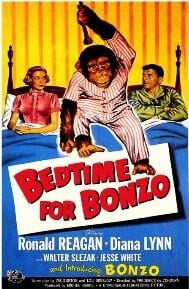
Movie poster for Bedtime for Bonzo, 1951
But the GE Theater gave Reagan exposure that he could not have gotten any other way. In 1956-57 the program’s Nielsen ratings were at #3, the highest they would ever be. But there was another side to Reagan’s employment with GE that would give him even greater exposure.
“Reagan’s contract with GE,” notes the Wikipedia entry about the program, “also entitled work as a motivational speaker for the company. After eight years as host, Reagan estimated he had visited 135 GE research and manufacturing facilities and met over 250,000 people. During that time, he would speak at other forums such as Rotary Clubs and Moose Lodges, presenting views on economic progress that in form and content were often like what he said on introductions, segues and closing comments on the show as a spokesman for GE.”
One of these appearances brought Ronald Reagan to the General Electric facility on South 12th Street in Allentown. He was greeted by rainless skies and temperatures in the 50s, warm for that time of year. According to “Allentown History 1765-1987,” General Electric took over the property in May of 1946 to manufacture small appliances, particularly toasters.
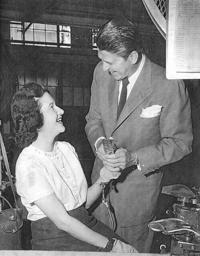
Ronald Reagan visits Allentown’s General Electric plant on March 12, 1957.
Part of the former American-Armament, the factory had been taken over by Consolidated-Vultee, which built during World War II the Sea-Wolf torpedo bomber for the Navy. The facility had been declared surplus by the Reconstruction Finance Corporation and was bid on by Roller-Smith, a Bethlehem manufacturer of electric equipment, and GE. Roller-Smith withdrew from the competition when it was assured of other space for expansion.
“Ronald Reagan, in the role of diplomat without portfolio for the film industry,” began the Morning Call’s story the next day, “scored a hit with his lines yesterday in his address to the manufacturers division of the Allentown Chamber of Commerce…The popular, handsome actor visited the small toaster division and was asked by some of the employees what sort of programs they would like to see next on the GE theater.”
Reagan commented that people don’t want to see “arty” productions, they want to see programs with a beginning, a middle and an end. “They are not interested in being used as subjects for experimental programs on T.V. People tell me what they like, and it is guide to what they see on television.”
Later Reagan travelled out to the Lehigh Valley Dairy building on MacArthur Road and its auditorium where he addressed 200 members of the Allentown Chamber of Commerce at a luncheon. Here he was introduced by Clifford A. Flower of Emmaus, Allentown GE’s plant manager.
In an address he spoke mostly about the film industry, which he claimed was responsible for giving $3 billion to the national economy. He added that 70 percent of the movies seen around the world were American made. “We have done this without any taxes or duties.”
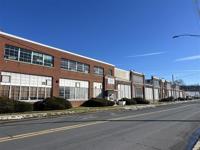
Former General Electric facility on Allentown’s S. 12th St.
Jenny McCain, WFMZ
It is not known how much longer Reagan stayed in the Lehigh Valley. But he did let it be known that his next stop was York.