
SCRANTON — PPL Electric Utilities customers and public officials from throughout Lackawanna and Luzerne counties voiced strong opposition against a proposed rate hike that would raise the average residential bill by roughly 7%.
The comments were heard during a public hearing organized by the Pennsylvania Public Utility Commission Monday night at the University of Scranton’s Brennan Hall.
PPL Electric Utilities, which provides electricity to about 1.5 million customers in 29 counties in eastern and central Pennsylvania, in September filed notice of its intention to hike its rates, effective Dec. 1, in an effort to generate an annual revenue increase of $356.3 million.
However, in October, the Pennsylvania Public Utility Commission voted to suspend and investigate the proposed rate increase by PPL. The move prompted the PUC to organize seven in-person and telephonic hearings to gather public input.
In addition to hearings in Catasauqua, Harrisburg, and Lancaster throughout the month, a session will be held at Wilkes University’s Henry Student Center, 84 W. South St., Dec. 18 at 6 p.m.
According to the PUC, the change would increase the total monthly bill for an average residential customer using 918 kilowatt-hours from $177.01 to $189.40.
A final PUC decision on whether to adopt, reject, or modify PPL’s rate increase request is due by July 1.

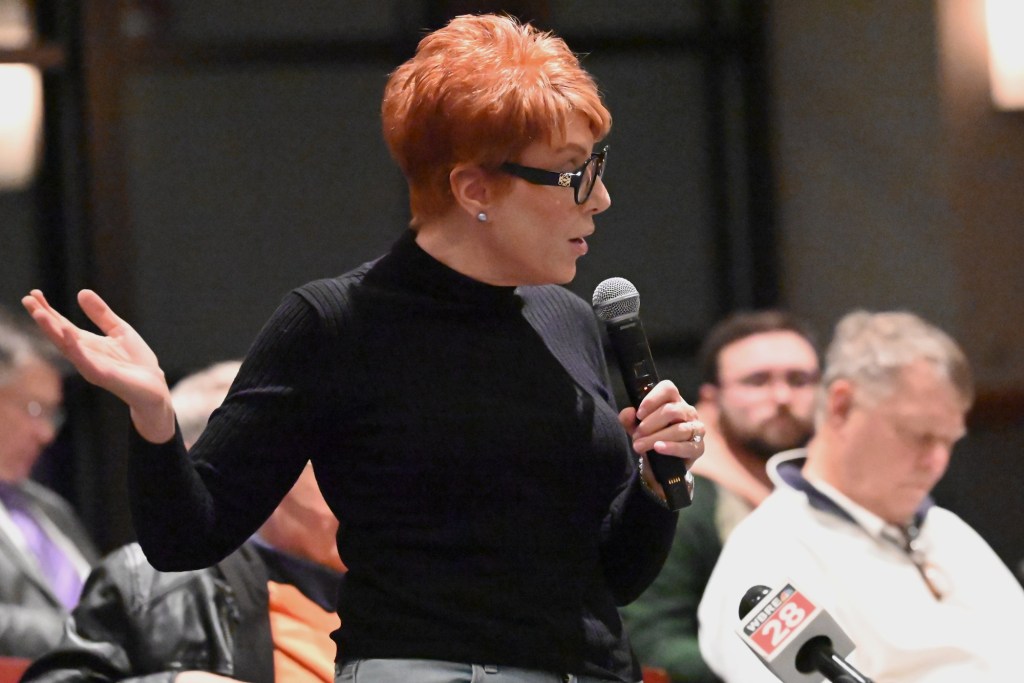
Jermyn resident Jordan Moran speaks during the public input hearing regarding the rate change proposed by PPL at the University of Scranton on Monday, Dec. 8, 2025. (REBECCA PARTICKA/STAFF PHOTOGRAPHER)

Community members and leaders listen to testimonies during the public input hearing regarding the rate change proposed by PPL at the University of Scranton on Monday, Dec. 8, 2025. (REBECCA PARTICKA/STAFF PHOTOGRAPHER)

State Rep. Jim Haddock speaks against PPL’s proposed rate change during the public input hearing at the University of Scranton on Monday, Dec. 8, 2025. (REBECCA PARTICKA/STAFF PHOTOGRAPHER)

Administrative Law Judge Barbara Shadie Nause and Deputy Chief Administrative Law Judge Christopher Pell listen to testimonies during the public input hearing regarding the rate change proposed by PPL at the University of Scranton on Monday, Dec. 8, 2025. (REBECCA PARTICKA/STAFF PHOTOGRAPHER)
Show Caption
1 of 4
Jermyn resident Jordan Moran speaks during the public input hearing regarding the rate change proposed by PPL at the University of Scranton on Monday, Dec. 8, 2025. (REBECCA PARTICKA/STAFF PHOTOGRAPHER)
The total bill for a commercial customer receiving default service from PPL Electric Utilities and using 1,000 kilowatt-hours with a maximum demand of 3 kilowatts would increase from $161.74 to $170.34 per month, or by about 5.3%, the company said.
PPL officials stated the increase would help the company make necessary investments to build and maintain a stronger, smarter and more resilient electric grid to better withstand increasingly severe weather, prevent outages and improve service to customers.
State Rep. Kyle Donahue, D-113, Scranton, called the proposed rate increase “unreasonable, unacceptable, unethical, and fundamentally unfair.”
“Just months after jacking up generation rates by 16%, PPL now wants another increase on the distribution side,” he said. “Families are rationing, skipping, cutting, and praying the next bill won’t break them. Meanwhile, PPL proposed no increase for its LP5 (large commercial/industrial electricity users) rate class — the class that includes data centers — so seniors, small businesses and working families must foot the bill while massive, energy-consuming corporate users are shielded.”
Scranton Mayor Paige Gebhardt Cognetti also pleaded with the PUC to reject the rate hike.
“This is the fourth time, in less than two years, that I stand before the Public Utility Commission, alongside the families, seniors, and small business owners who are doing everything they can to make ends meet,” she said. “Families cannot absorb any more utility rate increases — the cost of electricity, gas, water and sewer are climbing faster than the wages of the people who rely on these services. Across Scranton, seniors on fixed incomes are struggling to stay in their homes; and parents are making impossible choices between groceries, diapers, rent, prescriptions and keeping the lights on. We understand the utilities must maintain infrastructure, improve reliability and invest for the future, but those investments can’t come from the pockets of the most financially vulnerable people in their communities.”
Jordan Moran, 29, of Jermyn, a full-time student at Lackawanna College, who also works a full-time job, expressed his frustration and concern.
“You’re constantly told to budget better and spend less on luxuries, while these billion dollar corporations see record profits year-after-year,” he said. “I make about triple the Pennsylvania minimum wage and I still freeze it my house. My thermostat is at 60 degrees, and my PPL bill is still nearly 20% of my monthly income. We’re all living on the edge already in the fading middle class, how much more blood do you want to squeeze from us? I don’t have kids, and I can’t even think about starting a family in this economy, even thought I’m nearly 30 years old.”