
Like many, Andi Singer picked up a Covid hobby: sewing.
A graphic designer living in Washington, D.C., she’d always wanted to make her own clothes, but since she moved a lot for work and didn’t want to deal with the hassle of constantly packing up and hauling a sewing machine, she never pursued it. The pandemic kept her rooted, so she bought her first machine, refurbished, on eBay, set it up in her apartment and started watching YouTube tutorials and making garments in her free time.
Little did she know her Covid hobby would become a full-on career pivot. Fast forward a few years, and one move to Philly later, sewing machine in hand, and Singer (yes, she’s well aware of the coincidence of her last name) was making clothes out of “whatever I could get my hands on,” she says. She made her partner a coat out of a tablecloth and was taking classes on the weekends. She wanted to start her own fashion label, but she wasn’t sure where to begin.
Now Singer is making her dream a reality with the help of Philly’s Made Institute, a Rittenhouse-based fashion certificate program that helps people get into the industry, often from other career paths.
Clothing designer and educator Rachel Ford launched Made nearly a decade ago as a way to teach couture to people from all walks of life. Today, her school has graduated 225 students from its 18-month certificate program, offers one-off sewing and interior design courses, and is looking to expand to fine arts classes.
An apartment sewing school
Ford has always loved fashion. Her father, a professional composer and pianist, and her mother, an actress and performer turned stay-at-home mom, made her believe in a creative path. Ford taught herself to sew when she was around 12 and started making clothes to wear and sell to friends. By high school, she was getting pieces into boutiques near her Malvern home, and in 2004 she graduated with a degree in fashion from Drexel, where her portfolio featured couture gowns.
After a brief stint in corporate fashion, she landed a job in costuming for the Philadelphia Opera, designing and making dresses for divas. The first gown she designed was a red and black lace ruffled number for Carmen.
She loved her job. Then came the 2008 financial crisis. The opera was hosting fewer productions. Ford started taking on other gigs, designing costumes for everything from regional theater productions to movies and New York performances.
One of those gigs: teaching. While working at the Opera, she got a position teaching sewing at Moore College of Art and Design. She loved mentoring students and teaching them technical skills. Her passion was still couture gowns, and she wanted to share that with her students.
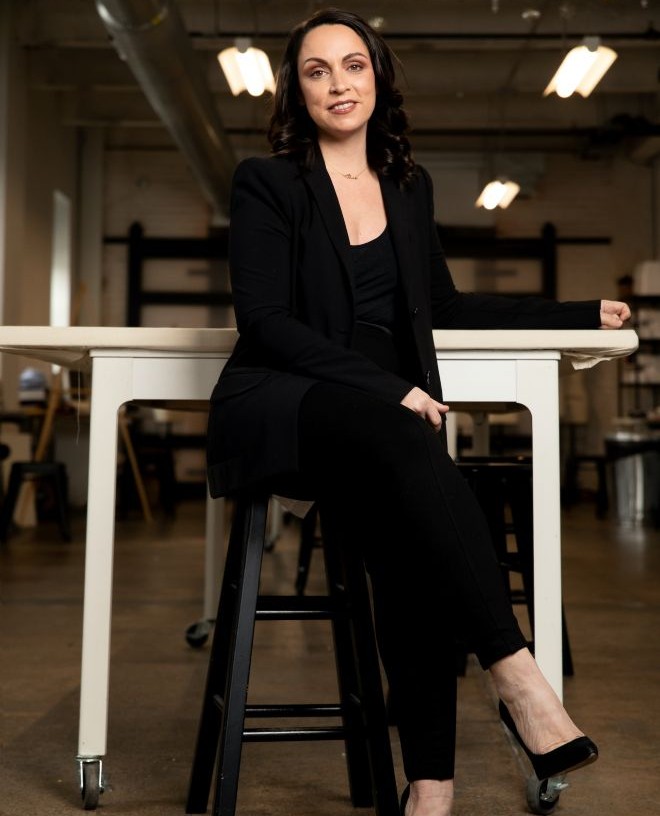 Rachel Ford, Courtesy of Made Institute
When Moore told Ford couture didn’t fit with their curriculum, she whipped up a Craigslist listing for sewing classes, complete with a logo of a pixelated corset; bought industrial machines as students signed up; and started teaching corset-making from her apartment. Dentists, moms, people who were frustrated with their careers — these were her students. As they’d sew, they’d ask Ford how she became a designer, a career they’d never considered or one that felt out of reach when they were young.
“We would just start talking about that pivot, that leap,” Ford says. “What I realized I was doing was slowly developing a curriculum in my mind: What would it take to get somebody who’s just diving into sewing and fashion as a concept to be able to be a fashion designer?”
The operation soon grew beyond Ford’s apartment — and not just because her “landlord was like, you’ve got to get this out of here,” she says. She knew she wanted to start a true school. She opened her first studio on Cherry Street — “I still walk by there sometimes, to feel the fear and excitement of starting something, of taking that leap,” she says. — and when she met her husband, a lawyer, he helped her get the licensing she needed to develop a program that would take people from “zero to fashion designer.” In 2016, she received her license from the Pennsylvania Department of Education.
Fashion + entrepreneurship
Made’s current address is fitting: Students learn right around the corner from retail outposts of Boyds, Anthropologie and Urban Outfitters, the latter where Ford worked in her corporate fashion days.
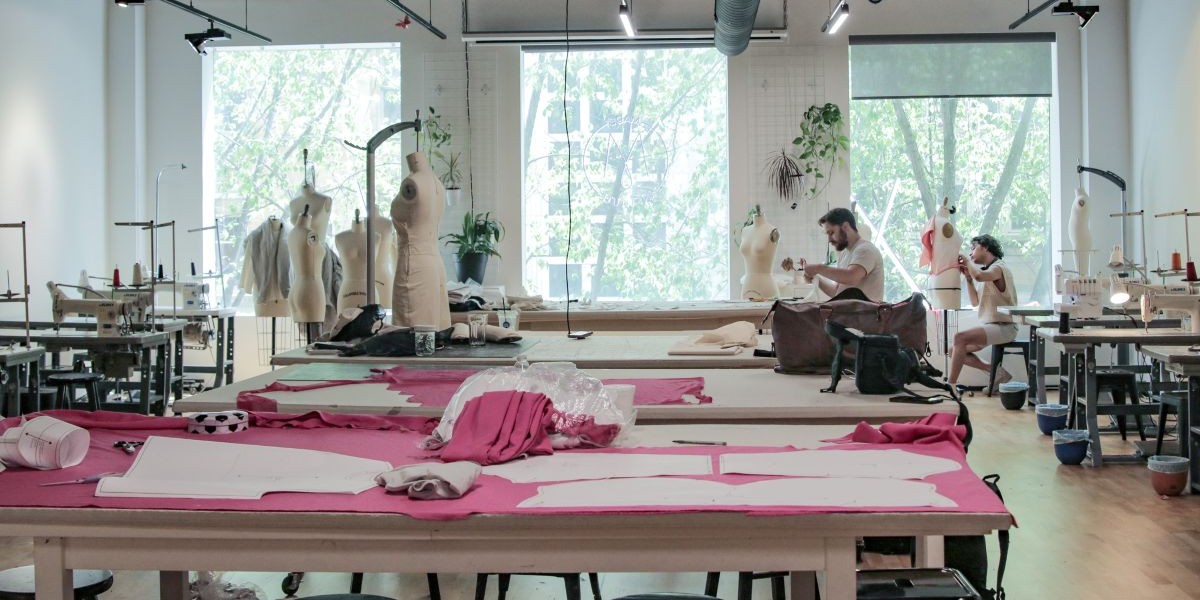
In Made’s Rittenhouse studio, 15 industrial Juki sewing machines strung with yarns in black, gold, cobalt and chartreuse line the walls. Drafting tables with cutting pads occupy the center of the room. In another part of the studio are specialty machines for sewing materials like knitwear, denim and leather.
“We have them on industry-level machines from day one,” Ford says. “That’s a game changer. I know many people who come here have only been on a home machine.”
Made Institute’s fashion certificate program lasts for 18 months and costs $15,000, broken into three payments. Students learn everything from sewing fundamentals to garment design, using tools like Adobe Photoshop and Illustrator, as well as analog, table-top patternmaking. Class sizes are intentionally small to allow teachers one-on-one time with students.
Ford also teaches them about entrepreneurship, helping them think through building brands and websites, and connecting them with mentors and career opportunities. They have between 20 and 25 teachers per session, all with degrees and experience working in the fashion industry.
Made offers both a daytime and an evening cohort, which meet for three hours three times a week. Students don’t need a portfolio to apply — something Drexel and many other fashion programs require — which makes it more accessible for people starting out.
In line with Ford’s original vision, many of Made’s students follow nontraditional paths. They might have completed a trade program or a four-year degree and want to pivot into a new industry. Some have full-time jobs and want to dip their toes into design as a side hustle. Sixty percent of Made’s students are people of color, a population often excluded from the industry, despite their outsized influence on the industry. Only about 46 percent of fashion students nationwide are people of color.
“We’ve really created this program to work around reality,” Ford says. “Students are here part-time. They’re working jobs. They have lives outside of this.”
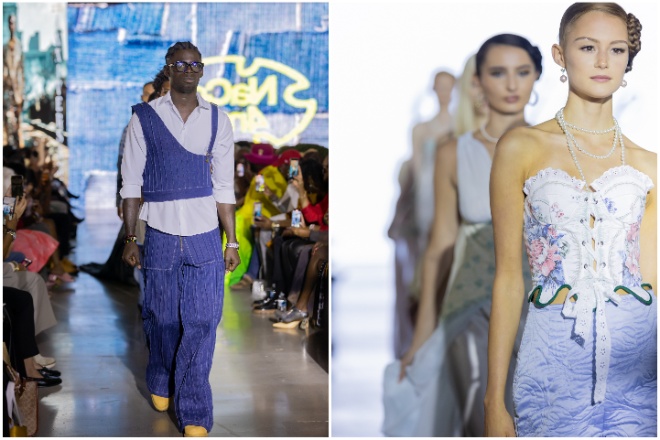 Left: Work by Runway Designer Najah Warren. At right, the work of Runway Designer Elisse Hanssen. Photo Credit: D. Rhodes, Courtesy of Made Institute Supporting students
Back in the studio, Singer lays out a few different outerwear projects she’s working on for her brand, Venus and Aries. There’s an aubergine vinyl trench, a black leather bomber jacket work-in-progress with zig-zagged detailing and dramatic lapels that would look at home on an Elvis jumpsuit. Singer is mindful of fashion’s notorious environmental impact and builds her designs around reclaimed, sustainable materials. She’s in the process of developing a biodegradable leather alternative using a 3-D printer.
Made has taught her technical skills, like how to work with different materials, but also helped her develop her brand. Ford has had one-on-one conversations with her that have made her feel prepared to launch her own label.
“I feel like it’s like a really good place to grow as a designer, because it’s such a tight-knit community,” Singer says.
Singer is building her brand, while also offering branding, product photography, and apparel design services for designers, small businesses and independent creators. Made graduates have started their own labels, gone on to land industry design jobs and pursued freelance design and costuming. Everyone leaves the program with a capstone capsule, which they show at Philly Fashion Week.
In 2023, the sneaker store Snipes approached Ford about having some of Made’s former students refashion Nike apparel into original, streetwear-inspired works for a Brooklyn fashion show during Air Max Day, a bash Nike throws each March to celebrate the shoe line. Ford sprang into action. Within two weeks, Made alums designed and produced clothes for the show; Snipes brought them from Philly to New York City in a limo for the star-studded event.
The folks at Snipes were so impressed, they decided to offer full tuition scholarships between 2024 and 2025 for Made students Eve Mathews, Opal Pruitt and Cora Vance. They also partnered on a competition with one of Made’s sewing classes that will land one student’s streetwear designs in Snipes stores.
“They’ve really been authentic,” Ford says of the Snipes partnership. Last year, members of the Snipes team “came to our fashion show and sat front row again, showing up for us in real time.”
Ford is looking to build more partnerships like this and to expand Made’s curriculum in the future. Already, the school has begun offering one-off sewing classes and youth programs. She’s interested in creating an interior design program, similar to the fashion certificate, and working with her brother, a sculptor, to create fine arts offerings.
In recent years, Philly’s arts education community has been devastated by the closures of University of the Arts and the Pennsylvania Academy of Fine Arts. Ford is acutely aware of those challenges and of the economics that make people pause before pursuing an art degree.
Tuition at University of the Arts was $55,630 per year before its closure. The median wage for fine artists is $28.51 per hour, according to Bureau of Labor Statistics data. Many can’t justify the cost. Ford hopes Made can help fill some of those gaps or partner with other schools to help give students more opportunities.
“The economy continues to be challenging. Our students need more resources,” Ford says. “That’s something that I lived when I was a freelancer. I was piecing things together when the whole economy and country can feel very out of reach or out of control, where you don’t feel like you can predict safety or job security. I really believe in being able to have a trade that can withstand those moments.”
Correction: A previous version of this post mis-linked to Made Institute’s website. The correct link is: made-institute.com.
 MORE BUSINESS FOR GOOD
Made Institute’s Rittenhouse Studio, Photo by Made Institute