

Around $15 an hour with few or no benefits or paid leave. That’s the average pay package for a childcare worker in Pennsylvania. It falls below 97% of what workers in other industries make.
For parents, though, the costs for childcare are astronomical. Top quality childcare in the state could cost from $209 to $444 per week depending on the child’s age. They could be on waitlists for years.
As childcare costs skyrocket nationally, the newly enacted Pennsylvania state budget is trying to address funding gaps, starting with a $450 bonus that would go to each of the state’s roughly 55,000 childcare workers. Under the new law, qualified childcare providers can apply to the Department of Human Services for a lump sum to allocate to their workers.
But it’s just a starting point in the long-term goal for sustainable solutions to make childcare accessible, according to experts and the state’s lawmakers.
Early childhood expert Dr. Milagros Nores with the National Institute for Early Education Research, said the bonus is “really a marginal point” to solidify an already fragile workforce.
“So it might do a temporary sort of band-aid on a broken leg kind of thing,” Nores said. “And I understand that there’s only so much the budget can do, but if children are not prioritized, the whole system becomes fragile.”
Harrisburg resident Ryan Zickgraf enrolled his one-year-old in a daycare in Mechanicsburg earlier this fall. His wife, a psychologist, and Zickgraf, a journalist, work from home. They used to pay a babysitter around $450 a week.
“And it really added up and it wasn’t full time so it was still a struggle,” Zickgraf said. They spent almost a year on the waitlist at the Jewish Community Center’s daycare. So even though the one-hour commute every day wasn’t enticing, Zickgraf said the Mechanicsburg daycare was the best option.
“I mean the cost ended up being about as much as our rent,” Zickgraf added.
How we got here
Historically, women in traditional households stayed home by default and took care of the children while men were at work. In 2024, however, more than half of married couple families in the U.S. had two employed parents.
Debra Lancaster, executive director at the Center for Women and Work at Rutgers University, said the undervaluation of women’s work is connected to the issue of childcare.
“If you look at male-dominated fields, the pay is almost always higher,” Lancaster said, “and I think it’s just something that we continue to have this myth about, that somehow taking care of children is a private matter.”
Studies show that high childcare costs are a significant barrier to women’s workforce participation.
Childcare costs in the U.S. are higher than those in other developed countries. Many European countries, for example, have public childcare or private networks that are heavily subsidized by the government.
“I think we as a nation prioritize children and we prioritize quality care for our children but we haven’t made the investments to align with that priority,” said Kathryn Tout, developmental scientist and vice president for early childhood research and partnerships at Child Trends.
During the 2020 pandemic, the U.S. government distributed billions in childcare relief funds. But after those funds expired, many states, including Pennsylvania, were left with gaping holes to find their own sources of revenue.
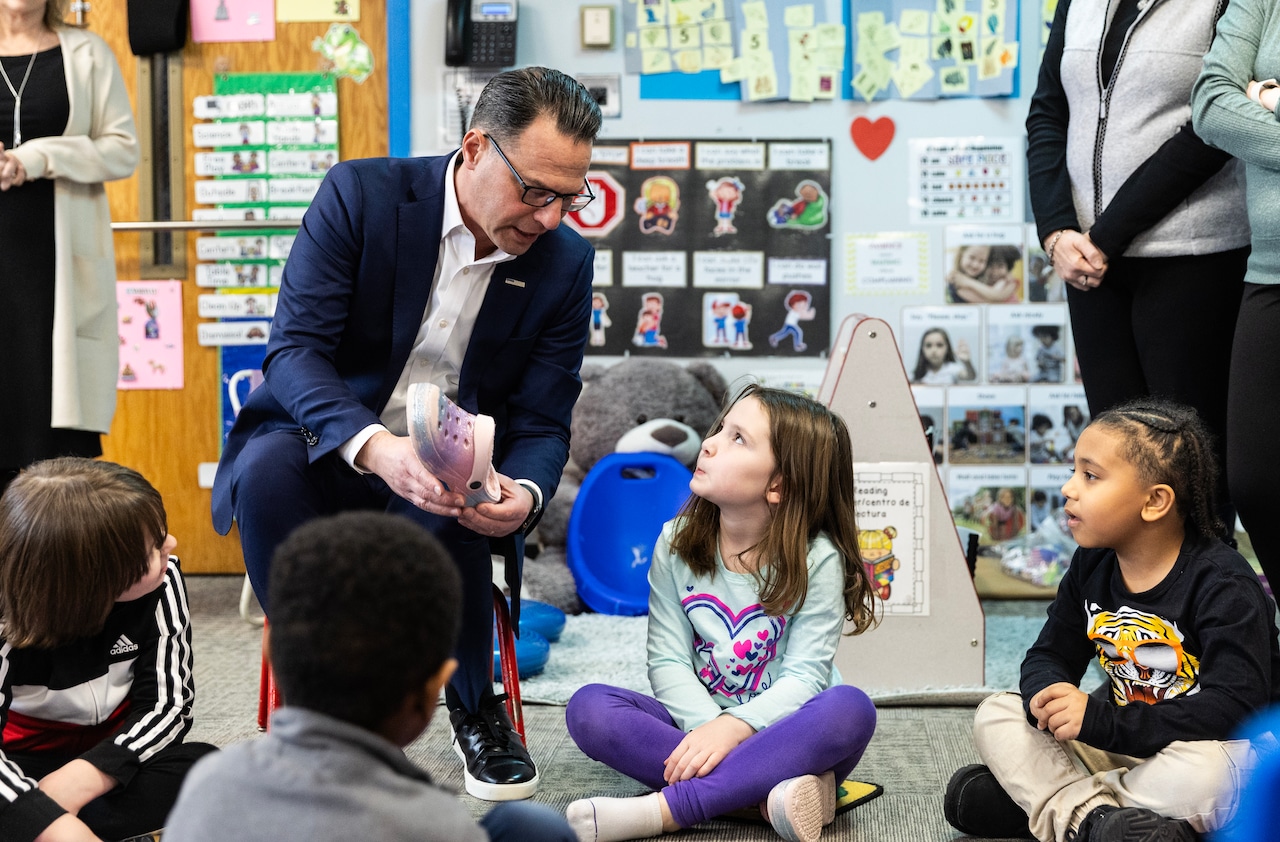 Governor Josh Shapiro discusses Crocs with a student while visiting CrossPoint Early Learning Center to talk about his emphasis on workforce development in his 2025-26 Budget Proposal and his plans for expanding Pennsylvania’s childcare workforce February 06, 2025. Sean Simmers |ssimmers@pennlive.comSean Simmers
Pennsylvania’s childcare subsidy program, Child Care Works, helps more than 90,000 low-income families across the state. But a 2024 report found the program is serving only one in four eligible children, it could use more funding to increase efficiency, and that other states have done more to expand public child care eligibility, compared to Pennsylvania.
Adding multiple children to a family drives up expenses quickly. And the problem exposes itself in a myriad of ways. Luke Bernstein from the state’s Chamber of Commerce told PennLive he hears from employers about how parents want to work but aren’t able to because of the lack of good quality and affordable childcare.
There are also not enough childcare centers to fill demand for multiple reasons, such as operating costs, which can add up with licensing fees, insurance, facility costs, salaries and equipment. Bernstein also pointed out that most centers are small businesses that operate on thin profit margins.
The industry itself is not known for being worker-friendly. A September 2024 survey found that 92% of respondents (childcare programs) had trouble recruiting staff and 85% reported teacher shortages. It gets more complex for kids with special needs and parents who need overnight childcare.
Nores from the National Institute for Early Education Research conducted a study, which found that the benefits of providing quality early childcare was multiple times larger than the costs of implementing it.
In Pennsylvania, the state’s budget impasse did not help either. Some childcare centers closed temporarily after running out of funds, including one in Rep. Nate Davidson’s Cumberland County district.
“That’s 500 kids that weren’t getting an education.” Davidson said, “The teachers don’t have a job. The parents have to make adjustments and what if they don’t have family or friends close by or available?”
Davidson walks around midtown Harrisburg pushing a stroller with his two children during community events. Living in a city, he said, made it easier to find childcare that was close to home. His little ones go five times a week — at least when things go as planned.
“One of the many ‘blessings’ of childcare is sickness and disease,” Davidson said. “Or the other day, power was out, so childcare was closed.”
Pennsylvania’s proposed solutions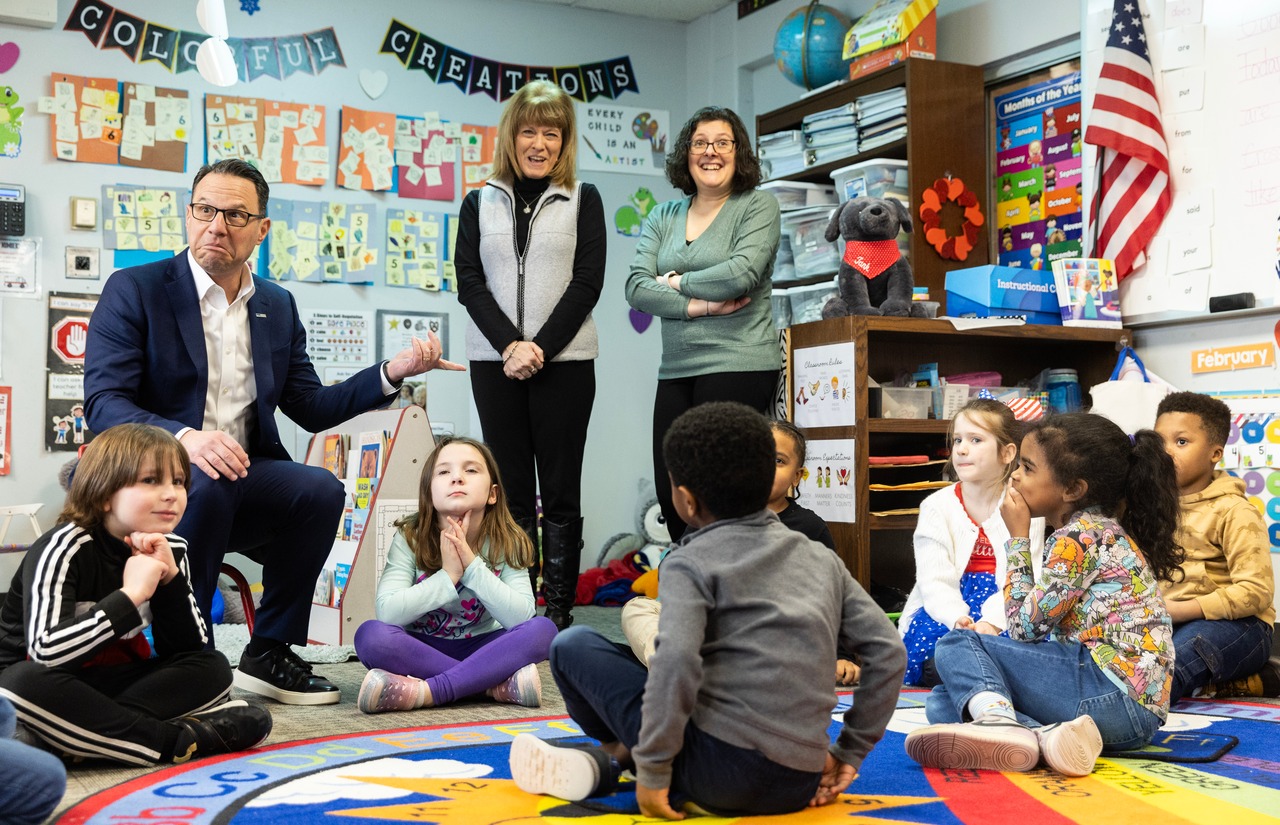 Governor Josh Shapiro reacts to a student’s answer to his question as he visits CrossPoint Early Learning Center to talk about his emphasis on workforce development in his 2025-26 Budget Proposal and his plans for expanding Pennsylvania’s childcare workforce February 06, 2025. Sean Simmers |ssimmers@pennlive.com
In recent budgets, Gov. Josh Shapiro, a Democrat, has pushed for childcare funding, including:
In 2025: a $450 bonus to retain childcare workers and increased funding for the state’s early intervention services and free preschool program for low-income families.
In 2024: employer childcare contribution tax credit, where employers can pay up to $500 for their employees’ child care expenses and get a $150 tax credit
In 2023: child and dependent care tax credit to give families with one child up to $1,050 and two children up to $2,100.
Lt. Gov. Austin Davis, the youngest lieutenant governor in the country and a new dad, found a babysitter online initially. The Second Lady, Blayre Davis, works for the Pittsburgh Steelers. When they started looking for longterm childcare, the reality of the costs hit hard.
“When you have a childcare bill that’s rivaling your mortgage, that’s a challenge for anybody,” Davis told PennLive. They found a center when their daughter turned one, and Davis said her development progressed by “leaps and bounds.”
Most people in Davis’ circle at his age don’t have more than one child, he said.
“Because as a society, we don’t make it easy for folks to have kids,” Davis said.
He led three roundtables to discuss childcare this year with workers, parents and other key stakeholders. He told PennLive addressing the challenges of childcare is “much more difficult because of the decisions that the Trump administration is making.”
“State government, we cannot supplant the role of the federal government in our lives,” Davis said. “But just imagine if we had a real partner at the federal level.”
Luke Bernstein from the state chamber said the commonwealth could reduce “rigid” qualification requirements for childcare workers to attract more talent. For example, he said teachers are “eminently qualified in the credentials they have” making it easier for them to get into the childcare system.
He added that childcare centers, like other businesses, would benefit financially from cutting down licensing wait times.
“I don’t think we have the luxury of time to wait,” Bernstein said. “We need to keep building upon our improvements.”
Where’s the disconnect?
Lt. Gov. Davis said it comes down to priorities.
“It’s just a matter of is it high enough on the priority list of many of the elected officials in this building?” Davis said. “We are one of the best places for folks to retire and that is wonderful, but we also want it to be one of the best places to raise a family and prioritize young people more in our budgets.”
Other governments have tackled the funding gap in different ways. D.C. childcare workers got salary bumps in 2022 through a fund created using taxes paid by high earners (salary of more than $250,000 a year). Research showed the extra funding helped staff recruitment and retention. Philadelphia imposed a soda tax to use for pre-K programs. New Mexico recently started an oil and gas tax that is set to be used for universal childcare. Davis said the energy industry in Pennsylvania provides similar opportunities.
“The reality is Pennsylvania is the second largest exporter of energy and we don’t currently tax that energy that’s being exported in a significant way,” Davis said. “There’s no telling what we could do if we added a tax to it.”
Davidson described childcare reform as a “Sisyphean task” — endless and ongoing.
“It’s not just the kids, it’s not just the teachers, it’s not just the parents, it’s not just the employers. It’s truly just a whole community thing, right?” Davidson said, “And as they say, it takes a village to raise a child.”