
Mayfield could become the first Upvalley community to regulate data centers on Wednesday.
Seeing the inundation of data center proposals in their neighbors to the south, where developers propose to build nearly four dozen data center buildings across five campuses in Archbald alone, Mayfield officials seek to amend their 25-year-old zoning ordinance to address data centers. Borough council will hold a public hearing at 6:40 p.m. Wednesday at the Borough Building, 739 Penn Ave., followed by a public meeting to consider adopting the legislation, according to public notices published Dec. 2 and 3 in The Times-Tribune. Mayfield’s ordinance would restrict data centers as conditional uses along its Business Route 6 corridor.
Mayfield officials started discussing the ordinance during the summer, council President Diana Campbell said.
“We knew we needed to do something,” she said. “We’re seeing what’s going on in Archbald and Jessup and Blakely, and we’re like, ‘OK, we need to put something on our books before it comes here because we don’t address it.’”
Failing to address them would be irresponsible as elected officials, Campbell said.
“We have to allow for every land use, and it’s also our job to protect the health, safety and welfare of our residents through zoning,” Campbell said. “That’s the control that we have, and we need to exercise it.”
The borough has not received any requests from data centers, she said.
Mayfield is the latest municipality to address data centers through zoning in Lackawanna County, where the overwhelming majority of interest from developers has been in the Midvalley region, namely Archbald and Jessup. In total, developers propose to build five data center campuses in Archbald, two in Jessup and a large campus in the North Pocono region along Interstate 380 in Clifton and Covington townships. A developer also proposed building up to four data centers in Blakely but withdrew those plans amid opposition from the community.
Municipalities in Pennsylvania are required to allow for every type of lawful land use, meaning towns can’t outright ban data centers through zoning. To maintain some local control over the developments, communities often designate data centers as conditional uses. As a conditional use, developers are required to adhere to a slew of conditions established by the communities, and before receiving approval from borough councils or township boards of supervisors, they must attend a public hearing where residents have the opportunity to testify for or against the project. Ordinances like Mayfield’s don’t approve data centers — they just establish the conditions needed for their approval while designating where they can be built.
Nearby Archbald, Blakely and Jessup have all adopted data center zoning ordinances in recent months, and Dickson City Borough Council was set to consider its own data center legislation Tuesday night. The outcome of Dickson’s meeting was unavailable by press time Tuesday.
Mayfield watched those communities, Campbell said.
“We’re paying attention to what’s happening, looking at what they’re doing and seeing what’s working, what’s not,” she said, explaining the borough also has to avoid being exclusionary. “We don’t want to get sued.”
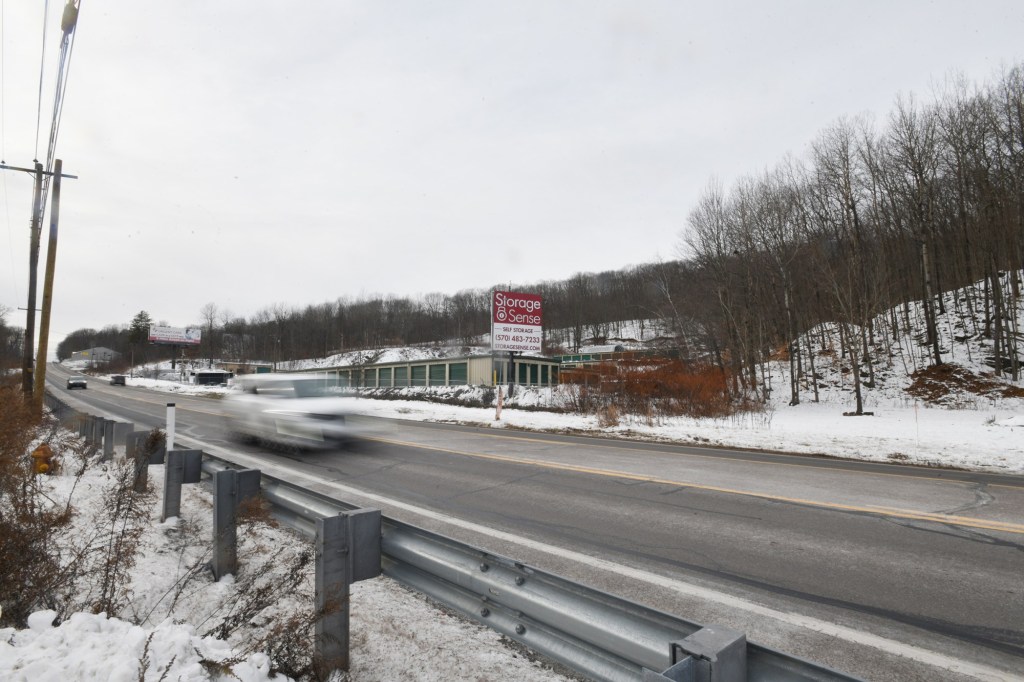
The proposed ordinance in Mayfield defines data centers and adds them as conditional uses in the borough’s heavy commercial zoning district. The commercial district encompasses the entire length of Business Route 6 in Mayfield extending to the Archbald and Carbondale Twp. borders, as well as Old Plank Road to the intersection of Chestnut Street.
The draft ordinance includes requirements and standards for dimensions, landscape buffers, screening and fencing, noise and vibration, water and sewer use, power supply, emergency management, aesthetics and parking. Those include a 60-foot height limit with 200-foot setbacks from residential areas, decibel limits with stricter standards during nighttime and weekend hours, sound study requirements before a data center is built, during its building permit approval process, and six months after it receives a certificate of occupancy; there must be no vibrations perceptible to humans beyond the property line; proof from utility companies if it uses public utilities; a water feasibility study would be required if the data center uses a non-public water source; and requirements to ensure first responders are safe if they have an emergency at the facility, among other items. It also requires that any data center would have to provide proof of review and approval from the Susquehanna River Basin Commission for projects withdrawing 100,000 gallons of water per day or more over a 30-day average or consuming 20,000 gallons per day or more over a 30-day average.
Campbell noted the borough voted last year to allow solar farms in that same commercial zone.
Mayor Al Chelik, who is also on the town’s planning commission, said they chose the Business Route 6 corridor because it’s an area that protects sensitive areas of zoning like schools and parks. A data center developer would have to spend money to run water and electric infrastructure to some of that land, Chelik said.
“But hey, that’s their problem,” he said. “We’re allowing it with, we feel some restrictions, but it’s not so restrictive that they can’t do it.”
Chelik pointed to a stipulation in the ordinance that would require a data center to pay for any cost to increase the conveyance or capacity of the public water system in Mayfield.
Overall, Mayfield’s council, planning commission and solicitor worked on the ordinance, which was then reviewed by the Lackawanna County Regional Planning Commission, Chelik said.
“We put together what we thought was the best ordinance for Mayfield,” he said.