
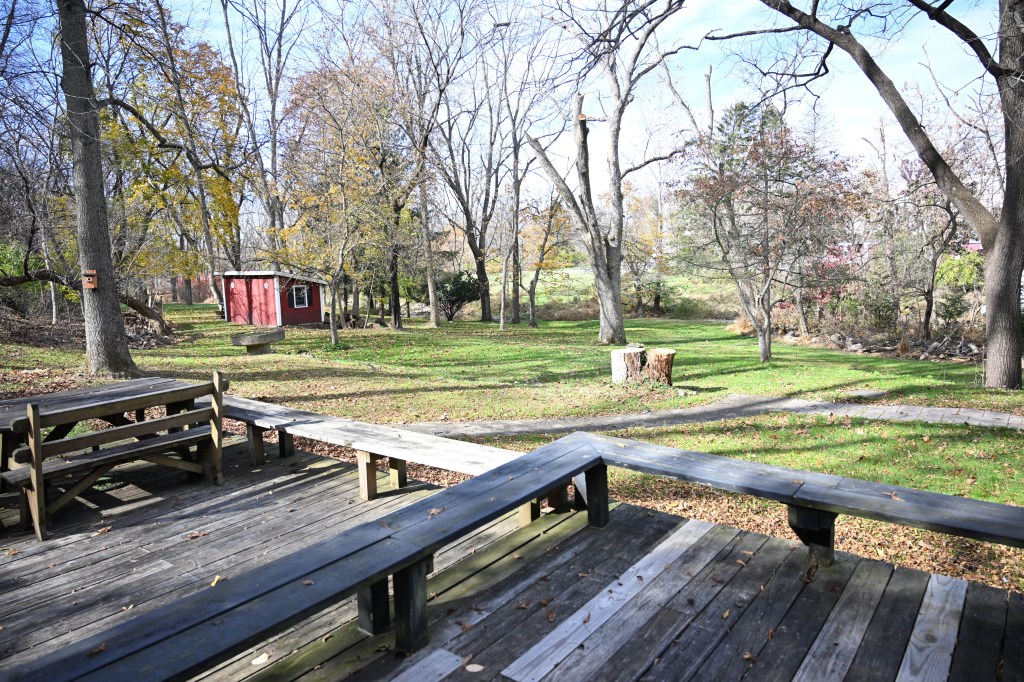
The house sits off busy Route 191 in Northampton County, yet it’s part of a quiet, wooded oasis, with a creek on one border that beckons fish and wildlife.
Marie and Frank A. Scattene Jr. bought the house with its nearly 7 acres of land in 1955. They raised their children, entertained relatives and friends, and lived in general quiet, according to their son, Frank Scattene III.
His father served in the Korean War, and upon returning to the Lehigh Valley, was searching for a “place like this,” Scattene said. “When the land was available, he bought it.”
It has remained pretty much as is since then, a residence teeming with wildlife and natural beauty. The Cape Cod house, with an addition built for the growing family, has been vacant since February 2024, when Marie Scattene died. Frank Jr. died in August 2007.
But henceforth, the site will be known as the Scattene Conservation Area, after the Scattene siblings sold the house they grew up in and land, most of which is in Lower Nazareth Township, to Northampton County for $485,000.
County Council approved the purchase at its Oct. 2 meeting by an 8-0 vote, with the money coming from its Livable Landscapes Grant Program (Council member John P. Goffredo, who is a relative of the Scattenes, recused himself). Closing took place this week.
Acquiring the property will connect to both Monocacy Meadow and Hahns Meadow Park, a 15-acre Lower Nazareth Township preserve that traverses the Monocacy south of Hanoverville Road, county conservation coordinator Sherry Acevedo told County Council Sept. 18.
She said the county sees making connections on a “continuous greenway” as important. In the case of Monocacy, the stream has connecting preserved land and parks, such as the Archibald Johnston Conservation Area and Bethlehem’s Monocacy Way Trail, all the way until the creek empties into the Lehigh River.
The county intends to keep the house and turn the area into a spot for people to enjoy fishing, passive recreation and environmental education, according to Acevedo.
“We have internal planning we will have to go through once the property is zoned,” Acevedo said, with the acquisition offering “lots of good opportunities for us.”
The Scattene acquisition marks the county’s 24th park or conservation area since its Parks and Recreation Division was formed more than 50 years ago. The county-owned system consists of more than 2,300 acres that includes farming, forest, streams, rivers and lakes.
A study released this year showed the county generates nearly $435 million in environmental benefits annually, according to Bryan Cope, the county parks and recreation superintendent. It also pumps more than $235 million into the local economy off goods and services obtained by park visitors.
Michael Harrington, president of the Monocacy Creek Watershed Association, said the county’s acquisition means the land is “going into hands that are good stewards to the land and help protect the Monocacy Creek in the process.”
The land wasn’t always protected. Three years after they moved in, Frank Jr. and Marie Scattene dealt with the rerouting of Nazareth Pike next to their property, bringing more traffic along the busy state road also known as Route 191.
Frank Jr. and his son planted evergreens along the border with the highway, but that didn’t do much to curtail the traffic noise, Frank III said.
“I would hear the cement trucks in the summer; my bedroom was on the highway side,” said Frank III, who at one point during a recent tour with siblings Cynthia Scattene and Diane Johnson called out at the sight of a blue heron flying low along the Monocacy Creek. A railroad track also runs next to the land, one that winds from the north to Bethlehem.
Other trees of various kinds — black walnut, white ash, hickory oak — dot the nearly 7 acres. The evergreens planted along the highway help buffer the noise from neighboring Nazareth Pike, which still hosts heavy traffic from cars and tractor-trailers, and leads to an industrial park with giant warehouses.
A large, concrete wash bin brought from the former Bethlehem Steel by a grandfather now holds dirt. Years ago, Frank Scattene said, another relative who was a plumber installed a sprinkler that was used for washing flying discs when the family hosted something called the Scattene Frisbee Golf Tournament as a small fundraiser for various groups.
Frank and his sisters described the woods as their backyard and playground, suitable for swimming in the creek, hiking and biking, building simple forts out of tree branches and more.
For the Scattene siblings, the sale is bittersweet, because it won’t belong to the family after 70 years.
“But the fact that it’s being preserved, my parents would be thrilled,” Frank Scattene said. “And we can come here the rest of our lives and don’t have to cut the grass, blow the leaves, do any of the maintenance. What’s not to like?
“It’s probably the best result I could ask for.”
Contact Morning Call reporter Anthony Salamone at asalamone@mcall.com.