
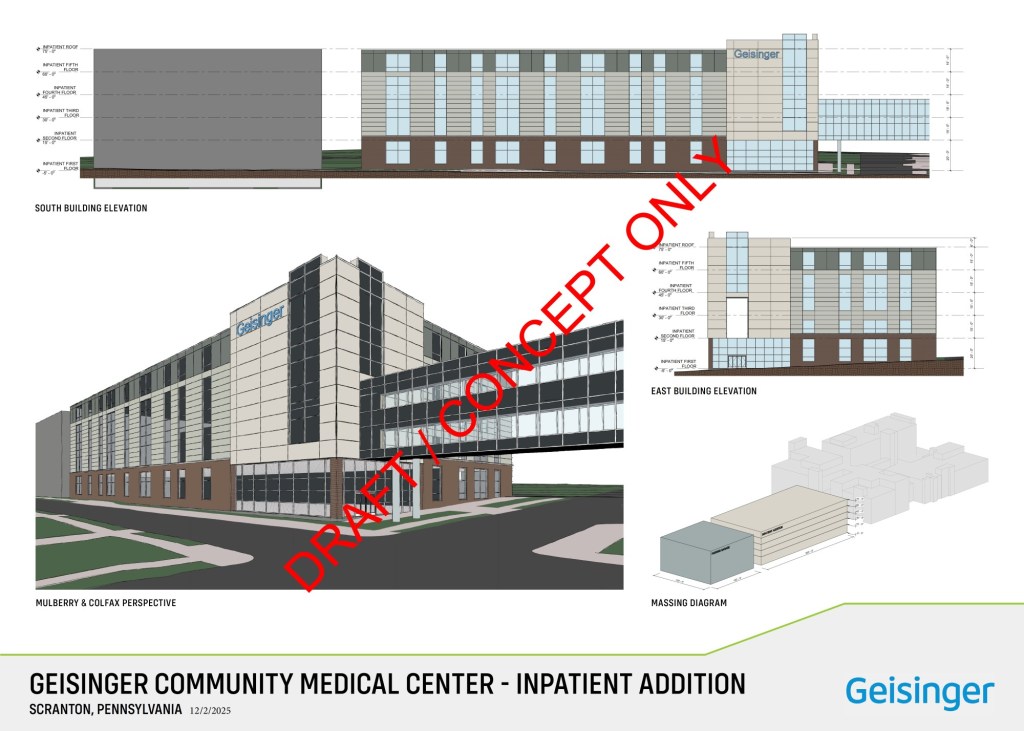
SCRANTON — A divided Scranton City Council passed Mayor Paige Gebhardt Cognetti’s rezoning of property of Geisinger Community Medical Center to accommodate construction of a five-story building and parking garage in the 400 block of Colfax Avenue, across from the hospital.
Council voted 3-2 — with council President Gerald Smurl, Bill King and Jessica Rothchild voting yes, and Mark McAndrew and Tom Schuster voting no — to adopt an ordinance rezoning land owned by Geisinger in the 200 and 400 blocks of Colfax Avenue, flanking the current hospital facilities’ footprints, according to an Electric City Television simulcast and video of the meeting posted online. As they did in recent weeks, McAndrew and Schuster questioned the process and timing of the mayor’s rezoning proposal. McAndrew again called the mayor’s rezoning a “rush job,” coming before a council with two new members taking over in January and presumably would form a majority that might not necessarily be as receptive to the rezoning and expansion concept as presented.
Rezoning arises
The final council vote taken Tuesday developed over the past month. Geisinger issuing a press release Nov. 10, outlining how major investments in the Hill Section hospital undertaken during the past two years have maxed out space there, and noting Cognetti would pursue a rezoning to accommodate GCMC expansion across Mulberry Street.
The issue revisited a zoning debate of two years ago that resulted in council at that time limiting the height of new buildings on GCMC’s Colfax properties to 45 feet tall, which stymied the hospital’s former plans.
Like then, the issue spurred numerous concerns and questions raised from Hill Section and other city residents, and council members; as well arguments in favor of the rezoning and expansion put forth by Geisinger, the mayor and others.
Expansion plan
On Dec. 2, Geisinger told council of plans to construct a five-story, 75-foot-tall clinical building and parking garage in the 400 block of Colfax Avenue. A bridge over Mulberry Street would connect the “inpatient addition” on the site of the former John J. Audubon School to the existing hospital; while a five-story garage with 400 parking spaces would go next to the addition, closer to Vine Street.
The rezoning would change Geisinger-owned property on the odd side of the 200 block of Colfax Avenue and the even side of the 400 block of Colfax Avenue that includes the site of the former Audubon school from institutional to civic zones.
The institutional zone has the 45-foot height limit imposed by council in 2023, while a civic zone has a 100-foot limit. GCMC currently has no plans for the lot in the 200 block of Colfax.
Legal challenge reflects concerns
Residential concerns generally have centered on giving neighbors more time to participate in an expansion they fear could harm the neighborhood already stressed by the hospital’s presence and traffic; and giving them more input and safeguards to ensure Geisinger sticks to its concept and it does not sprawl even bigger.
Such arguments were raised in an injunction lawsuit filed Friday by resident Edmund Scacchitti aimed at delaying the council adoption vote Tuesday night. During an over-two-hour-long hearing in Lackawanna County Court on Tuesday afternoon, attorney Ryan Barrett, representing Scacchitti, argued for a 30-day stay on council voting to give more time for “informed public discourse” on rezoning, after which council then would vote. “The community was caught off guard,” by the rezoning proposal, Barrett said during the court hearing.
Scacchitti’s suit also raised issues of whether the city properly notified residents about the rezoning. Attorney Jenna Kraycer Tuzze, representing the city, argued: “The city has fully complied with all of the procedural requirements” under municipal planning code law; a judge cannot block council action beforehand; and an appeal can only come after a rezoning is enacted by the city.
Lackawanna County President Judge James Gibbons agreed, ruling he did not have jurisdiction to prevent a legislative act of the council, and the legal remedy for an aggrieved party to challenge such an action would come afterward via a court appeal. “I just don’t think I have jurisdiction on this,” Gibbons said.
That paved the way for council to vote later Tuesday night.
Public hearing
First, council held a public hearing Tuesday that ran for two hours before the regular weekly council meeting, and that featured numerous speakers generally restating arguments and concerns on both sides of the rezoning and GCMC expansion issue.
The mayor, who penned an editorial published in The Sunday Times detailing her support for hospital expansion, noted that GCMC, dating to 1905, is the only trauma center in Lackawanna County. The city must help it and other providers meet growing health care demands of the city and region, she said.
“I have spoken many times in support of giving the Geisinger hospital what they need to be able to maintain and grow their space in Scranton so that we all, not just in Scranton, but in the entire region, can have the entire care that we need,” Cognetti said. “This (zoning) amendment isn’t about what’s going to happen in five weeks, or five months or even five years. This is about what will happen in the next 120 years.”
Comments by residents included: the rezoning amounts to giving Geisinger a blank check with no way to ensure it would abide by its concept; and GCMC has grown to dwarf its residential neighborhood and encroach on Nay Aug Park and should expand elsewhere in the city.
“Nobody wants to live near a hospital,” resident Gene McDonough said. “They are a cancerous tumor eating away at our beautiful neighborhood, all to save a few dollars. They should be building it elsewhere.”
Scacchitti said he believes nothing has changed from the issue of two years ago and there should be no rush to push the rezoning through without more community involvement. “Someone’s going to have to convince me that there’s something important that’s different and requires immediate action by this council, before a new council can come in and consider the same issue,” Scacchitti said. “We don’t want to fight with Geisinger, but we want to be part of the solution. And by voting yes on this amendment, you’re essentially leaving us (neighbors) out of this equation.”
Megan Brosious, who is Geisinger’s executive vice president and chief operating officer, said GCMC needs to expand beyond its footprint to meet the region’s growing health care demands. The current zoning’s height-limit constraints on the Colfax site precludes the size of expansion needed there and she pledged that Geisinger would be a good neighbor going forward in expansion design and operation.
“We appreciate the efforts of our neighbors to meet throughout this process. We pledge to continue to meet, share thoughts and when possible incorporate their feedback into our project. If given the opportunity to expand, we would have the bulk of our design work ahead of us. We remain committed to collaborating when we begin focusing resources on designing the expansion in detail,” Brosious said. “The longer we wait, the more difficult the health care experience will become in our community.”
Council gets final word
Schuster, McAndrew and some residents believe GCMC should instead seek a variance from the city Zoning Board to build taller than 45 feet, and the city rezoning of the Colfax lots amount to special treatment. The expansion would not qualify for a variance, Brosious said on Dec. 2, when and she and other Geisinger officials pledged to not build taller than 75 feet.
“This should have never come to us,” McAndrew said of the rezoning. “The mayor’s amendment is a clear circumvention of fair procedural processes. We have boards and authorities for a reason. Planning and zoning boards are one example where the public is notified for their input and a fair process takes place.”
Schuster said: “If this passes here, council or the neighborhood is not going to have a say in what happens from today on out … If we vote no, the hospital still has another day to bring a plan, they still have another day to expand. If we vote yes on this tonight, it’s over for what the neighborhood wants, and that’s a seat at the table and compromise.”
The GCMC rezoning also comes as the outcome of Tenor Health Foundation acquiring Regional Hospital and Moses Taylor in Scranton remains uncertain. One or both of those hospitals tanking would adversely impact the health care landscape of the city and region. When the GCMC expansion and zoning issues arose two years ago, the threat of losing Moses Taylor or Regional was not as pressing as today, King said. All plans by GCMC also would have to be vetted by the planning commission and permit process, so safeguards would exist, King and Rothchild said.
“While I’m empathetic with the concerns of the neighbors surrounding Geisinger and Nay Aug Park, I’m even more concerned about the future of health care for the nearly 77,000 residents of the entire city of Scranton,” King said. “I do not want to gamble with the future of health care in our great city.”
Noting she is the only member of council who lives in the Hill Section and works in health care, Rothchild said rezoning would not give Geisinger a “blank check” and the current expansion concept is an improvement over the prior one of two years ago.
“I believe this is a better plan and more reasonable and it is more of the compromise we’ve been looking for,” Rothchild said. “My gut’s telling me that if I vote no on this and this fails to pass, our city will be at a major loss and our healthcare will greatly suffer. I cannot have that on my conscience.”
Council then cast its 3-2 vote. Brosious said on Dec. 2 that GCMC’s expansion project would take 18-24 months to complete.