
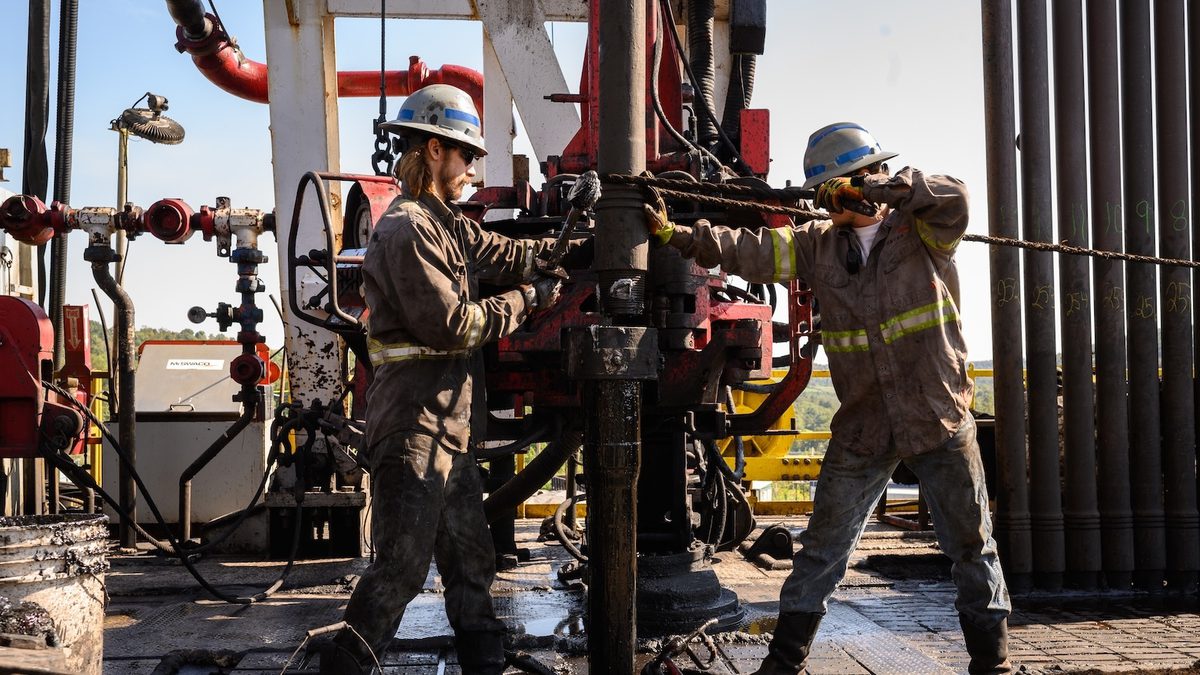
Twenty years after fracking began to boost natural gas production in western Pennsylvania, residents are bracing for another surge in output as gas-fired power plants prepare to meet a big jump in electricity demand. At least five new energy-hungry data centers are planned in the region, most of which will power themselves by producing electricity by burning natural gas on site. The burst in activity is prompting predictions, by power companies as well as their critics, of drilling hundreds or even thousands of new gas wells to fuel the centers’ power demands.
While the gas industry welcomes new users for western Pennsylvania’s abundant natural gas, critics fear that higher production will add to the industry’s pollution of air and drinking water and heighten risks to public health. And in places where these data centers draw power from the grid, ratepayers are concerned about sharing the higher costs stemming from increased demand and upgrading transmission lines to carry additional power.
“The reflexive response is always ‘drill more,’ so I think the likelihood is that you are going to see increases in drilling” as these projects move closer to reality, said John Quigley, a senior fellow at the University of Pennsylvania’s Kleinman Center for Energy Policy and a former secretary of Pennsylvania’s Department of Environmental Protection (DEP).
The Homer City facility, built on the site of a former coal-burning power plant, will be the largest gas-fired plant in the U.S.
By far the biggest power plant planned for western Pennsylvania’s data center industry is in Indiana County’s Homer City, some 50 miles east of Pittsburgh. There, developers plan to convert the Homer City Generating Station, a coal-fired power plant that was shut down two years ago, to a seven-turbine gas-fired plant that would eventually produce 4.4 gigawatts of electricity — double the generation capacity of the former coal plant. (One gigawatt can power between 300,000 and 750,000 homes a year, according to industry and government estimates.) When fully operational it will be the largest gas-fired plant in the United States.
Subscribe to the E360 Newsletter for weekly updates delivered to your inbox. Sign Up.
Designed to power multiple data centers on a 3,200-acre “energy campus,” the Homer City facility, which is scheduled to start operating in 2027, would generate all its own power rather than drawing on the grid, said a spokesperson for the developer, Homer City Redevelopment. Once its data center demand is met, it would feed electricity back into the grid, potentially meeting the needs of “thousands” of nearby homes, according to the spokesperson.
On November 18, Pennsylvania’s DEP issued the project an air-quality permit, prompting condemnation from air-quality advocates. The state government “has fallen in line across the aisle to support [the] rapid buildout of AI infrastructure, even though the new power plants being proposed to run data centers in Pennsylvania are almost universally plants that would burn methane from local fracking wells,” the Clean Air Council, an advocacy group, said in a statement.
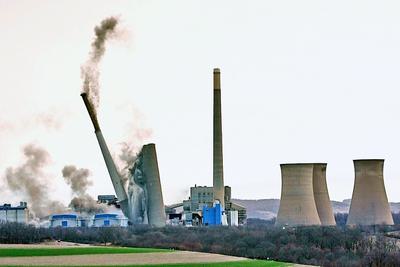
A shuttered coal-burning power plant in Homer City, Pennsylvania, was demolished to make way for a new gas-fired facility that will power data centers.
Gene J. Puskar / AP Photo
Corey Hessen, chief executive of Homer City Generation, said the project will be in “full compliance” with state air-quality regulations. The permit allows the Homer City power plant to emit two kinds of particulate matter, which can cause heart and lung illnesses, volatile organic compounds, nitrogen oxide, and sulfuric acid, in addition to carbon dioxide.
According to the Clean Air Council, the Homer City data center facility would produce 17 million tons of carbon dioxide emissions, equivalent to burning 18 billion pounds of coal or 39 million barrels of oil, while its annual energy consumption would be equivalent to that used by 3.2 million homes.
In Upper Burrell Township, in Westmoreland County, TecFusions, a global data center operator, is planning a project on 1,395 acres, powered by up to 3 gigawatts of gas-fired power generated on site. “This approach ensures reliability, efficiency, and reduced dependency on increasingly costly utility power,” according to a company statement.
And in Springdale, in Allegheny County, a proposed 565,000-square-foot data center on the site of the former Cheswick coal-fired power plant would use 180 megawatts of electricity drawn from the grid. The project has drawn protests from ratepayers who fear it will lead to higher residential electric bills if more capacity is required to meet the new power demand, in addition to generating more air and water pollution from power plant operations and from increased fracking.
As fracking expands to meet data center power needs, “conditions will get worse for the people of western Pennsylvania,” says a researcher.
Such concerns are not new in western Pennsylvania. For the last two decades, environmental advocates and researchers have accused the natural gas industry of polluting the air, polluting water through leaks and spills of chemicals used in fracking, and causing illnesses including cancer, asthma, and birth defects. The harms of fracking have been documented in a “compendium” of some 2,300 peer-reviewed studies from around the world published by the nonprofits Physicians for Social Responsibility and Concerned Health Professionals of New York. The Marcellus Shale Coalition, an industry trade group, maintains that fracking for natural gas in Pennsylvania is safe, and that by replacing coal-fired generation it was responsible for a nearly 11 percent decline in the state’s carbon dioxide emissions between 2022 and 2023.
How batteries, not natural gas, can power the data center boom. Read more.
Such industry statements do not reassure Liz Pebley, a 68-year-old resident of Freeport Township, in southwest Pennsylvania. She is particularly concerned about water quality and quantity as more wells are fracked. In June of 2022, a leak of drilling fluids — called a frac-out — from a gas well contaminated her well water with high levels of methane and heavy metals, including arsenic and barium. The well was operated by EQT, which will be supplying the Homer City plant with gas. Pebley said her water was discolored and smelled foul. In 2023, the company supplied her with a 550-gallon “water buffalo,” a plastic tank that still sits outside her house and remains her sole source of clean water. John Stolz, a Duquesne University professor and longtime critic of the gas industry who studied the EQT frac-out, estimates that the water of 50 other people was similarly contaminated.
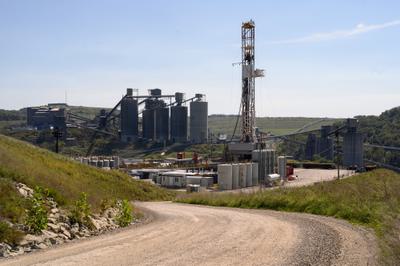
A gas drilling rig in Morris Township.
Justin Merriman / Bloomberg via Getty Images
“Unconventional oil and gas development has led to the loss of water resources not just at the front end, with removal, but also contaminating aquifers to the point where communities have lost their potable water,” said Stolz. As fracking expands to meet data center power needs, he added, “conditions will get worse for the people of western Pennsylvania.”
Despite scientists’ and activists’ concerns, only one western Pennsylvania municipality has proposed an ordinance to protect itself from data centers and their demand for electricity. Union Township in Washington County, a heavily fracked area south of Pittsburgh, wants power companies to certify that the grid can meet data center demand while ensuring supplies to existing and future homes and businesses; it also wants water suppliers to certify they have the capacity to meet the demands of the proposed facility while maintaining “sufficient levels of service” to existing ratepayers. To encourage other townships to pass protective measures, the environmental group PennFuture has published a model ordinance that includes similar requirements for electrical capacity and water supply.
The planned data center boom represents the latest attempt by the gas industry to find new uses for this vast resource.
The largest grid operator in the country, PJM Interconnection, which serves Pennsylvania and other mid-Atlantic states, is struggling to keep up with data center expansion. In late November, PJM’s independent market monitor, a watchdog for the operator’s wholesale energy markets, asked the Federal Energy Regulatory Commission to prevent PJM from adding data centers to the grid unless existing customers can be reliably served.
The Marcellus Shale, which underlies about two-thirds of Pennsylvania, has been producing natural gas using hydraulic fracking and horizontal drilling since 2004. Stolz estimates it still contains about 250 trillion cubic feet of gas. That’s about half of the 489 trillion cubic feet estimated in 2009 by former Penn State University professor Terry Engelder in landmark research that kick-started the state’s gas fracking industry. In 2024, the United States as a whole consumed about 33 trillion cubic feet of natural gas, according to the U.S. Energy Information Administration, while exporting 7.7 trillion cubic feet.
The planned data center boom represents the latest attempt by the gas industry to find new uses for this vast resource. In recent years there had been a push to make southwest Pennsylvania a petrochemical and plastics hub that would be dependent on fracked gas. But only one such facility has been built and is operating — the Shell ethane cracker plant in the town of Monaca.
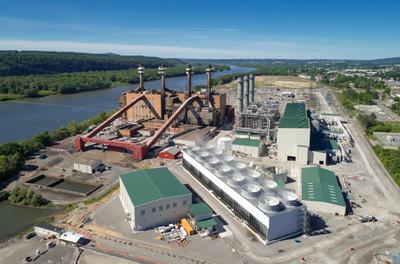
The Hummel Power Station, a gas-fired power plant in Snyder County, Pennsylvania.
Bechtel
Matt Mehalik, executive director of the Breathe Collaborative, a nonprofit that advocates for clean air in the Pittsburgh region, said that a surge in gas production to fuel data centers threatens to reverse a recent improvement in regional air quality that has been helped by the retirement of most coal-fired power plants. “Our air quality, even though it’s on a positive trend at the moment, can be put back on a negative trend, and we can be out of attainment [with federal air quality standards] because of these choices that are being made about building gas-fired power plants,” he said.
Still, it’s not certain that all the planned data centers will come to fruition should the supply of data center services exceed demand, said Alex Bomstein, executive director of Clean Air Council. “There is a giant data-center bubble that we’re living through right now where an enormous number of projects don’t necessarily have customers,” he said. “We don’t know which ones are going to materialize and which are going to disappear into the ether.”
It’s a ‘golden age’ for U.S. LNG industry, but climate risks loom. Read more.
David Hess, a former DEP secretary who currently edits an environmental newsletter, believes other factors besides the boom in data centers will lead to an increase in gas production. He forecasts it will also be driven by an increase in U.S. liquefied natural gas exports being championed by the Trump administration and by the Northeast Supply Enhancement Project, a planned pipeline that would move the fuel from Pennsylvania to New Jersey and New York City.
“There is no doubt all three will drive more drilling and more gas infrastructure development in Pennsylvania,” Hess said, “with all its documented negative impacts on public health and the environment.”