
According to Nolan Benner, Dan McFetridge, his boss when, as a young man, he worked at the purchasing department of Lehigh Portland Cement, was “a hard taskmaster.”

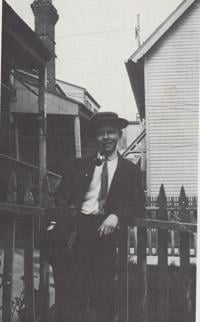
Nolan P. Benner
Lehigh County Historical Society
He would not even let his employees have a day off. In fact, the only way he could figure out how to get any time off in the summer was to enlist in the Pennsylvania National Guard. It may seem rather a roundabout way to get time off, but at least in that way he could spend two weeks at Mt. Gretna (in rural Lebanon County) with his buddies getting fresh air, sunshine and exercise.
As Benner recalled it later in “The General and His Captain,” edited by Morning Call reporter Dick Cowen and published in the 1984 edition of the Proceedings of the Lehigh County Historical Society, McFetridge could not really complain.
“Well, I can’t do anything about it,” Benner quotes him as saying. “Too many top executives… are officers in the guard.” So, it was. “At my first encampment, a real break kept me from being bored by the menial chores of a private. I was assigned to perform clerical work at the 4th Brigade Headquarters of Gen. C.T. O’Neil,” Benner recalled.
O’Neil was a well-liked figure in local business circles and when raising his fine tenor voice in local male choruses. His girth and panache when mounted on a white horse leading a parade down Hamilton Street were what his era thought a general should look like. But on a June day in 1916 “when the guard was called for active duty for the Mexican border service,” Benner got word that one of the founders of Lehigh Portland- Col. Harry C. Trexler- wanted to see him at his office in the Young building at 7th and Hamilton.
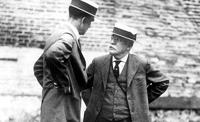
General Harry C. Trexler
Harry C. Trexler Trust
As was his wont Trexler was brief. He understood, he said, that Benner had been doing clerical work for the 4th Brigade. But now things were different. “I need a stenographer on my staff which I am organizing for the Mexico mobilization camp. General O’Neil told me he could spare you.” They would leave for Mt. Gretna the next day. The headquarters would be in the Conewago Hotel. He was to instruct Mr. McFetridge to give him a typewriter.
At 1:00 p.m. on June 24th, 1916, Trexler’s chauffer Louie Smith pulled up in the big Cadillac touring car. O’Neil, Trexler and two other officers got in. Benner noted later that he “felt like a war correspondent with a typewriter on my lap.” It was an open car, as most cars were then.
“The drive to Mt. Gretna was beautiful and peaceful,” Benner recalled. “No concrete superhighways. Narrow two-lane roads contoured to the lay of the land carried us westward to Lebanon County…On our way we passed over several toll roads and were amused at Colonel Trexler when he finagled the toll keepers out of their tolls. He would call out to the toll keepers, ‘We’re on military duty. Drive on through, Smitty.’”
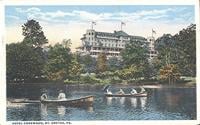
Hotel Conewago, Mt. Gretna
ExplorePAHistory.com
Arriving at the Hotel Conewago the group began to set up the headquarters, said Benner: “Col. Trexler’s duties as a quartermaster general was to provide the sustenance and transportation of the troops. By the time the first troops arrived at camp, he had to have supplies of food on hand. He required the regimental supply officers to request food supplies for their respective units.”
Benner gives a description of what he calls Trexler’s ability to organize. And he was not at all stopped by organizational channels. Discovering he needed fresh meat, Trexler went to the source:
“Ignoring military regulations, he placed a call to the Armour Co. in Chicago. The conversation: ‘I am Col. Harry Trexler of Allentown. I am the quartermaster general of Pennsylvania. Because of the mobilization of troops by President Wilson, I must, by noon Saturday, begin to feed 12,000 men. Immediately start with a carload of your best beef and better add a carload of hams and bacon. Send a man along with my men and you shall receive a check on the day of arrival.’”
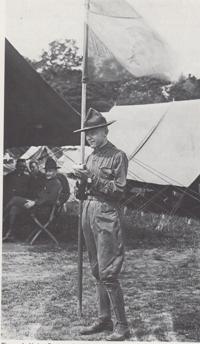
Capt. Nolan P. Benner
Lehigh County Historical Society
What national events had Pennsylvania National Guard troops rushing to the border with Mexico? The collapse of the military dictatorship of Genera Porfirio Diaz in 1910 led to clashes that sparked violence between various factions in the country, called by one source “the defining moment of modern Mexican history.” The regular army collapsed and was replaced by a revolutionary army. A new constitution was written but the factions were strong and fought each other.
“There is a consensus as to when the revolution began, that is 1910, but there is no consensus when it ended,” notes one source. Among the most famous figures was guerrilla leader Pancho Villa. Later a great deal of time was spent by General John J. Pershing and a young fellow officer George S. Patton tracking him down without success. Some historians have used this to argue as an example of the U.S. military of the day being unable to cope with guerrilla warfare. Others contend that it showed the willingness of being able to challenge an unconventional force on its own grounds. The widely regarded historian on the Mexican Revolution, the late Friedrich Katz, has written a respected biography on Villa and on foreign involvement in the revolution.
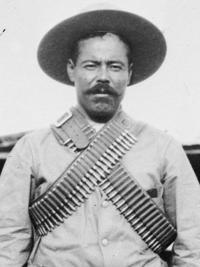
Pancho Villa
Library of Congress
“In June 1916 a crisis was brewing on the border. Villa had crossed the border and raided several U.S. towns including Columbus, New Mexico, and Boquilla, Texas,” notes Major Angelea King-Sweigart of the Pennsylvania National Guard in the Guard’s 100th Anniversary newsletter of the Mexican mobilization issued on July 26, 2016.
These events drew the attention of the Wilson White House. “While American authorities could look with approval on the pursuit of outlaws, a battle on United States soil by two opposing Mexican political factions was something that could not be overlooked or condoned,” writes American military historian Clement Clendenen.
Wilson ordered Secretary of War Newton D. Baker to issue a call to the governors to mobilize the entire National Guard. Pennsylvania Governor Martin Brumbaugh did so, and several units headed to Mt. Gretna.
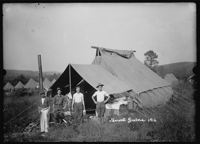
Soldiers at Mt. Gretna, 1912
Fort Indiantown Gap training grounds
According to the National Guard publication, the units were a part of the 7th Division, predecessor to part of the current 28th Division who arrived at Mount Gretna on June 23. There were nine infantry regiments as well as the First Cavalry, First Artillery, Signal Corps and the Ambulance Corps. Inoculations for smallpox and typhoid were given. Those men found fit for duty were mustered in on July 4 and began leaving for El Paso.
Benner recalled toward the end of July Trexler was surprised that the man had not been paid. “Well, I don’t want to see the men leave for Texas without money in their pockets,” he said. “Have the payroll prepared. I’ll give my personal check for the amount and take my chances on getting repaid by the government.” The payroll was prepared, and Benner drove into town in the officer’s Stutz roadster and got the cash from the bank. “The men were paid as they entrained for El Paso,” recalled Benner.
The National Guard source says a 1st sergeant could make $11.25 a day, sergeants and cooks $7.50 a day, and privates and musicians $3.75 a day. The troops were under the command of Major General Charles M. Clement, also president of the Central Railroad of Pennsylvania. They were rotated through into the late fall of 1916. All the troops had returned by March 1917. The U.S. would enter World War I that April.
Trexler completed his work at Mt. Gretna and returned to Allentown that August of 1916. Before he did, he offered Benner a job in his office, which Benner accepted. He went to work at the Young building on November 16, 1916. They would be together until Trexler’s death following a highway accident on November 16, 1933.
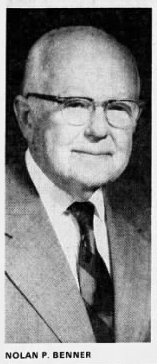
Picture of Nolan Benner from his 1980 obituary
Newspapers.com
Benner would lead the Trexler Foundation for 32 years before his own death in 1980.