

The first sentence handed down under a Pennsylvania law criminalizing the use of artificial intelligence to create sexual images of children was as harsh as a Lehigh County judge could make it, and prosecutors were pleased by the message it sent.
Adam Erdman will spend at least 28 months and as long as 10 years in state prison for using an online program to convert photos of a friend’s clothed preteen daughters into nude images.
At the Monday sentencing, Judge Anna-Kristie M. Marks was unimpressed by the defense’s claim that Erdman was driven by gender dysphoria into exploring how he would look as a nude young girl.
She rejected attorney Michael Stump’s request that Erdman be sent to county jail instead of state prison, where he potentially would find himself among more dangerous sex offenders.
“This type of offense is extremely calculated,” Marks said in imposing the highest sentence under state guidelines.
The 35-year-old Bethlehem man was charged last year after his estranged wife reported finding the images on his laptop computer. He entered a guilty plea in September to one count of child sex abuse material, the legal term for what is commonly called child pornography.
Erdman’s conviction and sentencing were the first in Pennsylvania under a law introduced by former Lehigh Valley state Rep. Ryan Mackenzie, who is now a U.S. representative, and pushed to adoption a year ago by state Sen. Tracy Pennycuick, who represents parts of Montgomery and Berks counties.
“What Mr. Erdman is going to jail for today could not have been punished until this law took effect at the end of 2024,” Lehigh County District Attorney Gavin Holihan said at a news conference after the sentencing.
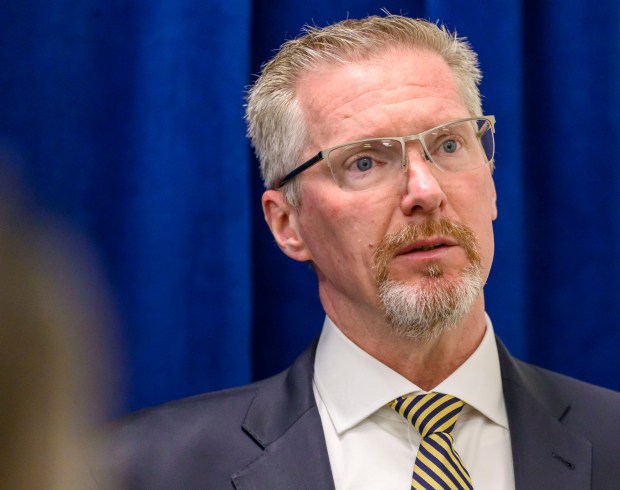 Lehigh County District Attorney Gavin Holihan said he is pleased by the harsh sentence given to a Bethlehem man who used artificial intelligence to turn photos of two clothed preteen girls into nudes.
(April Gamiz/The Morning Call)
The girls, ages 9 and 6 at the time of the crime, were daughters of one of Erdman’s friends. Before Marks handed down the sentence, the girls’ mother offered a tearful statement about her anger and sense of betrayal when she learned what Erdman had done to the vacation photos she posted on social media.
“I trusted Adam as a friend and all the while he was preying on my children,” she said. “I hope and pray justice will be served.”
Erdman’s defense was based largely on claims that he suffered from sex addiction and in Stump’s words, was “gender-fluid bordering on transgender” and wanted to see what he would look like as a girl.
Prosecutors said that claim was belied by the fact that he didn’t use the technology to put his own features on the altered photos. Erdman also had a lengthy history of online searches for terms related to child pornography, suggesting he had a broader interest in it.
The case was investigated by Bethlehem police Detective Stephen Ewald and prosecuted by Senior Deputy District Attorney Sarah K. Heimbach. Both joined Holihan at the news conference, where they talked about the easy availability of the kind of program Erdman used to doctor the photos.
“Simple Google searches can locate these types of programs,” Heimbach said. “The availability of that was shocking.”
Holihan called the technology “frightening and dangerous.”
“This type of child pornography raises great concerns with us because it is target-selective,” he said. “This offender knew the people he had the images of, had been in their home, was friends with their mom and targeted them to turn them from innocent pictures into child pornography.”
Holihan said he’d like to see more and stronger laws regulating AI.
“We could use laws that make this a crime when you do it to adults,” he said. “Right now it’s just children. … There should be limits on what technology is allowed to do to manipulate people who exist in real life into situations and images of things that they have never done.”
The law is unclear on whether Erdman would have faced the same penalty had he used the program to create images of nude children that weren’t based on real people.
“With the statute being so new there have not been any challenges to it yet, whether that is in a criminal law arena or a constitutional law, free-speech arena,” Heimbach said. “The case law does not exist to really fluff that out. So that’s going to be something that’s yet to be seen as the case law develops.”
Ewald said the case underscores one of the risks of putting personal photos and information on social media.
“You have friends on Facebook, you have trusted friends you give access to your profile to,” he said. “It could happen to anyone.”
Morning Call reporter Daniel Patrick Sheehan can be reached at 610-820-6598 or dsheehan@mcall.com.