
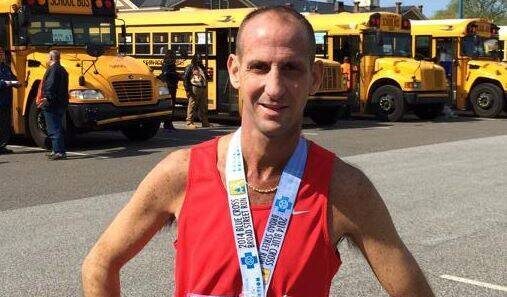
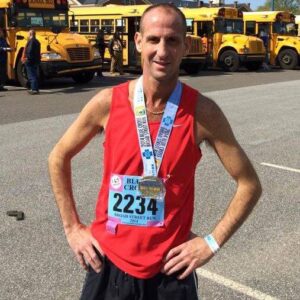
 Adam Mark Hyman after completing a 2014 race (Courtesy of the Hyman family)
Adam Marc Hyman spent most of his life confronting medical crises that would have sidelined almost anyone else. Instead, he used those challenges to build a career caring for children facing the same fears he knew firsthand.
Hyman, a longtime pediatric oncology nurse at the Children’s Hospital of Philadelphia, died on Nov. 24 in Souderton. He was 52.
To colleagues and families at CHOP, Hyman was known not for what he endured, but for what he brought into exam rooms and hallways: candor, steadiness and a sense of humor that could cut through the tension of even the most difficult days. When his health challenges precluded working 12-hour shifts, he became a nurse navigator — first in oncology and later in gastroenterology. He coordinated care for young patients, explained treatment plans and gave parents a single, trusted point of contact in a complex medical system.
“He was the one person the families could talk to,” said Michael Grossman, a former CHOP nursing director who hired him in 2000. “He organized everything and made sure they understood what was happening. He was perfect at it.”
Former patients and parents echoed that in online tributes. One young adult, treated at CHOP as a teenager, said Hyman “helped me find a sense of normalcy when I felt out of place,” and continued checking on him years after treatment. A mother wrote that he made her son’s long hospital stays easier, adding that he “was for sure an angel from heaven to care for all these sick children.”
Hyman built equally strong ties with colleagues, who said he blended sharp, dry humor with deep loyalty. He often referred to himself simply as “AH,” speaking in the third person when making a joke. “He always had a snarky remark,” said his sister, Shari Gold. “He let you know exactly where he stood.”
Born on Aug. 9, 1973, in Philadelphia, Hyman grew up in Northeast Philly, where he was, in Gold’s words, “a tough kid from the time he could talk.” She recalled him climbing appliances at age 2, breaking his arm on a Big Wheel at 4, and insisting on swimming at camp with a fresh cast the next day. He played basketball at the Klein Branch Jewish Community Center (now KleinLife) and developed friendships that lasted decades.
A medical emergency in high school ended his basketball days, but running soon became his foundation. It was the one physical space he controlled, no matter the obstacles in his life. He ran marathons in Boston, Hawaii and at Disney, trained with the Wynnefield Track Club, and logged countless early-morning miles through Center City.
He often stopped to chat with TV crews setting up for early morning broadcasts. He befriended sports reporters the same way he befriended fellow runners — by showing up, by engaging people, and by having opinions about everything from the Eagles’ chances to the best cheesesteak in town.
“He loved sports, food, restaurants — and he had strong opinions on all of it,” Grossman said. “We were experts in put-down humor.”
In recent years, he found a second family in Ross and Alyssa Iliescu. He and Ross had been friends since their middle-school days, and the couple later drew him into their home and routines. “He became like my second husband and a brother,” Alyssa Iliescu said. They brought him to Florida, included him in holiday dinners, and spent summers with him in the seaside town of Margate. “He lived life day-to-day and always lived it to the fullest,” she said.
His path toward nursing began at Beaver College, now Arcadia University. He went on to earn his degree at Frankford Hospital School of Nursing. His own childhood care at CHOP inspired him to return as a nurse. “He went into nursing because of what he experienced,” Gold said.
Families sensed that connection immediately. He did not sugarcoat, but he reassured. He understood the fear of not knowing what comes next. “He knew what parents were going through, what kids were going through,” Grossman said. “That made him extraordinary.”
Only later in conversations did Hyman’s sister and close friends describe the medical challenges he faced quietly. At 11, he was diagnosed with Zollinger-Ellison syndrome, a rare gastroenterological condition that began a lifetime of complications. He was ill at the time of his bar mitzvah and had to be tutored at home. But he rarely talked about the pain.
“People didn’t realize how much pain he was in,” Gold said. “He’d just say, ‘I’m OK,’ even when he wasn’t.”
In 2018, childhood friend Mike Green donated a kidney, a gift that allowed Hyman to return to running and to work. “It was the gift of life,” Gold said. When that kidney eventually began to fail, he tried dialysis without improvement. Doctors later declined him for a second transplant, and in early November he chose to discontinue treatment.
The decision reflected a principle he had long articulated: quality over quantity. Running, eating well, debating sports, connecting with patients and friends — these were the things that defined his life. “Health is wealth,” Iliescu said he often told her.
Though Hyman questioned religion from a young age — “If there’s a God, why did he make me sick?” he once asked — he embraced one value consistently: treat others the way you want to be treated. Gold said that guided him with patients, families, colleagues and the many friends he collected across Philadelphia.
His approach to life, Grossman said, mirrored a graduation speech Hyman once gave at his alma mater George Washington High School. He spoke about feeling “invincible.” He described pushing himself out the door in any weather to run — not because he had to, but because it made him feel alive and capable. “For the moment, I feel invincible,” he told students. “It’s just me versus the elements.”
Grossman said that spirit outlasts the physical limits Hyman lived with. “His physical body wasn’t invincible — nobody’s is,” he said. “But his spirit was. And it will live on as long as we keep telling stories about him.”
Ellen Braunstein is a freelance writer.