
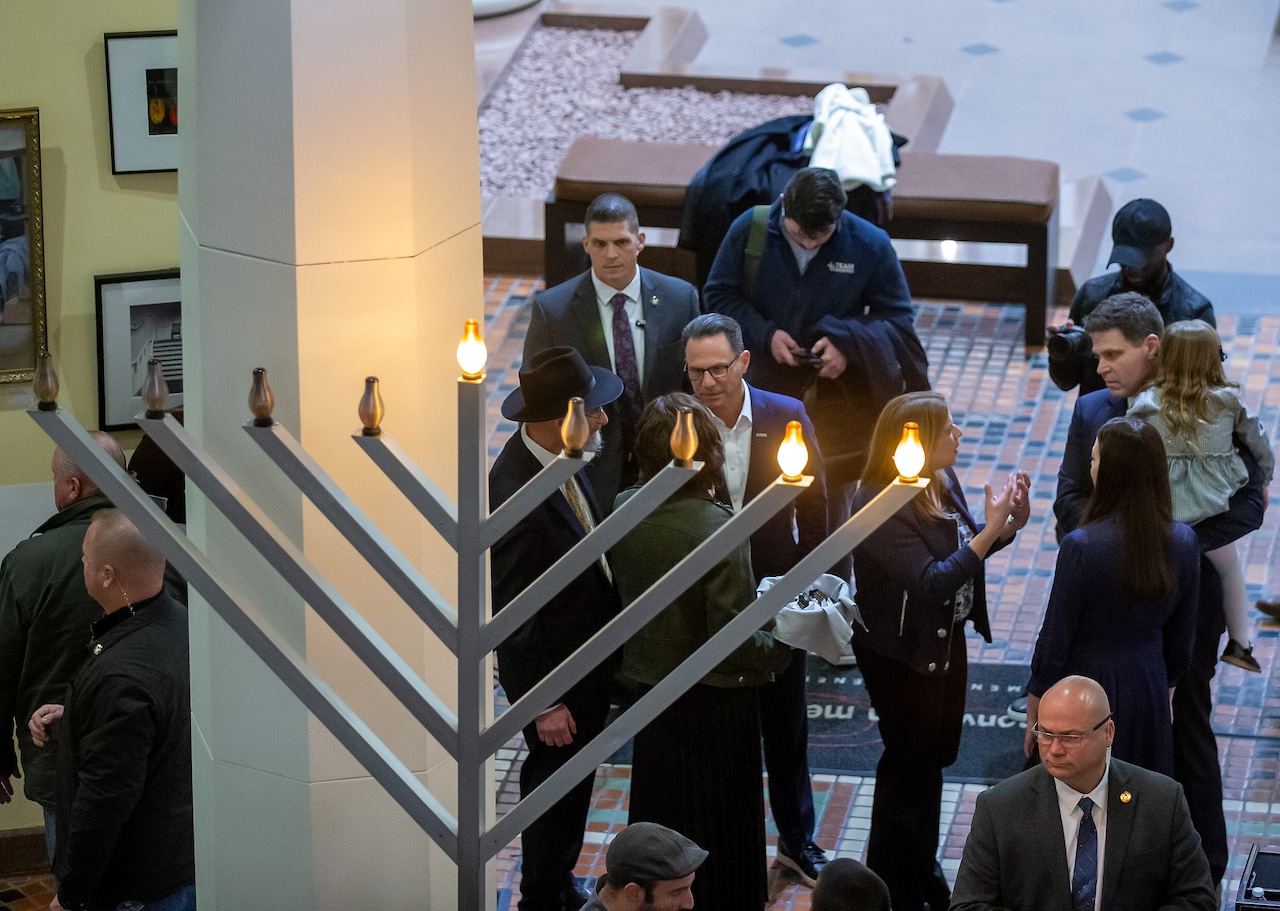
The state Capitol’s giant menorah was officially lit at sundown Monday, marking the second night of Hanukkah for Jewish Pennsylvanians.
The lighting of the roughly 10-foot-tall menorah – the traditional candelabra used for the Hanukkah holiday – was organized by Chabad-Lubavitch, an orthodox Jewish outreach group, and was accompanied by food, games, musical performances and giveaways in the Capitol’s east wing rotunda.
Elected officials, including Gov. Josh Shapiro, gave brief remarks before the lighting. Several made note of Sunday’s deadly mass shooting at a Hanukkah festival in Australia, which authorities believe was motivated by antisemitism.
“Hanukkah, for us especially now, is about the pride of presence, because we must continue to be present at every turn,” said Rep. Jared Solomon, D-Philadelphia, who has recounted the story of his own great-grandparents fleeing anti-Jewish pogroms in what is now Ukraine.
Hate crimes motivated by racial and/or religious animosity have risen across the state in recent years, according to the Pennsylvania Human Relations Commission. But the commonwealth remains a beacon of religious freedom, Shapiro said Monday, in keeping with William Penn’s vision.
“He set out to build a place, a home, that would be foundationally set in the notion of free expression,” said Shapiro, who is Jewish.
“Think about where we are today, here in the state Capitol in the place that Penn founded called Pennsylvania, about to light a haunukkiah openly and freely and proudly for all to see,” Shapiro continued. “That’s extraordinary progress that we’ve made in our county, and I believe Pennsylvania remains a light unto the nations, an example to the nations, as Penn had hoped.”
Hanukkah is an eight-day holiday based on the events of the 2nd century B.C. Maccabean Revolt in ancient Israel, during which — according to the popular retelling — the beleaguered Jewish fighters were able to survive for eight days with only one day’s worth of oil after re-occupying the Temple of Jerusalem.
The holiday is timed to the month of Kislev in the traditional Hebrew calendar, falling shortly before or sometimes shortly after Christmas.