
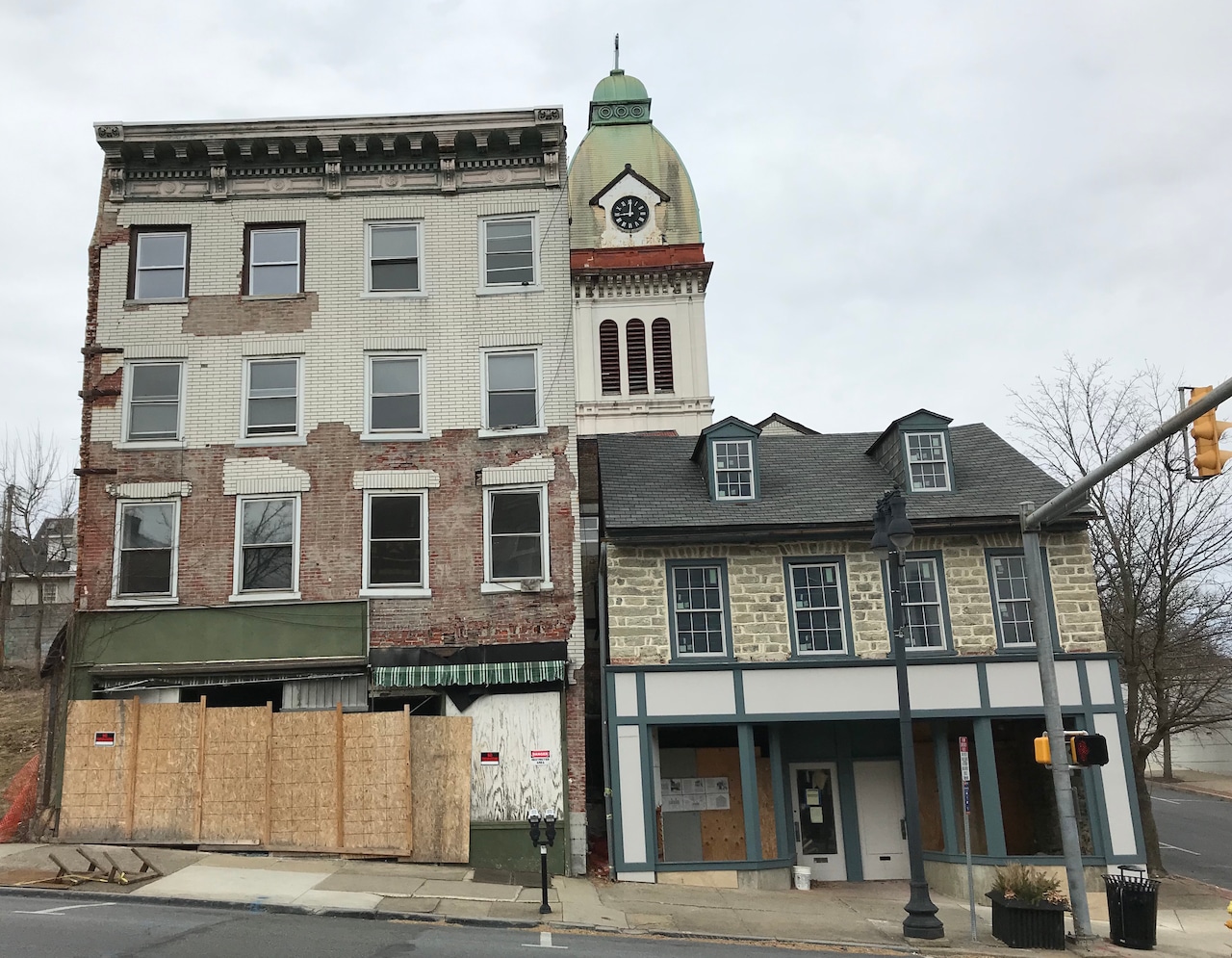
A longtime dispute over a historic Easton property may come to a conclusion.
The Easton Zoning Hearing Board unanimously approved a variance request Monday night allowing the subdivision of a parcel tied to the Rock Church of Easton. This clears the way for the City of Easton to restore the historic Hooper House while the church retains the Timothy House.
The request involved a reduction in minimum lot size requirements to permit the subdivision of a single parcel into two distinct properties. The decision follows months of negotiations tied to an ongoing condemnation case involving the site.
Hooper House, located downtown at the corner of Northampton and Fifth streets, is one of Easton’s oldest remaining structures and has long been the subject of preservation efforts by the city. Assistant City Solicitor Jeremy Clark said the city has attempted for years to acquire the building through negotiations before ultimately filing a condemnation action.
That taking transferred ownership of the full parcel to the city while the court reviews whether the action was legally valid.
“After the taking, where we were taking that entire property, the church filed an appeal of that decision,” Clark said.
The parcel also includes the Timothy House, a newer, two-story multi-dwelling structure used by Rock Church for temporary housing. Clark explained that the city and the church reached a tentative agreement to subdivide the lot, allowing each party to retain a building while resolving the broader legal dispute.
He said the subdivision line would run through a narrow gap separating the Timothy House from an addition attached to Hooper House.
According to Clark, the connecting addition between the two buildings is structurally integral to Hooper House and will remain with the city’s portion of the parcel. The city’s engineer determined that retaining the addition is necessary to restore the historic structure without extensive reconstruction.
Under the agreement, the city will retain approximately 1,417 square feet containing Hooper House and the attached addition, while Rock Church will retain roughly 2,018 square feet containing the Timothy House. Funds used to acquire Hooper House, which was previously agreed upon at $350,000, will be held and directed toward exterior renovations and upgrades to the Timothy House.
“The city will undertake restoring the Hooper house itself, and then we will be working hand in hand with Rock Church and making sure that the Timothy House is also restored, to really bring that whole corner up to par,” Clark explained.
Public Works Director David Hopkins said a yet-to-be-formed committee of city staff and church representatives will oversee how the renovation funds are spent. He said the city will likely prioritize the roofs, windows, making the structure weather-tight, and repointing, which renews mortar joints in brick and stone structures.
“I don’t know what the future use might be. There are a lot of ideas being kicked around,” Hopkins said. “It’s not a terribly large space, but I think it’s historically valuable.”
Clark said that if funds remain after renovations to the Timothy House are completed, Rock Church has agreed they would be redirected toward restoring the church’s bell or clock tower. He described the tower as another prominent historic feature in downtown Easton.
Had the variance not been approved, Clark said the city would likely resume litigation over the full parcel, potentially delaying restoration efforts by about a year. He said that scenario would also increase costs for both parties and require the city to manage multiple structures.
“I believe this is a project and an application that’s going to be really beneficial to the downtown,” Clark said. “It’s going to keep in character with the downtown, and is a great nod to the historic value of Easton in America’s history, not just the history of Easton.”