
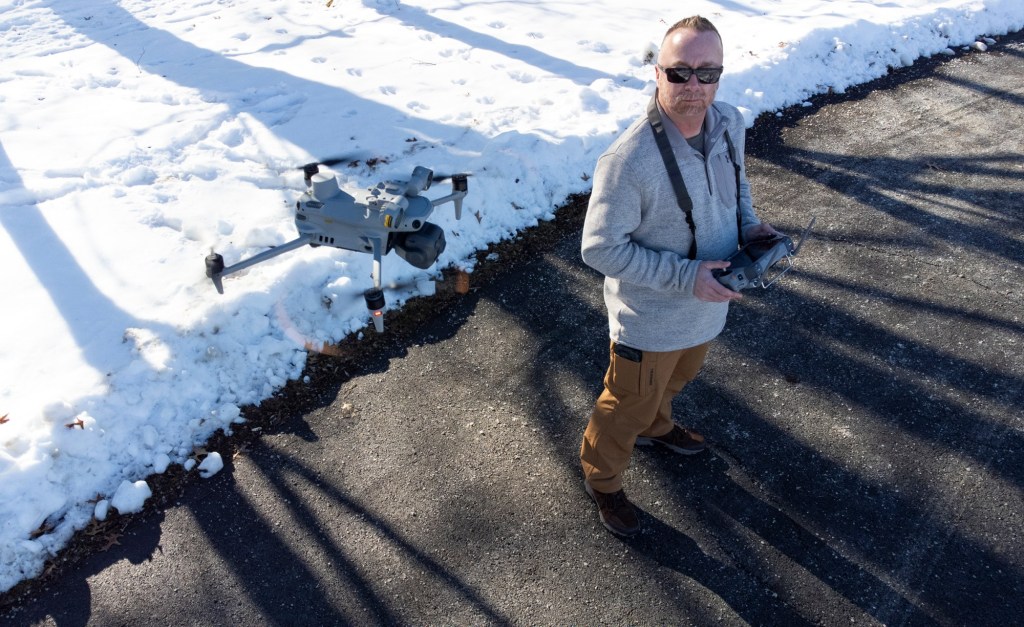
A potential federal ban on an extremely popular brand of Chinese-made drones could ground local drone pilots and first responders.
Barring a last-minute federal audit or extension, the Federal Communications Commission is poised to add Shenzhen, China-based DJI Technologies to its list of banned companies on Tuesday, effectively halting sales of the most widely used brand of drones in the United States over concerns about the company’s ties to China.
Although the ban wouldn’t retroactively apply to existing DJI drones, it leaves local commercial pilots and first responders with few options moving forward.
Congress adopted the National Defense Authorization Act for Fiscal Year 2025 last December, with then-President Joe Biden signing the annual defense appropriations bill into law on Dec. 23, 2024. The nearly 800-page document includes a section on “analysis of certain unmanned aircraft system entities,” stipulating that a national security agency must assess DJI and Autel Robotics, another Chinese drone maker, no later than one year after its enactment to determine whether they pose an “unacceptable risk” to the national security of the United States or the security and safety of its residents. The legislation does not designate an agency to conduct the assessment.
If the government does not make a determination within one year, the FCC will add DJI to its “Covered List” of banned equipment under the Secure and Trusted Communications Networks Act of 2019, according to the legislation. That list includes Chinese cell phone manufacturers Huawei Technologies Company and ZTE Corporation, as well as the Russian antivirus software maker Kaspersky Lab Inc.
President Donald Trump’s administration now has until Dec. 23 to carry out that review, but according to a Dec. 10 social media post by DJI, as far as the company was aware, the federal audit process had not yet begun.
The looming ban stems from concerns from lawmakers about the company’s ties to the Chinese government, though the drone manufacturer contends it is not controlled by the government and has no ties to the Chinese military.
If the ban goes into effect Tuesday, local drone pilots and first responders point to a lack of American-made competitors to replace their DJI drones, whether it’s filming a major sporting event, looking for a lost person or animal, or assessing a working structure fire.
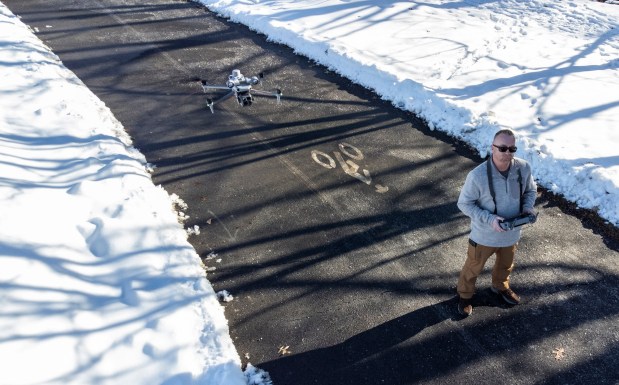 Johnny Lubeck, owner of NEPA Drone, hovers his DJI Matrice drone in the Blakely Borough Recreational Complex in Peckville Thursday, December 18, 2025. (SEAN MCKEAG / STAFF PHOTOGRAPHER)
Far-reaching effects
John G. Duesler Jr., Ph.D., founded the Pittston Twp.-based Pilot Mind Drone Academy in January, and his aerial production company, Kaze Aerial Production, employs 15 to 20 people who use drones to film 60-plus events worldwide, including filming for the NFL, NCAA, PGA and NASCAR, among numerous others. Earlier this month, his company became the first to use drones to film for the annual Army-Navy football game at M&T Bank Stadium in Baltimore, he said.
Duesler, who is also the president of the PA Drone Association, was an early adopter of drones, getting his first in 2012. At the time, he was hired to livestream an event in California when someone told him about a “flying camera.”
“I didn’t quite know what they were talking about, and of course, it was a drone,” he said. “I saw that drone, and we made our first one, and we were off to the races. Everything took off — pun fully intended.”
His early drone was very primitive, and as an early adopter, his company has been evolving with drones, even having some influence in the policies and regulations governing drones today, he said.
Currently, there are about 1 million registered drones with the Federal Aviation Administration, and about 460,000 registered pilots, he said. DJI maintains a roughly 80% market share, meaning there are about 800,000 DJI drones flying in the United States, Duesler said.
“More than 80% of the public use them because they’re so reliable, the cameras are so powerful,” he said, explaining they’re the preferred drone in the public, private and commercial sectors. “Anybody who flies a drone knows that these are the best drones.”
The legislation and lobbying to ban DJI was attributed to them posing a security risk, but no one has actually demonstrated any risks, he said.
“We’re concerned about it because the drone community obviously believes in the future of these drones, and so with claims of security, yeah, absolutely positively, we want to make sure that is not the case,” Duesler said. “But, we have yet to see any actual evidence of this.”
If a ban goes into effect, Duesler does not anticipate it will apply retroactively, though he noted the FCC has that option. In October decision, the FCC also gave itself the power to retroactively revoke its existing authorizations, meaning the agency could disable all DJI drones — not just blocking the import of new drones — by prohibiting them from broadcasting on federally regulated radio frequencies.
In a June 6 executive order aimed at “unleashing American drone dominance,” Trump ordered that the U.S. must “accelerate the safe commercialization of drone technologies,” intended to scale up the domestic production and expand the export of American-made drones.
The problem, according to Duesler, is that there’s no real competition to DJI, and the competitors that do exist are more expensive.
“There’s a huge drop-off from DJI,” he said. “The quality of the images, the safety of the drones … with these other options, it may work, it probably will, but it’s not as reliable.”
Banning DJI would be devastating, notably for first responders and their publicly funded drone programs, he said.
“It would be a really heavy weight for the municipalities to carry,” Duesler said.
In Pennsylvania, 28-plus industries now use drones, with uses spanning insurance adjusters, wind turbine and power line inspections, the construction industry, agriculture, delivery services, and even measuring methane emissions from fracking, he said.
Banning DJI will leave very few alternatives unless a company wants to invest significant money into creating its own drones — an option he anticipates pursuing for his business.
“Public service would be profoundly affected, but your neighbors and your relatives and your friends will be affected because it’s that broad of an impact that it’s going to make,” he said.
Local impacts
If the ban goes into effect, John Lubeck will feel the effects as both a commercial drone pilot and a first responder. Lubeck is a Blakely police officer who founded NEPA Drone in 2016, spending nearly a decade as a commercial pilot and the past four or so years flying drones for local law enforcement agencies.
Lubeck’s latest drone, a DJI Matrice 4T, cost him about $11,000 with extra batteries; an American competitor would be triple that with a $5,000 annual subscription fee, he said.
“If there was an American-made drone competitive with DJI, trust me, I would have it in my fleet, but there isn’t,” he said, explaining other drone pilots he’s spoken to share the same perspective.
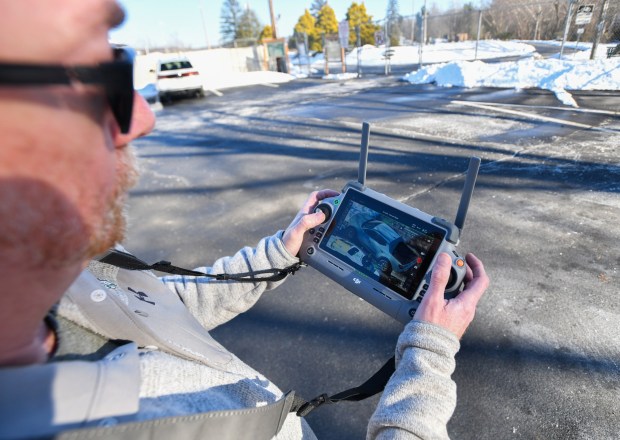 Johnny Lubeck, owner of NEPA Drone, controls his DJI Matrice drone in the Blakely Borough Recreational Complex in Peckville Thursday, December 18, 2025. (SEAN MCKEAG / STAFF PHOTOGRAPHER)
Police departments use drones to find missing people, document crime scenes and just for a better vantage point, especially when using a thermal camera at night, Lubeck said, recalling using a drone with a thermal camera to monitor a possible barricaded suspect to ensure officers weren’t ambushed as they approached the property. When a hiker fell off the “Top of the World” in Dunmore a few months ago, Lubeck found him using a DJI drone’s thermal camera. Pennsylvania State Police also use DJI drones, he said.
In another instance, in February 2023 when the former Atlantic Veal and Lamb slaughterhouse in Olyphant caught on fire — later ruled an arson — Lubeck flew the Olyphant Police Department’s drone to help firefighters look for hot spots.
While the ban will only apply to new drones, Lubeck worried about the supply of batteries for existing DJI drones. A drone battery is only good for a couple hundred power cycles, he said. His friends and competitors all fly DJI drones, and once that battery supply runs out — and with no consumer drones at an affordable price point — a ban will affect all of them, he said.
Locally, real estate is big for commercial drone pilots, with other work involving building documentation, construction documentation, and some businesses just want videos with aerial perspectives, he said. Lubeck also gets calls almost every other day to help people find their missing pets using his personal drone’s thermal camera. Local media also rely on DJI drones.
“If this goes through, and the audit is not done by the 23rd, it, absolutely in time, will ground everybody who has a DJI drone,” he said. “You can only cycle batteries so much. You can only fly so much before something, God forbid, does happen to the drone.”
The Olyphant Police Department spent nearly $20,000 on a DJI Matrice 30T drone with a thermal camera and extra batteries in 2022, Police Chief James DeVoe said. The department also has a smaller training model from DJI.
The Lackawanna County district attorney’s office gave the department the money for the Matrice 30T from funds seized by Olyphant police in a drug bust, DeVoe said.
“We’ve used it anywhere from drug busts — surveillance for our drug busts to make sure everybody is OK — to finding dogs to finding people,” he said. “It’s limitless, and on top of that, with us, DJI is one of the most reasonable drones out there that does more than some of these $50,000 drones.”
Olyphant also assists other departments with its drone, including helping Dickson City look for suspects who fled the Viewmont Mall, assisting Dunmore with a search and rescue, and using it to help provide security at different events, DeVoe said.
In the event of an active shooter, his department could send up its drone and set it to automatically track the gunman, he said.
If his department is no longer able to buy DJI drones, they won’t be able to afford an American-made brand without the help of grants from the companies, he said.
“We couldn’t afford to do them,” he said. “We’re small towns. You’ve got to remember, policing in itself is getting expensive.”
Last year, the Scranton Fire Department added three DJI Mavic 3T Enterprise drones to its arsenal for about $6,500 per drone, later adding a fourth for its emergency management specialist, Fire Chief John Judge said.
“They’ve been a game changer operationally for us at fire scenes,” he said. “Being able to see on top of the structure and use the thermal imaging capabilities to see exactly what’s going on with the fire inside there has given our incident commanders, essentially, information at their finger tips, useful information, good data.”
The information from their aerial view with thermal cameras allows the Fire Department’s incident commanders to make strategic, tactical decisions based on a fire’s progressions, giving them data to determine whether they should take a more defensive approach to protect firefighters inside burning buildings, Judge said. If there’s a working structure fire, as long as the weather permits, one of the first things a city fire inspector will do is send up a drone, Judge said.
His department has used them to look for missing people twice because they cover substantially more ground, and drones will also allow the department’s emergency management specialist to map out the aftermath of disasters and provide initial damage surveys, Judge said.
However, he believes losing access to drones will be more impactful to police than firefighting.
Judge now hopes third-party companies will fill the void of replacement parts for DJI drones if the company is pulled from U.S. shelves.
Like other first responders, he pointed to DJI’s affordability compared to competitors. His department would’ve been able to buy one drone for the price of its four DJIs, he said.
“I just can’t justify those types of costs,” Judge said. “The $30,000 option is not a feasible option right now. I mean, that’s not much less than what I’m paying for a pickup truck.”