
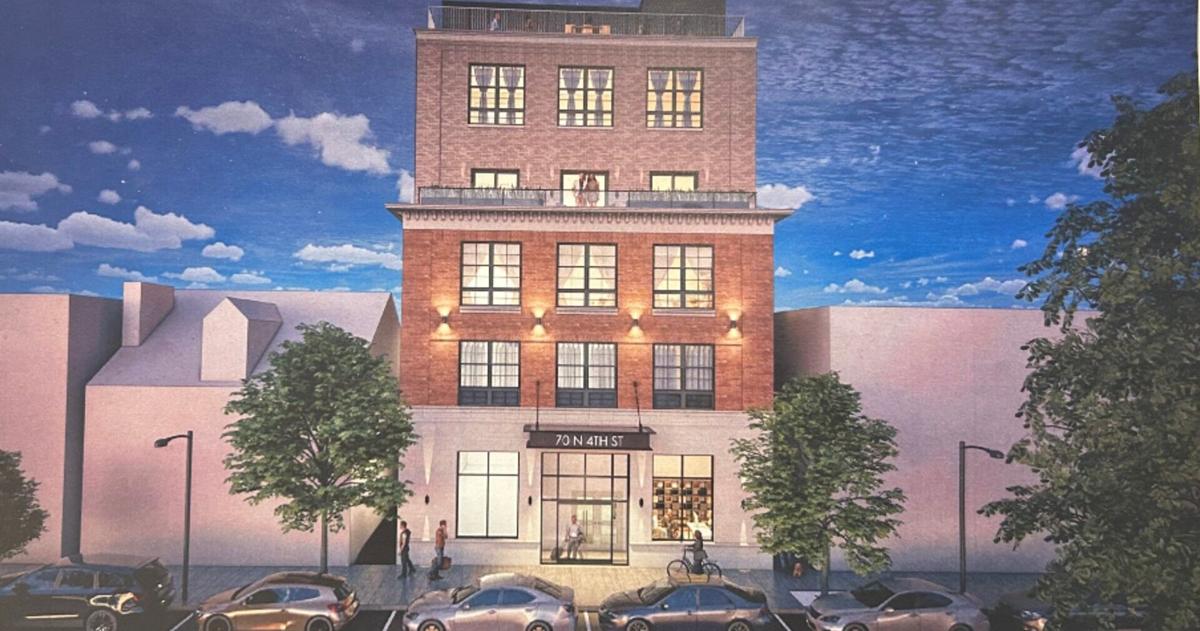
EASTON, Pa. – The Easton Zoning Hearing Board continued a hearing on variance requests and an interpretation challenge involving a proposed mixed-use apartment building Thursday night at city hall.
The appeal, offered by attorney Chad DiFelice, involves a six-story, 34-unit structure at 70 N. Fourth St. The application calls also for 1,190 square feet of commercial retail space.
Thursday night’s special public hearing involved three variance considerations. One involved a sidewalk width/configuration variance, a second would permit a building height and size greater than 15% more than adjoining properties, and a third to allow a 35% façade window service area.
The applicant also challenged a zoning officer interpretation, and without a favorable decision overturning it, DiFelice then sought a fourth variance.
DiFelice began the evening by presenting an argument which simultaneously challenged the ordinance’s validity and requested variances from it. However, board solicitor Robert Nitchkey indicated members would first render a verdict on the ordinance’s validity, and then, if needed, offer decisions on the variance requests.
In his opening statement, DiFelice addressed the audience which included various parties against the project. Most objectors have expressed concerns about parking and the building’s height.
“We are not your enemies,” the attorney said.
He added that his client has not developed any of the recent larger downtown Easton developments, contrary to rumors. DiFelice said the “use is permitted by right” and “the height itself is permitted by right.”
DiFelice said the applicant is “seeking 19 parking spaces from the garage,” not 100 spaces. He added there is “no separate downtown historic district.”
Finally, he added the reason his client was offering the appeal was that they “just wanted to be treated fairly. No more, no less.”
The evening’s first witness was Dwayne Tillman, director of planning and codes for the City of Easton. He was questioned about how he reached his verdict on the building’s size.
The next witness, Carl Manges, the city’s planning administrator who previously served as the city’s zoning officer, also received questions concerning how he determined the building exceeded the size of adjoining properties.
The objective was to question their code interpretation compared to how other properties were interpreted.
DiFelice asked also about which specific “adjoining properties” were used for comparison and why they were selected.
Other attorneys either representing the city or objectors also questioned the witnesses and made statements. One included Jeremy Clark, city solicitor, who said the applicant’s challenge is “not valid.”
Another witness called by the applicant’s attorney was Anthony Civitella, a senior architect designer. He testified about why the applicant was seeking sidewalk relief.
“The ordinance states that when you’re constructing new building, you need to put sidewalks on all sides,” Civitella said. “We would obviously renovate the Fourth Street sidewalk…but on West Street, it’s a back alley and it has vehicular entrance.” He testified further the design was consistent with what was there currently and in the neighborhood.
When asked by DiFelice if the project conformed to the neighborhood, Civitella replied it does.
Under cross-examination, Nitchkey asked Civitella if he could not build a bookstore, coffee shop, finance, real estate or insurance office on the site.
“We could,” Civitella acknowledged.
Another witness Thursday night was Stephen Nowroski, who served as the director of planning and codes in the city from 2015 through 2024.
After four hours of testimony, the hearing concluded. It is tentatively scheduled to continue Feb. 10.