
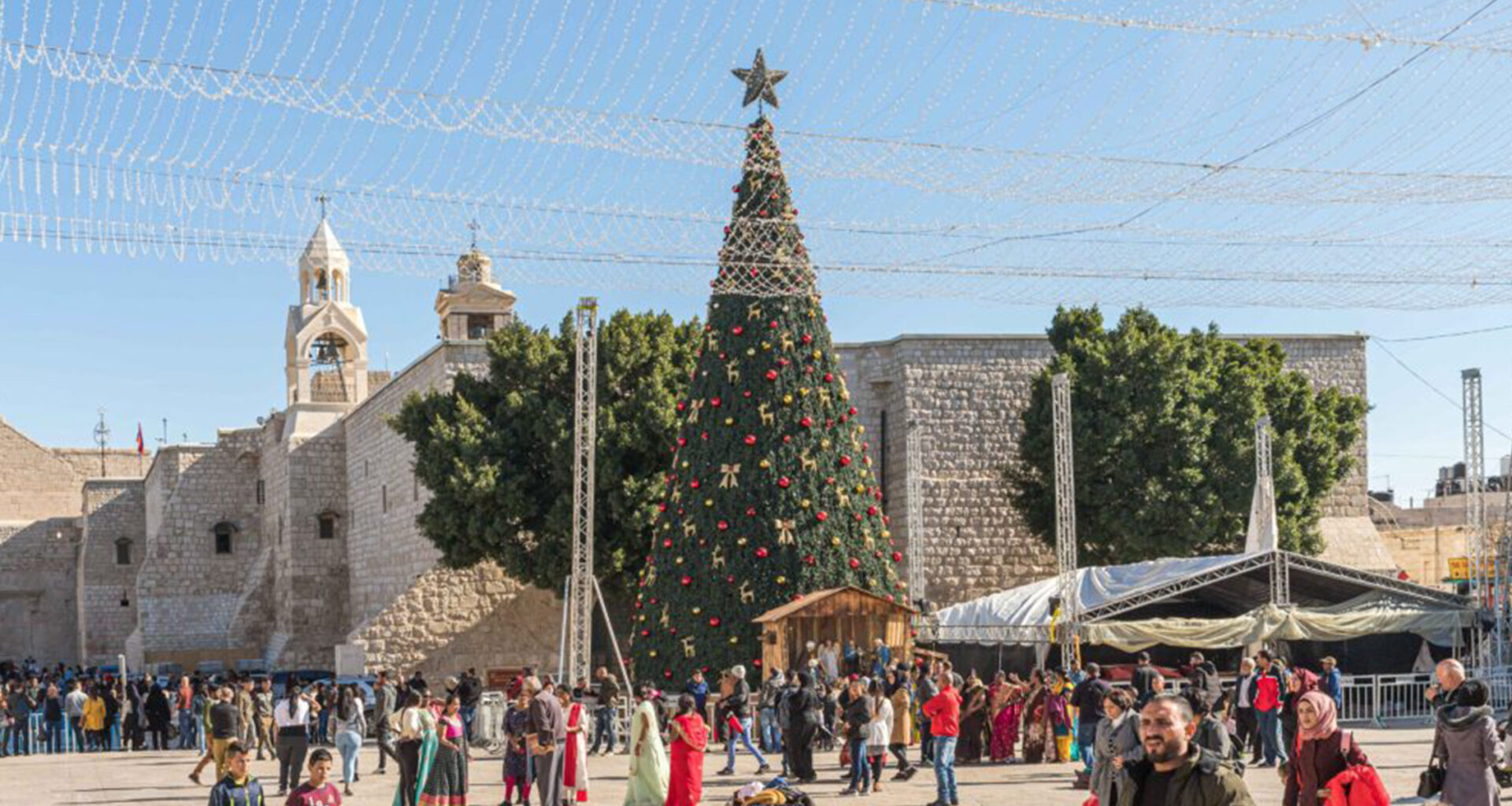
In December 2025, Bethlehem’s Manger Square glows again for the first time in three years. On December 6, a 20-meter Christmas tree illuminated the plaza as crowds gathered in packed but cautious celebrations — subdued hymns, no fireworks, modest festivities. Local Palestinians marked a fragile ceasefire with resilient hope shadowed by Gaza’s persistent devastation, obstructed aid, and ongoing violations and the enduring occupation.
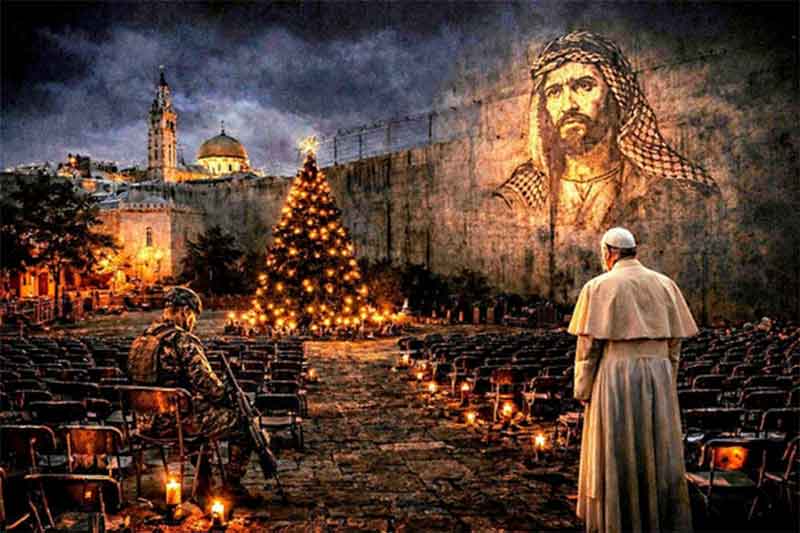
Every December, Bethlehem flickers back into Western view through familiar screens: livestreamed midnight mass from the Church of the Nativity, politicians mouthing “peace on earth,” social feeds flooded with charged images — Mary halted at a checkpoint, baby Jesus in a keffiyeh, the manger dwarfed by watchtowers.
These gestures signal unease with Palestinian suffering and a desire to claim Christianity’s moral legacy for justice. Yet they almost never challenge the machinery that keeps Bethlehem a curated symbol while Gaza remains a zone of relentless devastation.
Christmas also imposes its own calendar on the crisis. Attention swells in December, then vanishes by January, resetting everything to zero. Bethlehem becomes seasonal theater; Gaza’s ruin gets treated as a passing episode, not an enduring structure.
This ritual rhythm breaks political time into harmless fragments. Continuous domination is sliced into isolated tragedies that never build into real accountability. Suffering is replayed each year but never truly remembered, felt but never allowed to demand change.
In the end, Christmas doesn’t just ignore the ongoingness of Palestinian subjugation — it fragments it. The occupation turns into an annual sigh, Gaza into a recurring heartbreak rather than a daily reality. The season’s clock itself becomes a quiet tool of disavowal, teaching the world to meet Palestinian pain as fleeting winter sorrow, not permanent injustice.
This essay argues that Christmas, as Western discourse mobilizes it, doesn’t interrupt Palestinian destruction — it actively stabilizes it. As a ritual of moral recognition, the season absorbs Palestinian suffering into Christian conscience yet leaves untouched the political, legal, and civilizational frameworks that entrench Jewish supremacy as the governing regime and drive behind Palestinian erasure.
At the heart of this disavowal lies a refusal to face one foundational truth: Palestinian Christian life has endured not despite Palestinian society, but because of it — rooted in a predominantly Muslim social world where coexistence was everyday reality, threaded through shared work, family ties, commerce, and vulnerability. Israeli sovereignty, far from protecting Christians as it claims, has systematically eroded those conditions through land grabs, settlement sprawl, economic chokeholds, and demographic pressure.
The silence about this props up a political order where supremacy poses as civilizational guardian of Christian heritage while dismantling the very society that made that heritage possible.
Western ritual in Bethlehem assigns Christianity sorrow, symbols, and seasonal attention, while Gaza’s overwhelmingly Muslim devastation is rendered statistical, normalized, and inevitable. Partitioned empathy follows: one group is mourned in candlelight; the other recedes into managed background loss.
From Identification to Disavowal
The common refrain — “Jesus was Palestinian” — presents itself as solidarity. It pushes back against dehumanization by placing Palestinians inside a Christian moral world, bridging the gap through simple identification: he was one of you, so they are human too.
Yet this move carries a deeper, often overlooked irony. Jesus, after all, was a Jew born and raised in Roman-occupied Palestine — a Jewish man executed by imperial power amid his own people’s subjugation. Today, when violence against Palestinians comes from a self-identified Jewish state claiming to act in Jewish self-defense, the refrain quietly sidesteps that history.
It humanizes Palestinians by linking them to Jesus while rarely forcing Western Christians to grapple with the perpetrators’ own Jewish identity — or how supremacy now operates in Jesus’ name against the descendants of his neighbors.
In practice, the gesture shifts responsibility more than it challenges power. Claiming “Jesus was Palestinian” lets speakers express compassion and moral alignment without directly confronting the systems enforcing enclosure, dispossession, and control in Bethlehem and beyond. The focus lands on shared humanity in suffering, but authorship of that suffering — rooted in specific policies, actors, and enablers — stays blurred.
This is disavowal at work. The violence gets acknowledged and mourned, yet framed as tragic spectacle rather than accountable political reality. Palestinian pain slots into Christian tales of endurance and redemption, keeping eyes on the victims while the structures, their builders, and their ongoing force fade out.
By centering Jesus this way, Palestinian history becomes backdrop to a Christian story. Gaza turns into symbol of heartbreak, the occupation into illustration — rarely a regime with clear responsibility. Questions about who sustains it give way to how it touches Western faith and values.
Western Christians end up as the moral center: Palestine serves as their stage for feeling righteous, tied as they are to alliances fueling the dispossession.
That’s why Christmas talk absorbs massive destruction without cracking. Symbolic nods — naming suffering, praying over it — suffice. Identification soothes conscience; disavowal shields the order beneath.
When Christian Life Is Targeted
The pattern shows clearest when Palestinian Christians themselves come under fire. Even then, Western discourse rarely names the system behind the violence — the legal, spatial, demographic, and theological framework of Jewish supremacy.
Take the October 2023 Israeli airstrike on Gaza’s Church of Saint Porphyrius, one of the world’s oldest churches and a refuge where Christians and Muslims sheltered side by side. The blast damaged buildings in the compound and killed 18 people seeking safety inside, including entire families.
Western Christian reactions followed the usual playbook: shock, sorrow, calls for prayer, then a quick shift to spiritual language that painted the attack as heartbreaking tragedy rather than a political act with clear responsibility. The destruction of a 1,600-year-old church slipped smoothly into Christmas reflections without causing any real break.
The bombed sanctuary turned into one more symbol of suffering, not proof of a regime that strikes Palestinian life — Christian and Muslim alike — with impunity. Catastrophic loss got processed as feeling, not indictment. The architecture of supremacy stayed untouched.
Moral Authority Without Structural Naming
Even from Christianity’s most elevated pulpits, Palestinian suffering receives moving acknowledgment that pricks the conscience — yet the systems sustaining it almost never get named outright.
Pope Francis condemned Gaza’s violence in unflinching terms, calling it “cruelty” and declaring plainly “this is not war.” He forced the world to confront the civilian carnage: unarmed people bombed and shot, families, children, the sick, the disabled — “Enough, please. Stop.” Pope Leo XIV has carried forward and sharpened these pleas, branding the humanitarian crisis “unacceptable” and “barbarity,” demanding ceasefire, hostage release, and aid for a people crushed by hunger and war. He has insisted there is “no future based on violence, forced exile, or revenge,” wrapping the catastrophe in universal appeals to peace and human dignity.
These statements stir hearts and command global attention. From the pinnacle of Catholic authority, they matter. Yet they stay anchored in spiritual and humanitarian language, rarely identifying the specific policies, actors, or international enablers that prolong the devastation. Even this highest compassion absorbs suffering into sorrow while stopping short of structural indictment.
This restraint is not accidental. The Catholic Church, bound by its hierarchical tradition, speaks in broad principles — peace, justice, human dignity — rather than dissecting political regimes. It has never embraced the slogan “Jesus was Palestinian,” always affirming Jesus’ Jewish identity. Historically wary of Zionism, it opposed a Jewish state at Israel’s founding, withheld recognition for decades, and still favors internationalization of Jerusalem. Only after decades of reconciliation with Jewish communities — marked by John Paul II’s historic apologies for Christian antisemitism — did full diplomatic ties emerge.
But reconciliation has come at a cost. Europe’s lingering guilt over the Shoah, combined with swift accusations of antisemitism against any sharp critique of Israeli policy, imposes a heavy silence. Naming Jewish supremacy as the governing ideology risks instant backlash — not only from Zionist advocates but often from progressive circles too. Until that climate shifts, the Church’s moral voice on Palestine remains eloquent in lament but muted in analysis.
Christian Zionism, by contrast, suffers no such hesitation. Rooted in evangelical rather than Catholic tradition, it converts theology into direct political force. Biblical readings of covenant and prophecy drive funding for settlements, aggressive lobbying for unconditional U.S. and Western support, and pilgrimage economies routed through Israeli infrastructure — normalizing occupation as sacred logistics.
Far from mere sympathy, these efforts actively finance and legitimize the conditions that entrench Jewish supremacy. By portraying Israeli sovereignty as indispensable guardian of Christian holy sites, Christian Zionism transforms faith into a pillar of domination, supplying moral cover, money, and diplomatic shielding to a regime that steadily undermines Palestinian life — Christian and Muslim alike.
Even rare conservative challenges to this alignment stay shallow. Tucker Carlson hosted Rev. Munther Isaac in 2024 to question U.S. policies harming Middle Eastern believers, but the discussion remained trapped in secular politics and nationalism, never reaching theological depth. As of December 2025, no Christmas message from Carlson has framed Bethlehem’s occupation or Gaza’s ruin as matters of Christian witness.
The pattern holds: across Catholic compassion, evangelical activism, and conservative critique, Palestine enters Christian discourse through feeling, geopolitics, or selective outrage — rarely as a unified reckoning with power, faith, and justice. Suffering is seen and mourned; the architecture producing it remains unnamed and undisturbed.
Jewish Supremacy in Plain Sight and the Sanctification of Place
Jewish supremacy shows up raw and direct, not as some debated policy or lofty idea. It gets scrawled in Hebrew across Palestinian homes, mosques, churches, cars, and schools: “Death to Arabs,” “Price Tag,” “Kahane was right,” “This is our land,” “May your village burn,” “Death to Christians,” “Jesus is a monkey,” or “Jesus son of a whore.” These aren’t arguments or security excuses — they’re blunt claims of ownership and menace, carved straight into Palestinian space. From the Dormition Abbey and Monastery of the Cross in Jerusalem to historic sites in the West Bank, extremist settlers have repeatedly tagged Christian institutions with these threats, turning places of worship into targets of retribution. The message is simple: you’re just passing through; we’re here forever.
People brush them off as vandalism or the work of extremists. But these slogans spell out, in plain words, the logic running the whole landscape. They boil down what laws, military rules, planning offices, and blockades do on a massive scale: putting Jewish life, movement, and future first, always above Palestinian existence.
What started on the fringes has moved into the mainstream through paperwork and administration. Supremacy doesn’t need to justify itself anymore — it just runs things. Rooted in religious ideas of sole entitlement, it fits perfectly with a system that slices up land, bans gatherings, controls who can have children and where they can go, and makes Palestinian deaths disappear from official counts. The spray paint and the army order say the same thing, just in different voices.
Western Christian talk feeds right into this by refusing to call it what it is. It sticks to words like tragedy, complexity, or endless conflict, giving cover to treat those wall writings as rare outliers — even though they describe the real rules on the ground exactly. Christmas plays its role too, turning suffering into pretty tableaux: Bethlehem as touching sadness, Gaza as distant ache. Blame evaporates; only shared grief remains.
The walls state it more honestly than any diplomat: this isn’t two equal sides fighting — it’s supremacy versus survival. Naming that would mean dropping the comfort of looking away, admitting the religious and political forces keeping Palestinian erasure alive, and seeing it’s not some side issue or passing phase. It’s carved in, permanent.
The clearest evidence of Jewish supremacy’s operation lies in the stark divide between place and people. Bethlehem endures as a cherished Christian symbol — its holy sites preserved and illuminated — while Gaza, an overwhelmingly Muslim society, remains mired in persistent devastation. Recovery stays obstructed amid a fragile ceasefire marred by ongoing violations and severely restricted aid flows. This split is no coincidence; it directly enables supremacy, reinforced by Christian discourses that isolate and sanctify detached holy sites, while disavowing the living Palestinian communities — predominantly Muslim — that sustain them.
Bethlehem’s dwindling Christian community has persisted through deep integration into broader Palestinian society, upheld by a predominantly Muslim fabric of shared labor, kinship, commerce, and vulnerability. The primary driver of Christian decline — from over 80% in the mid-20th century to around 10–12% today — has been occupation: land confiscation, settlement expansion, economic strangulation, and demographic pressures. Palestinian society, not Israeli sovereignty, has historically provided the conditions for Christian continuity. Silence on this reality does not preserve neutrality — it actively aligns with supremacy.
Christian Zionists invert the truth entirely, portraying Israeli rule as Christianity’s essential protector against a fabricated Muslim threat. Institutional responses mirror this evasion: Catholics acknowledge suffering but refrain from dismantling the myth tying Christian security to Jewish sovereignty; mainline Protestants critique occupation yet confine analysis to humanitarian or legal frames, seldom naming supremacy outright; evangelicals and Zionists erase the Palestinian social fabric altogether, framing Israel as sole guarantor of Christian survival. Across denominations, the common thread is reluctance to identify the root: occupation and its supremacist logic have eroded Christian life far more systematically than any Muslim context.
Christmas amplifies this hierarchy. It recasts Bethlehem as a solitary Christian beacon — tentatively revived this December 2025 with subdued lights, packed yet cautious crowds, hymns and prayers only, no fireworks — marking a fragile return after two canceled years, yet inescapably shadowed by Gaza’s unresolved ruin. Muslim Palestinians receive symbolic inclusion but political exclusion. Attacks on Christian lives or sites provoke swift outrage; Gaza’s vast, overwhelmingly Muslim toll — tens of thousands dead, society shattered — gets reduced to statistics or inevitability. Christianity claims sorrow; Islam faces disappearance.
Bethlehem flickers with resilient hope and hymns while Gaza remains suspended outside political time, its people managed as surplus.
Western audiences enact this disavowal in daily habits: streaming Christmas Eve mass from Bethlehem with Gaza off-frame; hearing Advent calls for peace that omit the siege; sharing wall-side Nativity images while scrolling past obstructed aid and mass burials.
No overt hostility is required — just acclimation to a moral order where token recognition suffices. Viewers feel connected without accountability, moved without obligation, comforted without disturbance.
Institutions sustain it: statements highlight sorrow, evade attribution; vigils abound while divestment demands stay rare. Pilgrimages reroute through controlled paths, presenting occupation as mere logistics, not design. Church media celebrate Bethlehem’s endurance, bracketing the machinery of permits, checkpoints, and seizures.
Neutrality here equals alignment: prioritizing access and institutional ease over confronting the regime governing sacred ground.
The circuit closes with consumers — newsletters, podcasts, holiday features framing Palestine as fleeting December tableau, surging seasonally then receding — while Gaza persists as perpetual crisis. Attention rituals rise and fall on cue.
Power recedes from view as grief becomes the practiced response. Christmas refines this process, training attention toward emotion rather than action, sentiment rather than solidarity, and in doing so leaves the architecture of supremacy firmly in place.
Alignment Beyond Recognition: Precedents for Christian Witness
Dismissing calls for Christians to confront the systems governing land, life, and future in Palestine as unrealistic or extreme simply reflects how low expectations have sunk.
Christianity boasts a robust history of transcending mere sentiment. At pivotal junctures, it has withdrawn funds, institutional ties, and theological sanction from oppressive powers — at real cost to prestige and security.
True alignment demands concrete action: economic boycotts of injustice, outright rejection of neutrality, disruption of sacred spaces tainted by domination. Churches have divested from dispossession-fueling economies, severed communion with racial hierarchies, and accepted marginalization rather than endorse supremacy. They sought no compromise — they traced firm boundaries.
Precedents run deep. Against South African apartheid, the World Council of Churches and allies branded it theological heresy, dismantled white civilizational pretensions, drove divestment and sanctions, and deemed neutrality complicity. They attacked not only Black suffering but the statutes, boundaries, and finances entrenching control over land, mobility, and destiny.
Latin American liberation theology fused faith with battles for land and labor; clergy and communities allied with peasants and workers, courting imprisonment, exile, or death. In the U.S. civil rights struggle, Black churches spurned incrementalism and decried white inaction as ethical betrayal, exposing segregation as sin codified in law.
Palestine differs not in lacking models, but in denser entanglement. Earlier resistances left Western self-conception largely intact. Here, Jewish supremacy nests within a Judeo-Christian framework portraying Israeli sovereignty as restorative or safeguarding. Confronting it requires Christianity to acknowledge its own complicity in crafting a worldview that normalizes Palestinian dispossession.
Christmas exposes this bind. It channels sorrow without mandating rupture. Bethlehem — revived softly this December 2025 with quiet lights, packed yet cautious crowds, hymns and prayers alone, no fireworks — functions as poignant emblem while Gaza’s persistent wreckage, obstructed aid, and fragile truce scarred by violations fade into abstraction. Christian legacy preserves; Palestinian existence treats as expendable. Sentiment substitutes for solidarity; ritual for reckoning.
Authentic alignment demands proven, accessible measures: withdrawing resources from dispossession machinery; boycotting rituals that legitimize control; risking reduced access to holy sites over sanctifying their gatekeepers; amplifying Palestinian Christian testimony — like Rev. Munther Isaac’s unflinching proclamations or Kairos Palestine’s fresh 2025 plea amid genocide threats — as binding political theology.
Emerging actions illuminate the route: the World Council of Churches’ June 2025 denunciation of Israel’s apartheid regime, coupled with calls for targeted sanctions, divestment, and arms embargoes; denominational divestments, such as the United Methodist Church excluding bonds from prolonged occupiers. These require no novel morality — merely consistent application of enduring principles.
Christmas recasts alignment’s refusal as virtuous: candles flicker, hymns rise, hope proclaims — all while foundations endure unshaken. Bethlehem summons as remote origin; Gaza archives as stalled tragedy. The season doesn’t merely accommodate disavowal — it masters it, conditioning recognition of suffering absent disruption, equating pageantry with partnership.
Conclusion
Christmas doesn’t fail Palestine for lack of compassion — it fails because it lets compassion count as enough. Suffering gets seen, but in ways that ask for no real change: no breaking old loyalties, no facing the rankings that shield some lives while counting others disposable, demanding some people vanish to keep the system running.
The real question is whether Christianity will see how its own rituals have gotten tangled in a larger project that handles destruction while denying any role in it.
As long as Bethlehem can light up, stream live, and draw tears — revived quietly this year yet still overshadowed by Gaza’s lingering devastation, stalled recovery, and ceasefire violations — while Gaza stays locked outside normal time; as long as Christian heritage gets preserved and Palestinian existence gets treated as leftover; as long as Jewish supremacy can pose as guardian of civilization instead of what it is — a regime of domination — Christmas will keep steadying the very order it claims to question.
Breaking free takes more than better words or new symbols. It means stepping out of the ease of isolated holy places, yearly sentiment, and safe watching — and committing Christian witness to tearing down the systems that rule land, life, and future in Palestine.
Until that happens, Christmas stays not a rebellion against empire, but one of its longest-running tools.
Subscribe to Our Newsletter
Get the latest CounterCurrents updates delivered straight to your inbox.
Note: First published in Medium
— –
Rima Najjar is a Palestinian whose father’s side of the family comes from the forcibly depopulated village of Lifta on the western outskirts of Jerusalem and whose mother’s side of the family is from Ijzim, south of Haifa. She is an activist, researcher and retired professor of English literature, Al-Quds University, occupied West Bank.