
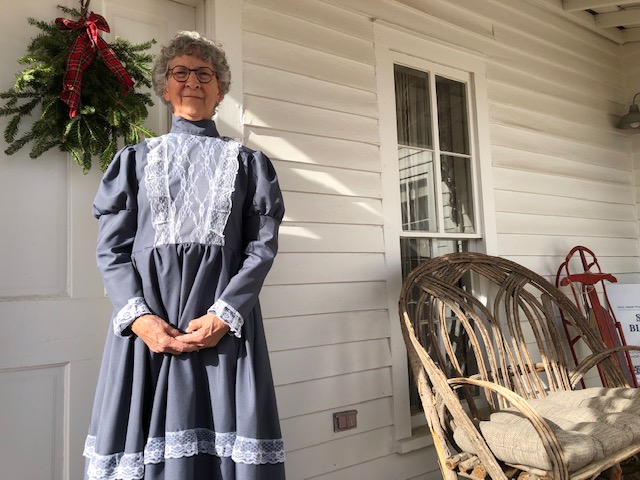
ERIE — Visitors saw Santa’s red long johns hanging from a clothesline when they arrived at the Wise Homestead Museum on Dec. 13 for the Erie Historical Society’s annual A Homestead Christmas.
Clothespins secured the long johns, cap and socks so they wouldn’t fly away in the wind. The clothesline and pins were a hint of what people would find in the two-story farmhouse.
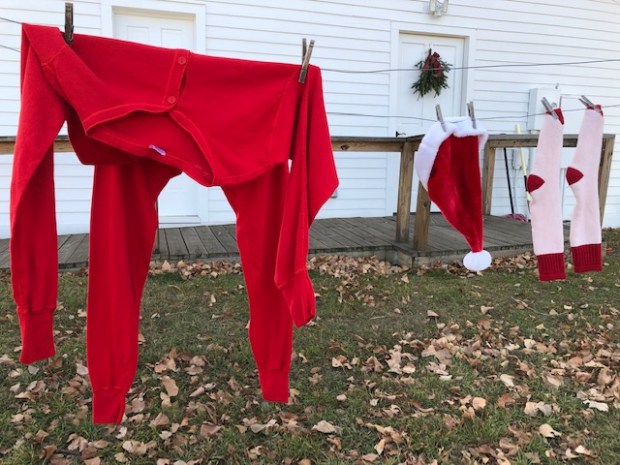 Santa’s red long johns, cap and socks hang on a clothesline in the backyard of the Wise History Museum in Erie. (Ed Otte/For the Greeley Tribune)
Each room in the Western Victorian-style house offered a glimpse into daily life dating back more than a century ago.
“My great-great-grandfather O. E. Wise and his wife, Adeline B. Wise, moved from Wisconsin to homestead here in 1870,” Elizabeth Wise Kissell, 72, said.
They raised cattle and sheep, and they grew alfalfa, wheat and corn. Members of their family tree worked to preserve the most important remnants of the homestead.
“My aunt Sarah — she’s 102 — was a real mover and shaker,” Kissell said. “She put a lot of time and work into getting grants to support this.”
After more fundraising and restoration work, the museum opened to the public in 2007.
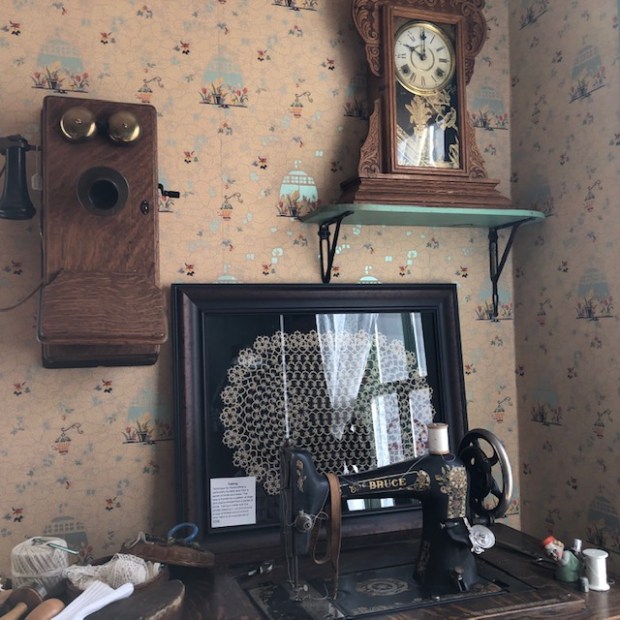 The sewing machine from the early 1900s in the Wise Homestead Museum in Erie was used by Elizabeth Wise Kissell’s grandmother. The wall telephone was gifted to the museum. (Ed Otte/For the Greeley Tribune)
Wearing a pioneer period dress she found in a thrift store, Kissell greeted visitors and led them through the parlor, kitchen, bedrooms, laundry room, bathroom and display room, explaining the history of items and how they were used by adults and children.
“Most of the questions from all ages are about kitchen things because they’re so different from what we have now,” she said. “Some of these are from our family, some from people who went through their parents’ stuff and donated items to us.”
A sewing machine near the front door “is from the early 1900s,” Kissell explained. “It was my grandmother’s. The wall telephone was gifted to us so people could see what an old phone was like. It’s from the 1920s or 1930s.”
Alan Wise, Elizabeth’s 84-year-old cousin, said the museum serves an important role in teaching people about the homestead’s history.
“Erie has wiped out a lot of its history,” he said.
Elementary and middle school students visit the museum to learn about history, and adult groups from community organizations including the recreation center also take tours — with the latter recognizing details similar to their grandparents’ homes.
“It’s especially fun giving tours of the house because it’s about your own family,” Wise said. “It’s a lot of fun, and it’s a lot of work.”
Younger family members “are involved with the museum when they can do it. But they’re all busy. They all work.”
In addition to tours, some people stop by just to take photos of the outside, Kissell said.
The homestead was originally more than 320 acres. Today, it is less than four acres. A large parcel of land on the south side of Jasper Road was donated to the county and designated as open space.
During the holiday event, the Highway 66 Bluegrass Band and two Erie High School choral groups entertained visitors. Students sang on the farmhouse front porch. The band played in a tent between the farmhouse and the barn.
Hot apple cider, hot chocolate and cookies were served in the barn. South of the barn is a large collection of rusted farm and mining equipment.
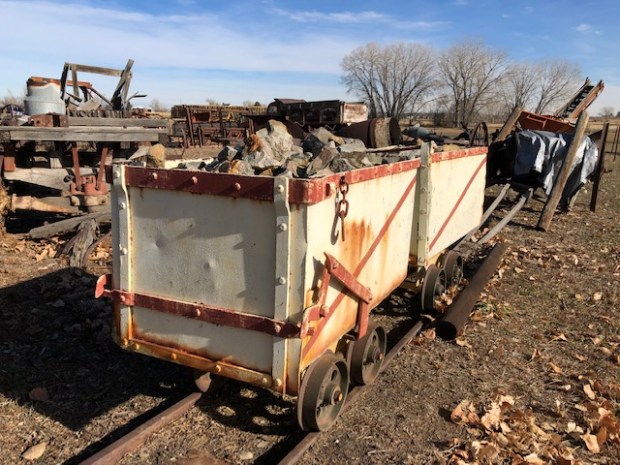 Old mining and farm equipment is displayed on the south side of a barn at the Wise Homestead Museum. (Ed Otte/For the Greeley Tribune)
Coal fueled Erie’s economic engine for decades. It was discovered in the southwest corner of Weld County in the 1860s. The mines provided jobs for generations of men and boys while two railroads hauled coal to Denver and other Front Range communities.
The boom times continued until coal production declined during the Great Depression and then again after World War II. Most of the mines closed by 1960.
The historical society honors the mining heritage by hosting Erie Biscuit Day each fall in the town’s Historic Downtown. The event is the organization’s biggest fundraiser.
“We have it on the third Saturday of September,” Kissell said. “That’s when kids went back to school and the miners went back to the mines. In the summer, the coal was soft and the miners did other work.
“We have biscuits, sausage gravy and sausage. We get a pretty good turnout. About 800-900 people.”
A display case in one room of the museum features equipment and tools used by the men and boys who worked the mines. The exhibit reflects both the importance of the mines and the grim nature of the work.
Beneath one of the black-and-white photographs is this statement:
“I was fifteen (when) my dad got killed (in) 1911. There was no insurance see; they didn’t even send a flower. So (the super) said, ‘When Tom gets big enough to work we’ll give him a job.’ That’s what I got for my father getting killed. I got the job.” — Tom Somsky, Erie, 1984
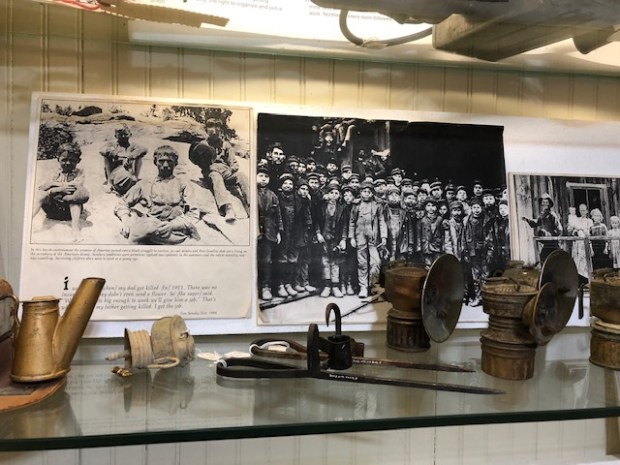 Old black-and-white photographs from Erie’s early coal mining days are displayed in the Wise Homestead Museum. Boys who worked at the mines are in some of the photos. (Ed Otte/For the Greeley Tribune)
The Wise Homestead Museum, 11611 Jasper Road, is open 10 a.m. to 2 p.m. Saturdays May-October and by appointment. The phone number is 303-828-4568.
— Ed Otte is a former editor of the Greeley Tribune and a former executive director of the Colorado Press Association.