
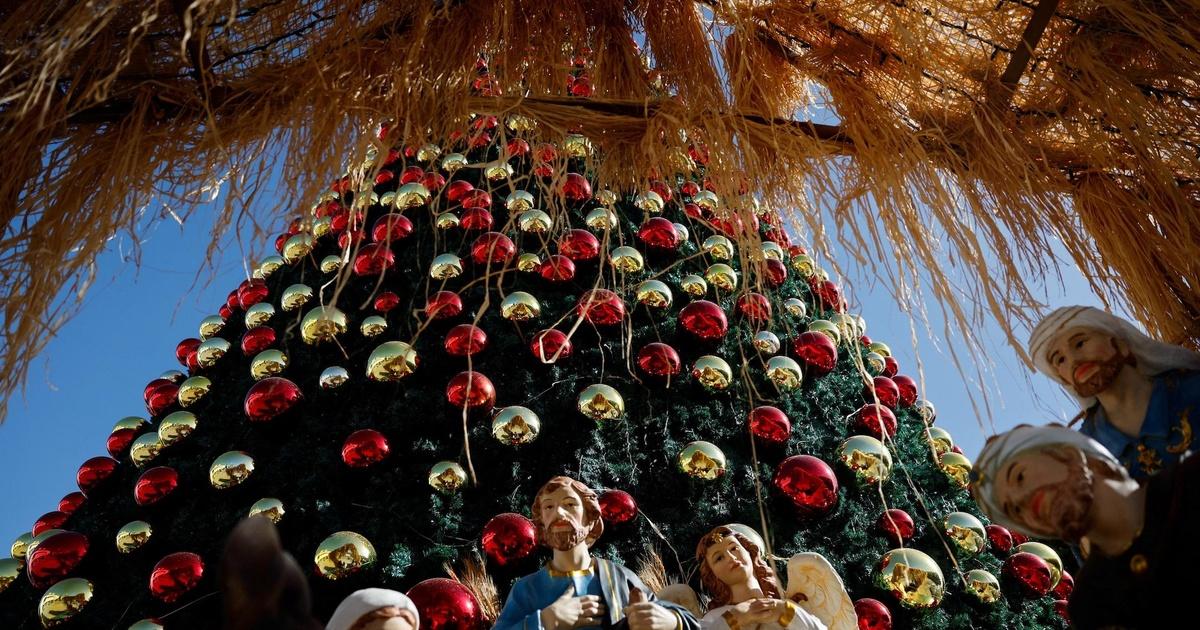
WILLIAM BRANGHAM: Today, thousands# of people flocked to Bethlehem’s## Manger Square.
It’s the spot where# Christians believe Jesus Christ was born.
It’s in the occupied West Bank, and celebrations# were canceled the last two years because of the## Israel-Hamas war.
For Palestinians who live in# Bethlehem and work in Jerusalem, the distance## is not far, about five miles, but taking the# bus this short way sometimes becomes an ordeal.
“News Hour” producer Karl Bostic looks at what# life is like for Palestinians who live there.
KARL BOSTIC: In Bethlehem, this bus# is loading up with passengers to## take them to work in Jerusalem, but# they may already be late for work.
This is the bus you take in the morning?
RUBA MAHDI, Nurse: Yes.
KARL BOSTIC: How.. RUBA MAHDI: Five years.
KARL BOSTIC: Ruba Mahdi is a.. but it’s the ride to work before she# can even think about what the day will## bring at the hospital that makes her more anxious,## what it will be like this morning# at the checkpoint into Israel.
Despite leaving so early, she# already thinks she may be late.
RUBA MAHDI (through translator): Almost every day,## we’re late for our jobs at the hospital.
Also, we# could wait for a.. and it’s possible that they ask us to exit the bus# even while it’s raining, so they can search it.## So we always worry about our morning journey# to our job with all of these checkpoints.
KARL BOSTIC: And it’s what can# happen at a checkpoint that can## cause so much anxiety and change everything.
RUBA MAHDI (through translator):# There was a person who used to work## in the hospital and was posting# on Facebook during the war.
Th.. Israelis canceled her permission,# so she can’t work here anymore.
KARL BOSTIC: Do you even feel like it’s Christmas?
RUBA MAHDI (through translator):# This year is better than before,## but not like it used to be before the war.# But, this year, at least we feel better.
KARL BOSTIC: This time, it wasn’t too bad.# Everyone got off the bus and they showed their## I.D.s and special permission papers to work in# Israel, despite the war.
It took about 20 minutes.## Ruba was relieved.
She navigates between two# worlds, the harsh reality of life in the occupied## West Bank, including Bethlehem, and working# in Israel, especially at this time of year.
In these last few days leading up to Christmas,# normally, this Manger Square here in Bethlehem## would be packed with thousands of people, instead,# today, only a few hundred.
And, also, buses,## you would have more than 100 buses pulling up to# Bethlehem today, and, instead, less than a dozen.
The giant Christmas tree in Nativity Square stands# lonely.
Hotels are struggling to survive, like## this shuttered four-star hotel next to the square.# In the case of Joseph Giacaman, business has## collapsed during the war.
Only family pride that’s# part of Bethlehem’s history is keeping it open.
JOSEPH GIACAMAN, Woodcarver: And this has a lot# of work, now nobody., Maybe, some time, one bus## comes, two buses.
They come from here, people# who live here, but not tourists, not tourists.
KARL BOSTIC: So you hope the war will end soon?
ASHRAF, Falafel Chef: Yes, of course.
We don’t# like it.
We don’t like i.. KARL BOSTIC: Bethlehem’s Mayor Maher# Canawati, who is an American citizen,## is numb from citing the cost of war in Bethlehem.
MAHER CANAWATI, Mayor of Bethlehem,# West Bank: I tell you, before the war,## we had approximately 2.5 million visitors# and pilgrims com.. the Church of the Nativity.
After# the war, we haven’t had more than## 1,000 a year.
That’s a complete collapse.# Definitely, it was.
It was catastrophic.
KARL BOSTIC: That is the reality Ruba tries to# put behind her, at least while she’s at work.
And## she begins her day with eagerness, but must wait# for news of the patients she’s expecting to see.
DR.
KHADRA SALAMEH, Augusta Victoria# Hospital: So this is our regular day.## We are waiting for patients, as usual,# to come to the peritoneal dialysis## to do our regular checkup for# these patients.
But, unfortunately,## we can’t predict the arrival because they’re# waiting for checkpoints and maybe they are## forbidden to come to these checkpoints, they have# to go to another checkpoint.
And we are waiting.
KARL BOSTIC: Because Augusta Victoria Hospital# provides cancer and kidney treatment for## Palestinians from the West Bank and, until the# war began, Gazans, Ruba has become used to this## unpredictability, accepting it with grace.
But# that doesn’t make it any easier on her family.
RUBA MAHDI (through translator): Of course,# there are challenges to coming here every day,## but we need to do it.
After the war,# there were less jobs in the West Bank,## especially that my husband is working in# tourism, and we have no tourism anymore.## No tourists are coming anymore.
So I have to# work and support my family so we can live.
KARL BOSTIC: But Ruba also thinks about the# satisfaction she has by working at the hospital.
RUBA MAHDI (through translator): It’s# true that we leave in the early morning## to the hospital leaving our homes, our# children and suffer in the checkpoint.
But,## honestly, I’m satisfied when I come# to the hospital and help my patients.
KARL BOSTIC: Augusta Victoria Hospital has# its own church for staff and patients.
Ruba## is Christian and, when she can, she visits# to say prayer for family and for peace.
After a long day of work and returning through# checkpoints, Ruba is back home in Bethlehem.## It’s quality time with her family.
Her daughter,# Rain (ph), is waiting for her and so is dinner.## At this time of year, the quality time# includes a visit to the Church of the## Nativity.
Visitors still try to pay homage to the# birthplace of Jesus, even while there is a war.
And, inside, tradition remains untouched# for Christmas.
The superior of the Armenian## church descends the staircase to the grotto,# where Jesus was born to conduct a ceremony for## his birth.
And for this Christmas,# he’s optimistic about these times.
Has the spirit of Christmas come out?
FATHER ASBED BALIAN, Superior, Armenian# Apostolic Church, Bethlehem: We can say## yes.
Yes.
For the last few years, we# didn’t feel it because of the war,## because of the corona before that.# So, this year, it seems like yes.
KARL BOSTIC: Ruba and Fadi (ph)# are preparing their daughter,## Rain, for her second Christmas, so that# she will grow with love, faith and hope,## and, as she grows, she will know# there remains a joy to this world.
For the “PBS News Hour,” I’m# Karl Bostic in Bethlehem.