
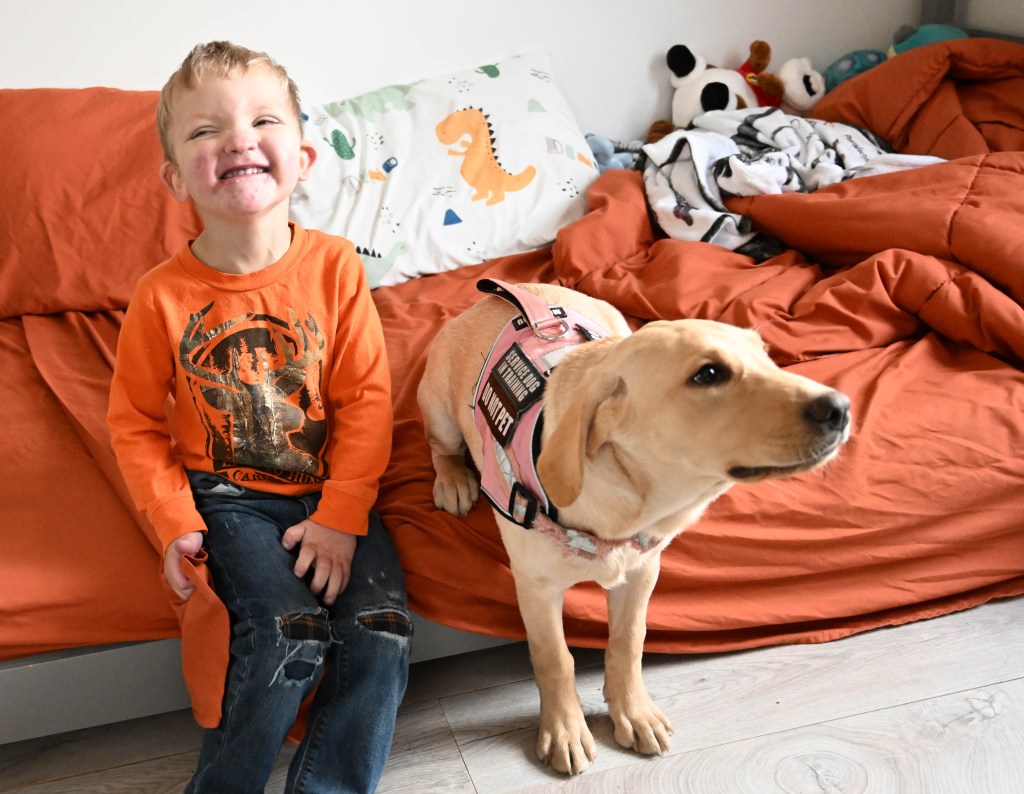
Brenda Marra of Macungie was searching for a buddy to grow with her 5-year-old daughter, Renna.
Renna is a curious girl on an independent streak, wanting to go exploring on her own when they are out. She’s very sociable and loves making friends. But her rare genetic disorder — Pitt-Hopkins syndrome, which causes mobility and communication issues — makes these traits more difficult to navigate.
A service dog would give Marra an extra set of “paws,” helping Renna maneuver uneven surfaces, alert when she wanders off and calm her down when she’s overstimulated. Marra hopes it might also help Renna build relationships.
But local nonprofit options were not accepting new applicants, and other popular options presented hefty price tags that Marra could not afford.
So, she turned to the community for help, and they responded big: over $30,000 in monetary donations since July and more than 250 bags of donated footwear for a shoe drive that will generate thousands in additional funds.
“I had no idea how much people would really connect with her and want to help her,” Marra said of the community support for Renna. “It’s just amazing.”
She isn’t the only Lehigh Valley parent with this mission: Multiple families are turning to service dogs — and the community — hoping they will bring life-saving medical assistance and comfort to their children with disabilities. With high costs associated with securing these specially trained animals for families already paying for expensive medical procedures and therapies, fundraising has become a staple of the experience.
Younger handlers
Some experts in training and placing service dogs say they’ve noticed an increase in families obtaining service dogs for their children, citing more awareness of the benefits.
“I think every year, applications grow because the popularity of service dogs increases,” said Jessica Reiss, the Northeast region executive director for Canine Companions, a nonprofit that provides service dogs to families, free of charge. “It’s more socially acceptable to have a dog in public.”
At least half of the 480 active service dogs in Canine Companion’s Northeast region have gone to children, according to Reiss. She attributes an increase in applications, in part, to an increase in media featuring service animals.
John Bellocchio, lead instructor of training organization Fetch and More, believes that younger generations being more open to dogs in public spaces helped create this cultural shift.
“Twenty years ago, a service dog in a school setting was like, ‘What are you talking about? There’s no dogs in here,’ ” Bellocchio said. “Now it is really very much a changed world.”
Jennifer Lutes — executive director of 4 Paws for Ability, an Ohio organization with national reach that specializes in placing service dogs with children and veterans — said the number of applications it receives has remained consistent over the years, but agreed that the need has grown with awareness.
“In the beginning, I don’t think that people had a really wide grasp on the different ways a dog could support someone with autism,” Lutes said. “Over the years, it’s become more apparent how effective service dogs for individuals with autism actually are.”
Lutes said autism is the most common disability among the organization’s child clients — who typically are 6-9 years old — though she has noticed an increase in children with multiple diagnoses and rare conditions applying.
Cerebral palsy, autism and muscular dystrophy are the most frequent diagnoses for children receiving service dogs from Canine Companions, according to Reiss.
These service dogs typically are trained to the specific needs of the child they assist, being able to do a variety of tasks including turning on lights or detecting low blood sugar. Beyond providing physical assistance, service dogs also facilitate social interactions and instill confidence in the children they help.
“By having the dog, it allows them to be independent in their own home,” Reiss said. “ ‘I don’t need my mom to pick up the remote that fell because my dog can do it.’ ”
Expensive care
Upfront costs for service dogs can reach upward of $40,000 to cover veterinary care, basic needs and training — and insurance generally does not cover the cost. If families are not able to be matched with a dog through a nonprofit like Canine Companions, it can contribute to the financial stress for families already tackling staggering medical bills.
“My job is caring for my son, so when he gets hospitalized, I don’t get paid, so I won’t have my income at all, which at that point, I don’t know how we’re going to keep anything afloat,” said Stephanie Perez of Allentown.
Perez recently started a training program with Fetch and More with her new puppy, Molly, raising funds through a T-shirt sale. The dog — which she says has already made a big impact — will be able to detect seizures and retrieve emergency medications for her 4-year-old son, Peyton. Extra proceeds will go toward an upcoming open-heart surgery.
Fetch and More’s “bring your own dog” system, which allows for any dog the family has to be trained as a service animal, helps alleviate some costs, according to Bellocchio, though he said the average cost is still “in the thousands.”
Increased cost of living has become an additional factor in families’ decisions about service dogs.
“What we have seen is — as we’ve seen costs in general go up — that people are more hesitant, actually, to look for a service dog, if they’re concerned about, ‘Where is my meal going to come from? Do I have my housing?’ ” Lutes said.
Programs like 4 Paws for Ability — which covers half the cost for families through donations — encourage families to reach out to the community for support. On average, it takes about two months to reach their fundraising goal, according to Lutes.
For some families, though, raising enough money can take much longer.
Jessica Wojciechowski of Bangor has been raising funds for her 7-year-old daughter Aria for five years, having raised a little over $7,000 of the $17,000 needed.
“It was definitely the equivalent to a full-time job, on top of everything else,” Wojciechowski said.
For Aria, who — among other disabilities — suffers from nonconvulsive overnight seizures, technological motion detection aids do not work. A service dog would be able to use smell to identify her seizures.
“Knowing the outcome, where we’ll be and what it will provide for my daughter,” Wojciechowski said. “It’s all worth it.”
Potential costs also are alleviated by volunteer “puppy raisers,” who take care of future service dogs before their advanced training.
“The big question we get is ‘how can you give up a dog?’ ” puppy raiser Fran McBride of Emmaus said. “But maybe it sounds corny, but we fall in love with a dog, and somebody else is going to love the dog and they need the dog.”
After placement, service dog owners adopt the usual costs of pet ownership. The annual cost for dog care ranges from $1,390 to $5,295, according to Rover, a pet sitting and dog walker website.
Since children cannot act as the dog’s handlers, parents take on the responsibility of caring for the dog. For Michele Ciofalo of Emmaus — who welcomed a service dog into her family for her grandson, Justin, when he was 10 — that meant going to school with Justin and their dog, Holidays.
“I had been working and stuff, but it was one of those things where I decided that I was getting phone calls from the school all the time anyway, and if I could do the investment now for Justin and help him that I chose to do that,” said Ciofalo, who has gotten two service dogs from Canine Companion.
For many families, including Ciofalo’s, the benefits service dogs give their children outweigh any potential downsides. She said Justin, who is now 21 and on his second service dog, went from 20% school attendance to 80%-90% after Holidays joined the family.
“You would never believe he’s the same child,” Ciofalo said. “He’s a volunteer firefighter, he goes to wood shop, he goes to an art class and these are things he never would have been able to do.”
Mandy Wong of Easton said Nugget, her 10-year-old son’s dog that they’ve had since May, helps every member of their household.
“Some of us might be under stress, she will quickly come to us,” Wong said of Nugget. “It’s like another piece of a comfort.”
Nugget is trained in search and rescue, having the ability to find Wong’s son, Zack, who has autism, when he wanders away from the family.
“She’s able to find him in no time,” Wong said. “So you’re giving the parents a peace of mind.”
Isabella Gaglione is a freelance writer.