
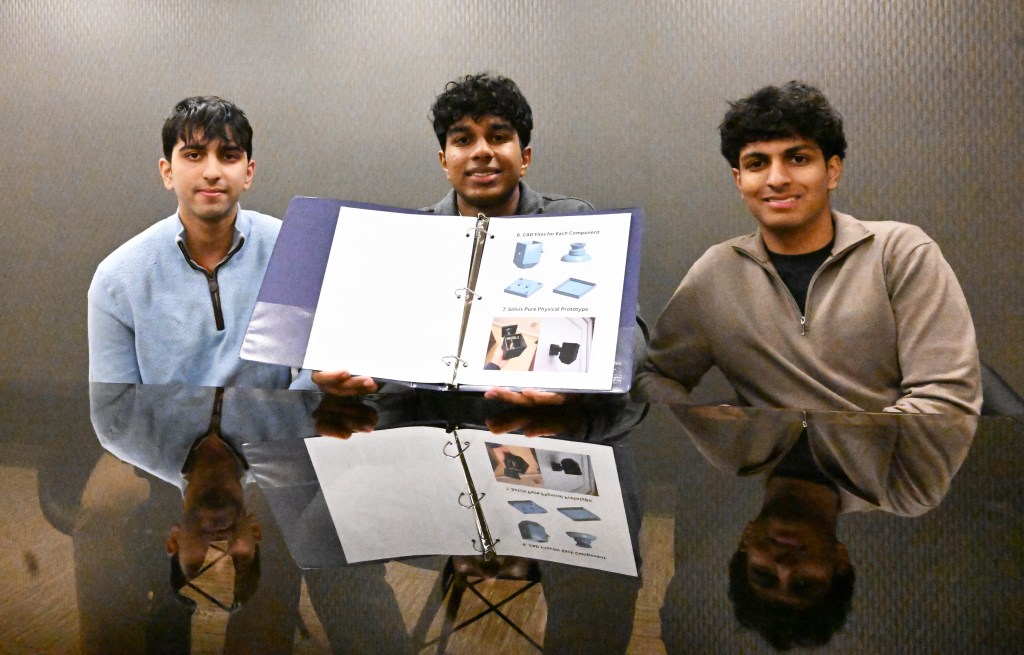
It took nearly 18,000 photos to train an artificial intelligence algorithm to detect hazardous materials within construction runoff, but now the 17-year-old founders of Solvis have a computer vision product that can aid companies in reducing pollution.
The three Moravian Academy students who founded Solvis have earned thousands of dollars in pitch competition awards and now aim to place test cameras at 25 construction sites by the end of next year.
“It’s about confidence, really,” Aveer Chadha said. “First, we believe in our solution.”
The product the students developed, dubbed Solvis Pure, is a camera that monitors construction sites and uses a proprietary algorithm to crunch the data, alerting companies through a mobile app if hazardous runoff is approaching or exceeding regulatory limits.
The problem of harmful construction runoff initially came up during a spontaneous walk along the Lehigh River.
Chadha and fellow co-founders Nikhil Skandan and Qayn Jaffer were working in a Lehigh University building, brainstorming startup ideas for a competition.
They needed a break and decided to go outside. As they walked along the river, they saw dirt, woodchips and what appeared to be pollutants flowing from a construction site into the river.
Curious to find out how widespread the problem might be, the students researched construction industry statistics and found that runoff causes significant environmental damage.
One statistic that stood out in their research was a widely cited 2015 study from construction blog BIMhow that found the industry contributed to 40% of drinking water pollution.
“We found that the problem was two-sided: So, not only was construction contributing to such a large portion of environmental harm, but in that increased environmental harm is also very detrimental to the companies themselves because they were being fined at the Environmental Protection Agency,” Chadha said.
Tasdemir Marble and Granite provided photos from its field testing to help the students train their algorithm. Solvis company testing shows the model is 91.2% accurate at identifying materials in construction runoff.
“They’re solving a problem that is community-based,” said Tony Mattei, the director of entrepreneurship at Penn State Brandywine.
Mattei directs the Brandywine LaunchBox, a Penn State service that provides free resources to early startups.
LaunchBox staff partnered with the Ideas X Innovation Network — also known as i2n — to launch a pitch competition called LionCage at which the Solvis founders won a $2,000 Rising Entrepreneur prize.
“They really shined in this big pitch competition,” Mattei said.
Next steps for Solvis
Connecting to customers and building partnerships will be the next key phase for the startup, Mattei said, adding that government grants could be a good way to start tapping into the network of environmental regulators that could one day provide contracts that go beyond one-off hits with construction companies.
The Lehigh Valley construction industry is tight-knit, with multiple companies often collaborating on one project, and Jaffer said Solvis aims to tap into that network.
“It’s just kind of building the confidence within the industry and reliability and kind of just the word of mouth marketing is what really carried us so far,” Jaffer said.
The LionCage win was Solvis’ second triumph of November, following the award of a $10,000 Be More Fund grant at the National Society of High School Scholars Day in Atlanta earlier in the month.
Applying their concept in a real-world setting at scale is the next challenge for the Solvis founders, i2n Director Matt Cabrey said.
“When you can repeat the success of a technology like this in a consistent way, that really elevates the organization to the next level,” Cabrey said.
So far Solvis has been relying on Skandan’s robotics and coding background to build the devices and fine tune the mobile app that produces monitoring data for participating companies.
One challenge to scaling production is the need to employ expensive cameras capable of generating the high-quality images needed to identify materials within runoff, Skandan said, adding that work continues to determine how to grow the company in a cost-effective way.
Creating a business is a new challenge for someone with a science background, but it’s taught Skandan that discoveries can have a tangible impact.
“They can be scalable to actually help people and be implemented in the real world that basically is able to create this society for the better,” Skandan said.