
It was once the place to go for shopaholics in Pennsylvania‘s biggest Democratic city but now a popular mall is on its last legs and up for sale.
Following years of decline, the Franklin Mall in North East Philadelphia has been listed by real estate firm Jones Lang LaSalle (JLL).
The 1,604,934sq ft shopping center was originally built in 1989 for $300 million in the shape of a lightning bolt to honor the city’s hero, Benjamin Franklin.
The sale comes as retailers like Macy’s have fled the city. The retail giant left its iconic location at the Wanamaker building next to City Hall in March.
Formerly known as the Franklin Mills and Philadelphia Mills, it was once teeming with life in the 1990s, welcoming roughly 20 million shoppers a year, but today that number has dropped to an abysmal 5.6 million, according to JLL.
While the rise of online shopping has been shutting down malls across the US, Jerry Roller, founder of the design firm JKRP, told the Daily Mail that is not the only reason for this location’s failure.
‘Once it stopped being a discount mall, it was never really a viable mall. Malls haven’t done well in general, especially third-tier malls,’ said Roller.
‘They don’t have the tenants, they don’t have the traffic, and this was a particularly inexpensively built mall.’
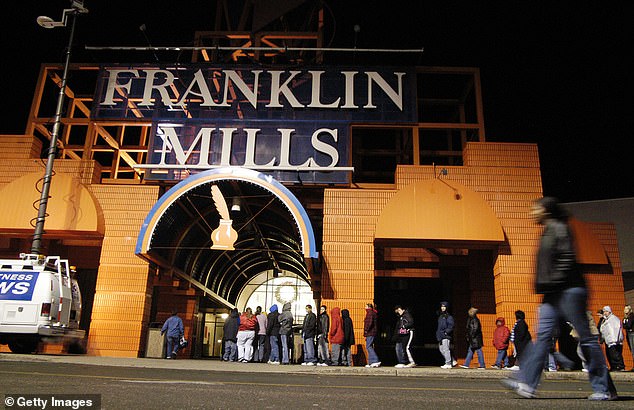
The Franklin Mall which was formerly known as the Franklin Mills and Philadelphia Mills, has been put up for sale after years of decline
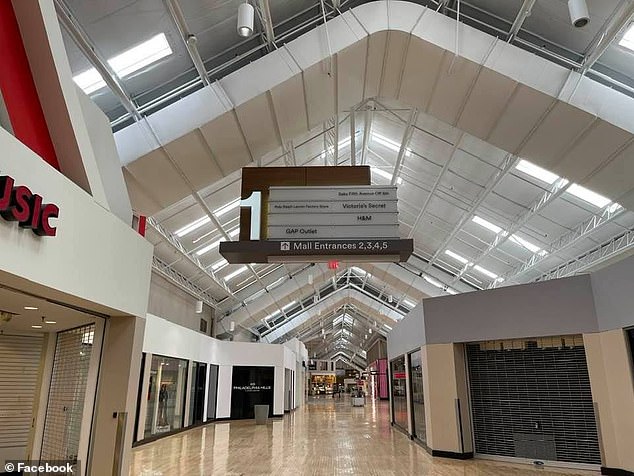
A picture of the mall while its open shows almost all stores closed and no signs of life
The mall is currently at 68 percent occupancy and has lost major tenants, including the AMC movie theater and the clothing store Forever 21.
The property was appraised at $201 million in 2012, but was valued at only $76 million last year.
JLL described the mall in its listing as an exceptionally located, single-level super-regional shopping center, but the asking price was not listed.
Not included in the sale are the separate Walmart and Sam’s Club.
‘It’s a cheap (looking) building. There’s nothing particularly attractive about it. The site itself is well located at a major highway intersection,’ said Roller.
Roller explained the difference between successful malls and failing ones: ‘Big malls do well, like King of Prussia or Mall of America.
‘Small malls struggle. They struggle for tenants, they’re expensive to maintain, and they don’t attract shoppers.
‘Large regional malls have a wide range of tenants at all price points. That’s the attraction. Small malls have limited tenant variety, aren’t exciting shopping experiences, and that’s why they’re generally not doing well.’
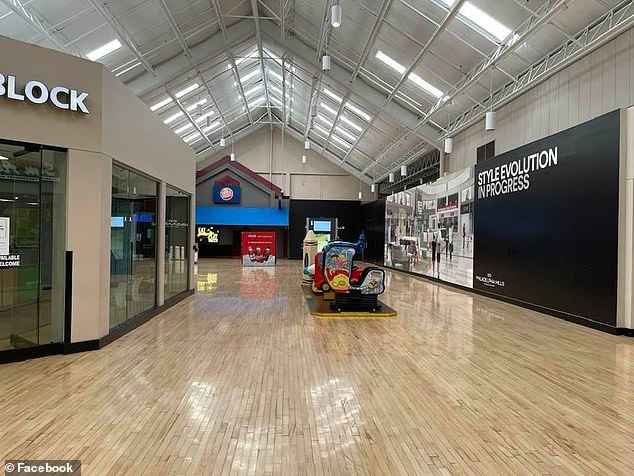
Another spot in the 1,604,934sq ft mall shows even more businesses closed
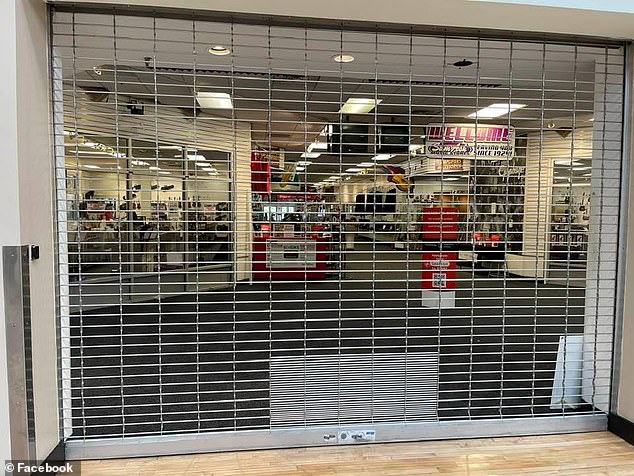
A retail store with all its lights shinning while behind a metal gate as no workers or customers appear to be seen
He continued to highlight that regional malls like the King of Prussia have variety and accessibility.
‘Could you build another regional mall? Probably not. Retailers don’t want to maintain multiple locations like that,’ said Roller.
‘There are only a handful of true regional malls, like Tyson’s Corner or the Mall of America. Those attract a wide range of retailers. Small malls like Franklin Mall don’t have depth.’
He added: ‘They have the same stores as other small malls, which isn’t exciting. Online shopping has cut into much of what people used to go to malls for.’
The King of Prussia Mall is the largest in the region at 2.9 million sq ft and is only 32 miles away from the Franklin Mall.
JLL suggested in the listing that the property’s location and highway access make it a strong candidate for redevelopment into a modern industrial facility.
This was echoed by Roller, who mentioned that it could be used for residential buildings.
However current zoning restrictions would not allow a residential project, as it is classified as a CA-2 zone, which allows for wholesale, distribution, and storage uses.
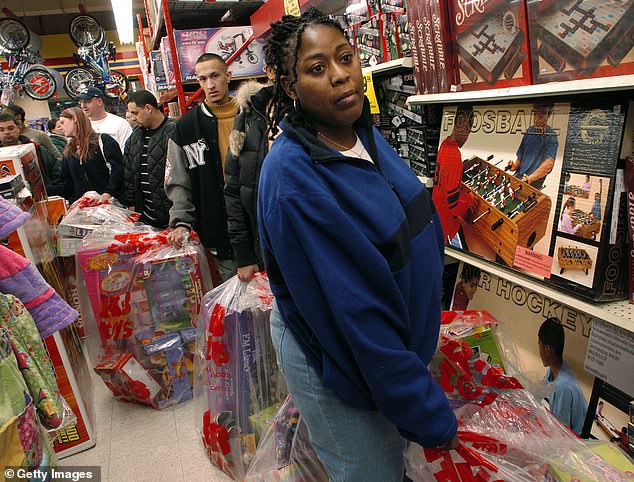
A photo of customers lined up in a toy store in the mall back in 2005, two years before the mall was acquired by Simon Property Group
However, Roller believes ‘you could get it zoned for almost anything if you have a solid plan.’
He noted that the vast amount of land and the property’s location could make it desirable to buyers. The mall is about 15 miles away from Center City, Philadelphia.
‘You could put any number of uses on a large vacant commercial property,’ said Roller. ‘It could be partially residential, partially industrial, maybe even small local retail as a shopping center. But the existing buildings aren’t conducive to anything.
‘Realistically, I think it will be demolished. That’s my guess.
‘I haven’t looked at it for clients, so I can’t say for sure, but I would guess it’s more valuable as vacant land than with the buildings.’
While shopping malls have declined, the architect noted a practice of ‘demalling’ that has worked in the past.
The process is taking a smaller mall in a good location and turning it into a shopping center.
‘The remodel is successful because, traditionally, you drive up, go into the store, and retailers are comfortable with that. They have visibility, and that seems to work.
‘When you take it into a mall where you don’t have direct access, and you have to go into the mall to go shopping, people are less likely to do it, and consequently, tenants are less likely to rent.’
In 2007, the mall was placed under the management of Simon Property Group after its original developer, Mills Corp, was acquired by the company. The property was taken over by debt holders in 2024. It was last renovated in 2016.